
Tesla's Robotaxi account posted on 3 October 2026 that the Austin service is "now available until 11pm". It is a one-hour extension of the 10 PM cutoff Tesla has kept since August, and the first time the window has moved in the longer direction since September 2025.
Elon Musk quoted the post the same morning with something more useful than the hours: a reason.
"Grey kittens on grey tarmac"
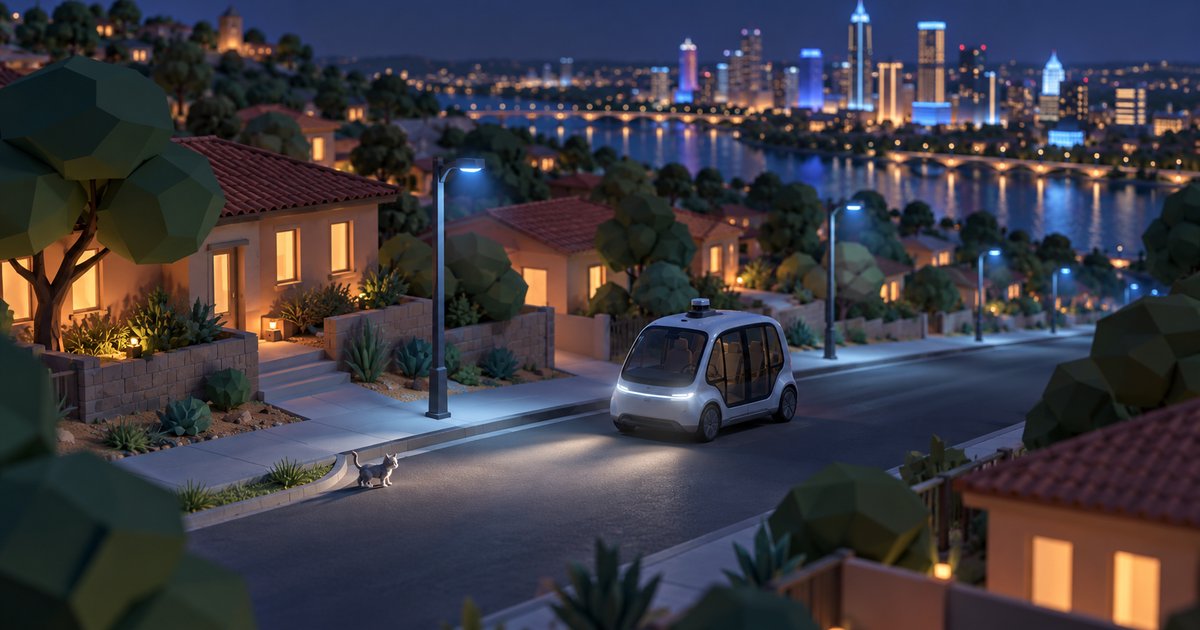
"The main thing we're trying to solve is making sure that we don't run over pets when they're hard to see at night," Musk wrote. "Literally trying to avoid grey kittens on grey tarmac in the dark."
That is the first explanation Tesla has offered for why its driverless service stops before midnight. When this site covered the cut to a 10 PM finish in August, the notable part was that Tesla presented a four-hour reduction as an expansion and never said what drove it. Now it has, and the answer is a perception limit rather than a regulatory one.
An hour back, three short of the peak
| Period | Service window | Length |
|---|---|---|
| June 2025 (Austin launch) | 6 AM - midnight | 18 h |
| From September 2025 | 6 AM - 2 AM | 20 h |
| From August 2026 | 6 AM - 10 PM | 16 h |
| From 3 October 2026 | 6 AM - 11 PM | 17 h |
The gain is real and it is small. Austin is still three hours short of the 20-hour day Tesla ran for most of a year, and an hour short of the day the service opened with. The extension also names Austin alone: Tesla's five other robotaxi markets, Dallas, Houston, Miami, Orlando and Tampa, were not mentioned and are understood to keep the 10 PM finish.
The sensor argument Musk keeps having with himself
A grey animal on grey asphalt in the dark is a low-contrast detection problem, which is the textbook case for lidar. A lidar unit fires its own laser pulses and measures what returns, so it reads shape and distance at midnight exactly as at noon and never needs the object to differ in colour from the road. Musk has called lidar a "fool's errand" for years, and Tesla's night ceiling is now set by the failure mode lidar was adopted to remove. He has also ruled out thermal cameras, which separate a warm animal from cold tarmac with no visible contrast at all.
Waymo, which carries lidar, runs around the clock. Cost is no longer the defence it was: Rivian says a usable automotive lidar is now a few hundred dollars.
What 24/7 now rests on
Ashok Elluswamy, Tesla's AI lead, replied to a rider on 4 September that 24-hour service was coming "next month or so", once "the next tech to merge on the v15 plan" enabled it. We flagged at the time that this was intent rather than a schedule. That month is now up, and what has arrived is sixty minutes. Tesla still lists 24/7 service and FSD v15 for Robotaxi as targets for this month; an operator moving an hour at a time is not obviously on track to delete the remaining seven.
Why the clock matters in Europe
Unsupervised FSD is approved nowhere in Europe, so the American service is the evidence file Tesla will eventually put in front of a European type-approval authority. Night performance is not a footnote in that file. The capability Musk has just described as unsolved is the one every EU assessor will probe hardest, and Waymo has already booked Munich for driverless operation by the end of 2027 on sensors that do not care whether a kitten matches the road.