
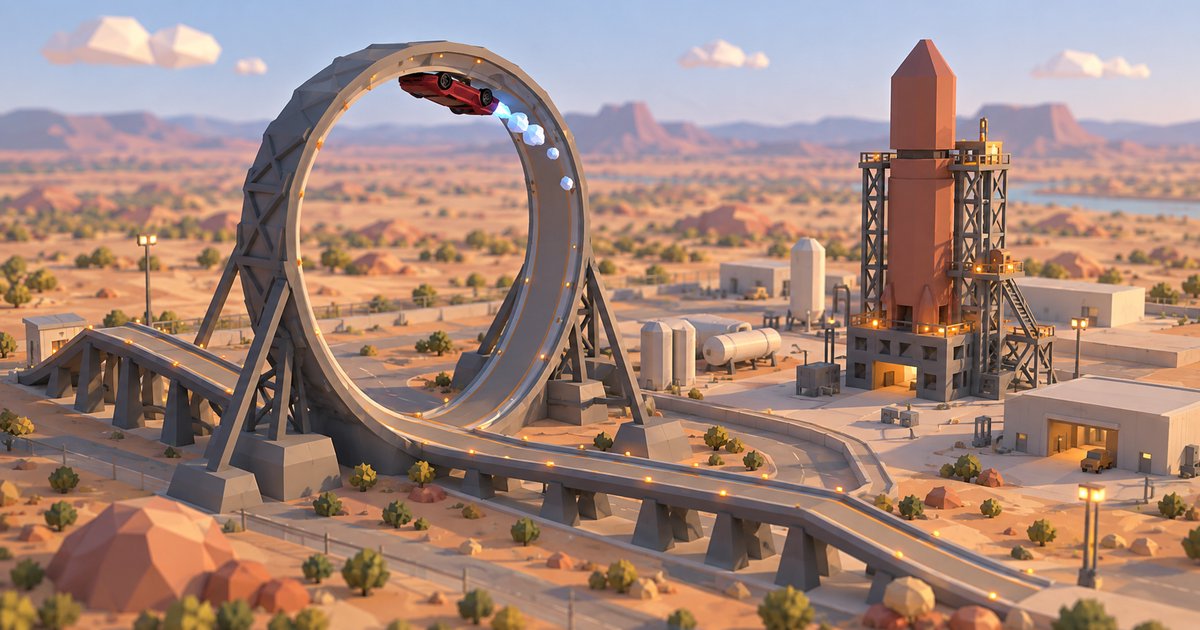
Nine years after the prototype, Tesla has shown the second-generation Roadster. On the evening of 15 October 2026, Texas time, at SpaceX's rocket test site in McGregor, a white two-seater went from 0 to 60 mph in 0.81 seconds, drove up a half-loop and held itself upside down, then jumped a row of Teslas and flipped before landing on compressed-air thrusters. The demonstration had slipped from April to August, then to the 1 October date Tesla confirmed in September, and finally to this week.
What Tesla published afterwards is more useful than the stunts, because it separates the car it will sell from the car it showed.
Three versions, one of them for the road
| Performance | Thrust | Rocket | |
|---|---|---|---|
| Tesla's label | Road ready | Race ready | Air ready |
| Seats | 2 | 2 | 1 |
| 0 to 60 mph | Under 1.6 s | Under 0.9 s | Under 0.59 s |
| Extras | Active aero, multi-mode suction | Rear cold-gas thrusters | Thrusters around the body for lift and rotation |
| How to get one | Reservation | Limited release | Invitation only, not in every region |
| Reservation payment | $50,000 | $250,000 | Not listed |
All three share a range Tesla gives as "more than 300 miles" (about 480 km) and a top speed it lists as above 230 mph (370 km/h). Tesla says the battery and drive unit produce a third more power than a Model S Plaid's at half the mass; NotATeslaApp's account of the event puts the output at about 1 MW. The flying hardware is a SpaceX cold-gas system: ten nozzles fed from two carbon-overwrapped pressure vessels holding about 250 kg of compressed air in 600 litres, which the car refills itself. Tesla told the audience the thrusters deliver four to five times the force the tyres can transmit.
The suction system is the part that reaches the road car. Fans under the floor pull the Roadster onto the surface with up to 2 g of downforce, which is what held it inverted on the loop; Tesla's cornering figure is more than 2 g, against roughly 1.26 g on tyres alone. The active wing described in a Tesla patent is there too, driven by Optimus actuators in Track Mode.
What is smaller than in 2017
| Promised in November 2017 | Published on 15 October 2026 | |
|---|---|---|
| Range | 620 miles | More than 300 miles |
| 0 to 60 mph | 1.9 s | Under 1.6 s (Performance) |
| Top speed | Above 250 mph | Above 230 mph |
| Seats | 2+2 | 2, or 1 |
| Price | $200,000; $250,000 Founders Series | Not announced |
| Production | 2020 | 2028 |
Range has halved and the rear seats are gone. Elon Musk put production at 2028, eight years after the original target, and said he was "not sure it moves the needle massively from a revenue standpoint". Of the stunts, he said he was "not sure it's necessarily legal in all jurisdictions"; Tesla's own specification marks the Rocket as not approved for public road use.
What it means in Europe
Nothing for the order book. The reservation pages Tesla reopened on 18 September take $5,000 on a card and $45,000 by wire within ten days, in the United States and Canada only. Nothing said on the night extended them, and the one regional note Tesla published is that the Rocket will not be offered everywhere. Tesla has still not named a purchase price for any version.
For a European buyer the practical questions are the ones Tesla did not answer: whether a car with a steer-by-wire yoke and brake-by-wire pedals passes EU whole-vehicle type approval, and whether a suction floor and retractable aero survive it. The Cybertruck, which took the same by-wire route, has never been offered through Tesla's European stores. A road-going Roadster for this market is, at best, a 2028 question.