
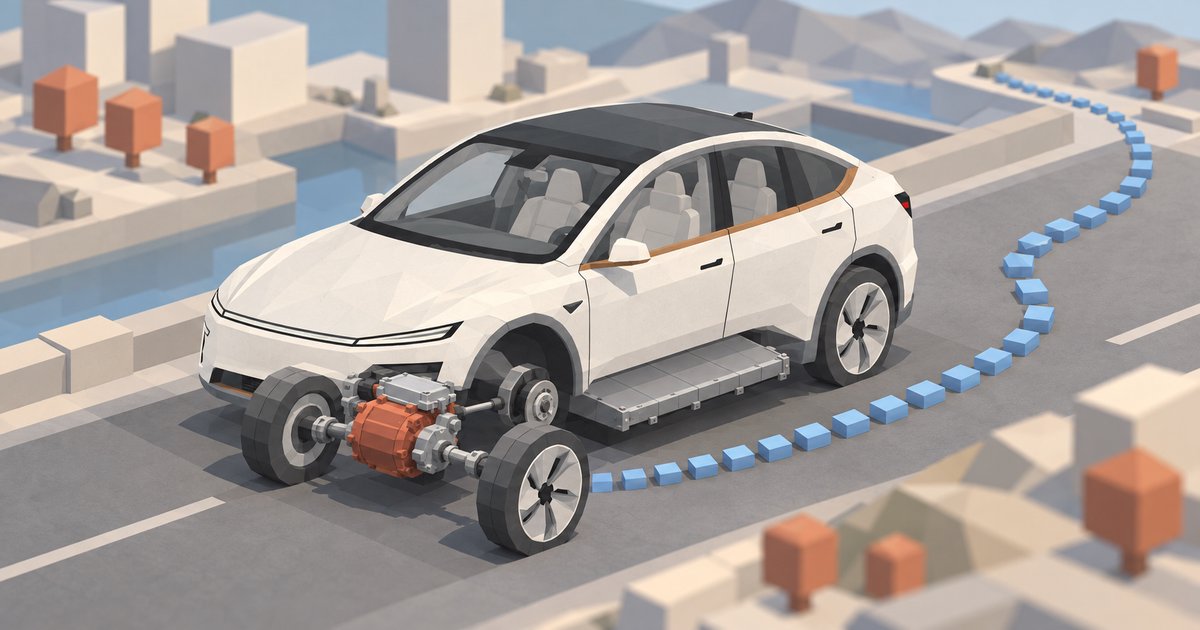
A Chinese regulatory filing shows Tesla fitting the six-seat Model Y L with a stronger front motor and claiming 25 km more range for it. The car does not get a bigger battery, does not get heavier, and does not get more expensive.
What the filing changes
The front motor goes from 142 kW to 176 kW — Tesla's newer TL2 unit, the one already used on the Model Y Performance in China. That is 34 kW more at the front axle on a car whose rear motor is unchanged.
| Model Y L (China) | Before | After filing |
|---|---|---|
| Front motor | 142 kW | 176 kW |
| CLTC range | 751 km | 776 km |
| Consumption | 12.8 kWh/100 km | 12.4 kWh/100 km |
| Kerb weight | 2,088 kg | 2,088 kg |
| Price | Unchanged | Unchanged |
A more powerful motor that also uses less energy is the part worth pausing on. Tesla has not added cells: the battery is the same, the weight is the same to the kilogram, and the range comes from the drive unit being more efficient than the one it replaces. Consumption falls 0.4 kWh per 100 km, which is where the extra 25 km comes from.
The effect is showing up outside China too. In Malaysia the Model Y L's 0-100 km/h time dropped to 4.5 seconds this week at an unchanged RM263,000, which is the same hardware change arriving in a market that publishes acceleration rather than range.
Why this matters before Europe gets the car
Europe cannot buy a Model Y L. What Europe has is a trail of signals that it will be able to: the badge turned up in the configurator code for Germany, France, Italy and Spain in August, and a car was seen testing at the Nürburgring in July.
So the specification being improved now is the specification Europe would be launched with, not an update European owners would wait for. The Model Y L has been criticised for being the heavy one in the range; it answers that by being the efficient one. Edmunds already recorded 358 miles for it on a standardised test, the longest of any Model Y it has measured, and a drag coefficient of 0.216 — lower than the standard car's.
A 776 km CLTC figure does not convert to WLTP, and nobody should read a European range from it. CLTC is the most generous of the major cycles. The useful comparison is Model Y L against Model Y L: the same car, measured the same way, 25 km further than it went before.
What is not in the filing
Tesla has not said when cars to the new specification start leaving the line, and the filing does not carry a date of effect. It also does not address the thing Chinese owners have been raising about this car — the reports of the rear settling on the extended wheelbase, which Tesla has been answering with warranty spring replacements and a quietly revised set of published dimensions.
A front motor change does nothing about rear springs. These are separate pieces of work on the same car, and only one of them has a filing behind it.
For anyone in Europe tracking the Model Y L, the practical read is narrow but real: whenever it arrives, it will arrive with the better front motor, and the number on the configurator will be slightly larger than the one a European configurator would have shown in August.