
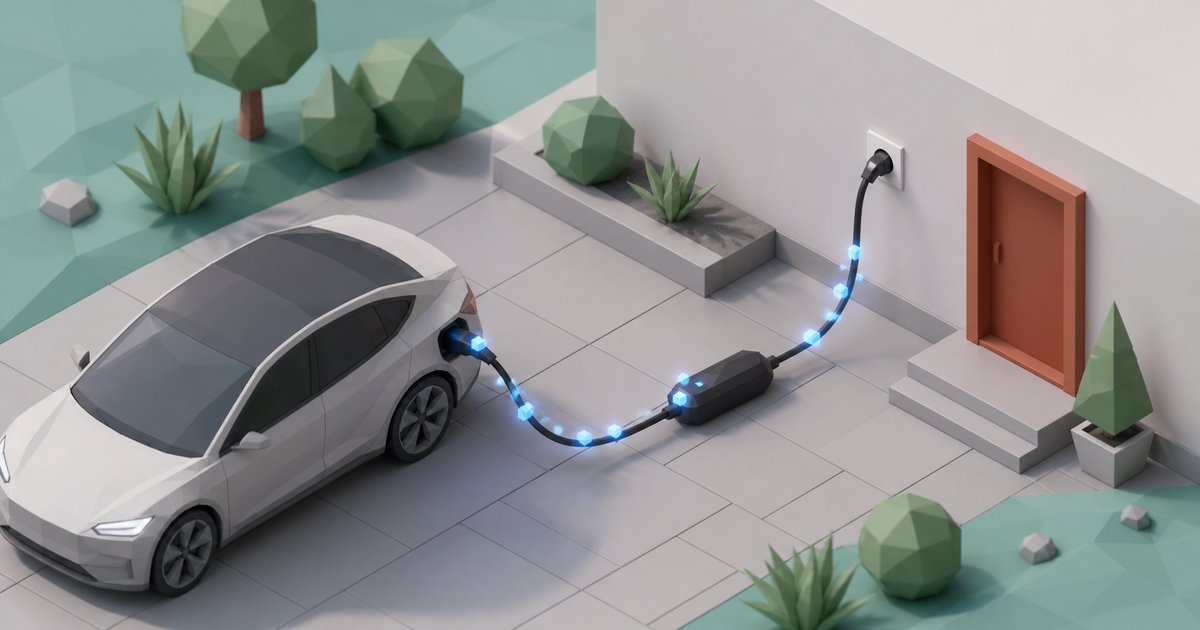
Tesla has started pushing a firmware update to its Mobile Connector — the portable charging cable that ships as an accessory rather than as part of the car. Owners are seeing it arrive without asking for it, and without any published explanation of what it does.
How the update reaches the cable
The delivery mechanism is the interesting part. A Mobile Connector has no network connection of its own, so the car supplies one. The vehicle downloads the firmware package over its own internet connection while plugged into the connector, then transfers it directly to the device. As the reporting puts it, "the vehicle acts as the middleman."
Nothing is required from the owner. There is no manual installation and no reboot — the vehicle screen simply displays an alert confirming that a charge connector update is in progress, and the process completes on its own.
What Tesla has not said
Tesla has published no release notes and no version number for this update, and that gap is worth stating plainly rather than filling in. What the firmware changes is, at the time of writing, unknown.
The plausible candidates are the ordinary ones for a device of this type — thermal management, the communication protocol between the connector and the onboard charger, or fault handling around unexpected charging interruptions. Those are informed guesses, not confirmed contents, and no owner-visible behaviour change has been reported.
Coverage so far confirms Gen 2 Mobile Connector units as the target. Whether other hardware builds are included — notably the Gen 3 Mobile Connector with PowerShare capability — remains unclear.
Why it matters, especially for European owners
Firmware in a charging cable sounds like a technicality until you consider what the cable is. A Mobile Connector negotiates current limits with the car, monitors its own temperature, and cuts power when something is wrong. It is a safety device with a plug on each end, and it is the piece of charging hardware most owners actually use least carefully: coiled in a frunk, dragged across gravel, plugged into domestic sockets of widely varying quality.
That last point is sharper in Europe than in North America. European Mobile Connectors terminate in a Type 2 plug at the car and take interchangeable adapters at the wall, which means the same unit is expected to behave correctly across a range of domestic and industrial socket types and installation standards. Thermal and fault-handling logic has more work to do in that environment, and household sockets are precisely where charging losses and heat build up — as the ADAC's measurements of wallbox versus socket charging showed.
The wider pattern is the one to file away. Tesla updates the car constantly; it updates the accessories almost never. A rare firmware drop to a cable suggests either a fix worth shipping quietly or the groundwork for something that needs newer connector behaviour. Without release notes there is no way to tell which, and owners are left to accept an update they cannot inspect — a small illustration of what over-the-air ownership actually involves.