
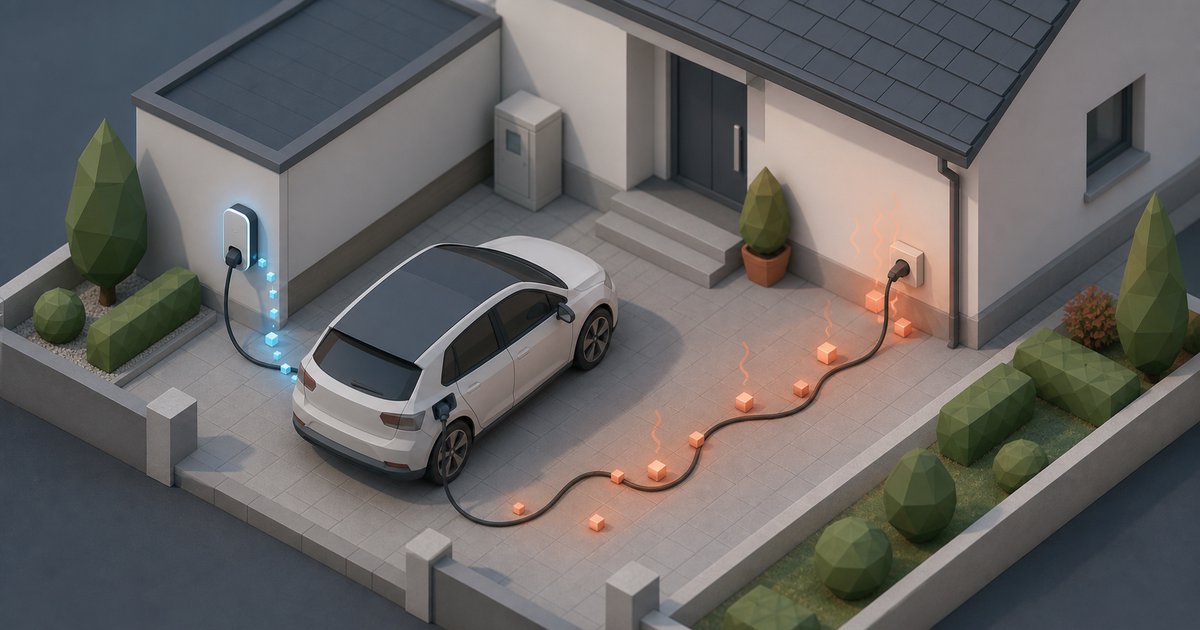
Germany's ADAC has published a measurement of how much electricity an electric car actually wastes while charging on alternating current, and the spread between the best and worst method is large enough to change what you should install at home. Charging five cars on a wallbox at full power kept losses under 7%. Charging the same cars from an ordinary household socket pushed losses as high as 24.2%.
Charging losses are the difference between the energy your meter records and the energy that reaches the battery. The gap goes to the onboard charger converting AC to DC, to cable resistance, and to the car's electronics and thermal management running for the whole session. You pay for all of it.
The numbers
| Charging method | Loss range |
|---|---|
| Wallbox at 11 or 22 kW | under 7% |
| Household socket (Schuko) | up to 24.2% |
The worst single result was a Mercedes CLA 350 EQ, which lost 24.2% of the energy drawn when charging from a domestic socket. The same car on a wallbox lost 6.9% — a difference of more than 17 percentage points on identical hardware, changing only how the electricity was delivered.
The Renault 5 was the standout in the other direction, posting the lowest losses both at high charging power and when charging from photovoltaic surplus.
Why the socket is so much worse
A household socket delivers roughly 2.3 kW; a wallbox delivers 11 or 22 kW. The car's own overhead — low-voltage systems, battery thermal management, the onboard charger's fixed losses — runs for as long as the session does, and at 2.3 kW that session runs five to ten times longer. The same fixed overhead is spread across far fewer kilowatt-hours delivered, so it swallows a much larger share of the total.
The ADAC also tested charging from photovoltaic surplus, where available power varies with sunshine. Low-power PV charging sits between the two extremes for the same reason.
What it costs
A car consuming 16 kWh/100 km over 15,000 km a year needs about 2,400 kWh at the battery. At 7% losses you buy roughly 2,580 kWh; at 24% you buy roughly 3,160 kWh. That is around 580 kWh a year heating your cable and your car's electronics rather than moving you. Over a wallbox's service life the efficiency gain alone recovers a meaningful share of the installation cost, before counting the time saved by charging five to ten times faster.
What it means across Europe
The ADAC tested to German conditions, but the physics travels. Every European market offers the same two options at home — a 230 V socket at roughly 2.3 kW, or a wall-mounted charger at 11 or 22 kW — and the loss ratio follows the power level, not the country.
What changes is the financial case. High domestic electricity prices make the wallbox pay back fastest; installation grants shorten it from the other end. The UK now charges a lower VAT rate on home electricity than on public charging, which widens the gap further.
The safety point
The ADAC's recommendation is not only about efficiency. A domestic socket and its wiring were never designed for a continuous multi-hour draw near their rated limit, which is exactly what sustained 2.3 kW charging is. That is why the ADAC calls the household socket an emergency option rather than a charging solution — a Notnagel, in the German phrasing.
The conclusion for anyone charging regularly at home is straightforward: a permanently installed wallbox is cheaper and safer, and the granny cable belongs in the boot for when there is nothing else.