
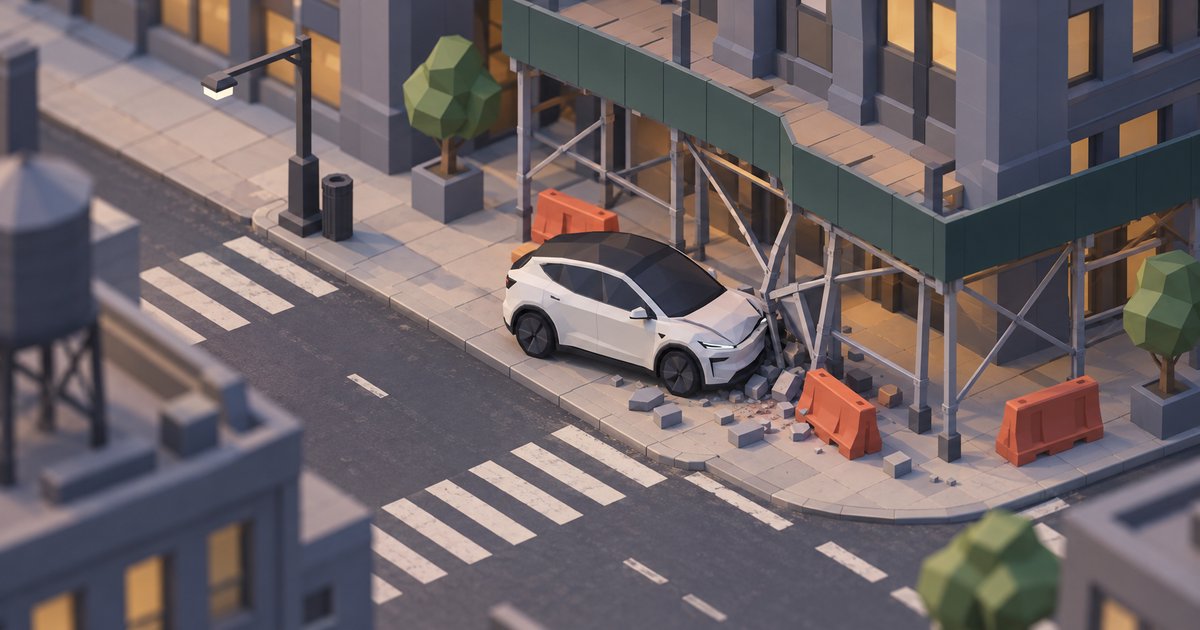
A grey 2024 Tesla Model Y left the road on East 42nd Street in Midtown Manhattan at about 2:43 a.m. on 9 September 2026, striking scaffolding, a bus stop and a mailbox. The passenger, 27-year-old Elise Suomi of Harlem, was killed. The driver, also 27, was arrested and charged with vehicular manslaughter, leaving the scene of an accident resulting in death, and driving while ability impaired.
What the police said, and did not say
The New York Police Department's account of the crash is one sentence: the driver "was traveling eastbound on East 42nd Street and failed to navigate the roadway." Its Highway District Collision Investigation Squad has the case. No public police statement attributes the crash to Autopilot, to Full Self-Driving, or to any driver-assistance system.
That is worth stating plainly, because what followed was a fight about attribution rather than about the crash.
The dispute is over a deleted post
Elon Musk pushed back on X, writing that "it wasn't the car" and that Autopilot had nothing to do with the wreck, and adding that "the legacy media will never forgive Tesla for failing to advertise with them." The target was ABC News.
Here the coverage needs a correction of its own. ABC News's article on the crash does not mention Autopilot, Full Self-Driving or driver assistance anywhere. It reports the time, the vehicle, the charges and the police statement, and nothing more. What Musk objected to was a separate ABC News social-media post, which he said mischaracterised the incident and which has since been deleted. Because it was deleted, its wording cannot be quoted, and no outlet reporting the dispute has reproduced it.
So the headline version — Musk attacks a news report for blaming Autopilot — is not what happened. The report did not blame Autopilot. A post did, or was read as doing so, and it is gone.
How this actually gets settled
Neither a post nor a rebuttal decides whether driver assistance was engaged. In the United States that comes from Tesla's own filings under the National Highway Traffic Safety Administration's Standing General Order, which requires manufacturers to report crashes involving their driver-assistance systems and to record whether the system was engaged in the seconds before impact.
Those filings are why TeslAnt has been able to report a run of US cases in which the answer was yes — including, this week alone, a Model Y that left an Alabama highway at 55 mph and a Model 3 that rolled a stop sign at 4 mph in New Jersey. In both, Tesla's data recorded driver assistance as verified engaged, and in both the local police report never mentioned it. That is the reverse of the pattern alleged here: the system's involvement surfaced from Tesla's own data, not from a headline.
No such filing exists in the public record for the Manhattan crash, and the charges laid so far do not describe one. If Tesla does file, it will appear in the same monthly release the Alabama and New Jersey cases came from, and it will say either engaged or not.
What a European owner should take from it
Very little about the car, and something about the reporting. The Standing General Order is a US instrument; there is no European equivalent that publishes per-crash driver-assistance status, so on this continent the question is usually settled by a national investigator or not at all. That asymmetry is why US filings dominate coverage of Tesla crash attribution everywhere, including here.
Until a filing appears, the honest position is the narrow one: a passenger is dead, the driver faces charges alleging impairment, and nothing on the record says the car was driving.