
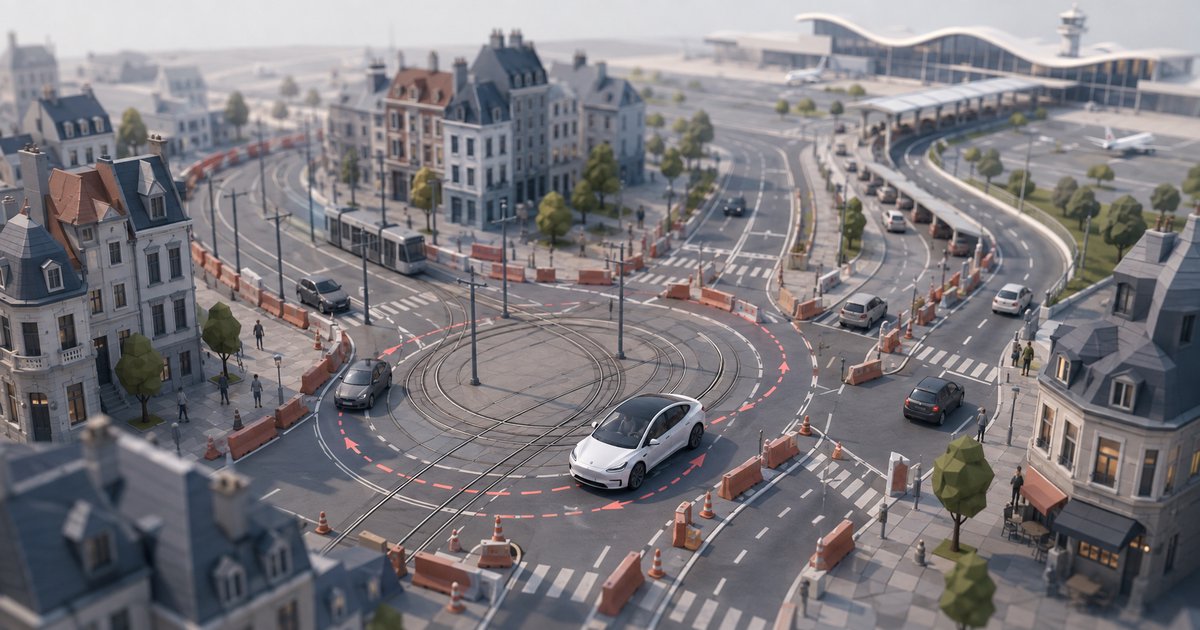
The robot*irl channel let Full Self-Driving (Supervised) drive for roughly two hours through Brussels and out to Brussels South Charleroi Airport, then published the result on 6 September 2026 as a 17-minute cut with a title that gives away the ending: "Driving Tesla FSD in Europe Until It Breaks".
It is one video, one car, and no stated software version. It is not a study and should not be read as one. It is, however, the clearest public look yet at what the version Europe has actually approved does on the kind of road furniture Europe actually has.
Why Brussels is a fair test
Belgium is not a country that took FSD on trust. Flemish mobility minister Annick De Ridder announced the approval on 10 June 2026, after Tesla completed a 5,000 km testing benchmark on Flemish public roads. Belgium leaned on the Dutch RDW's provisional type approval under UN Regulation 171 rather than starting from scratch, but it read the file and drove the roads first — which is more than Lithuania and Estonia did in simply recognising the Dutch certificate.
That makes Belgium the fifth European country where the system is legal, and Brussels a useful proving ground. It supplies what American training data mostly does not: tram rails running through the traffic lane, priority-from-the-right junctions, and roadworks that redraw the lane markings faster than any map updates.
What it got right
| Situation | Outcome |
|---|---|
| Car reversing into its path | Recognised it and continued, no harsh braking |
| Police approaching from behind | Moved aside |
| Unprotected left across fast traffic, outside the city | Completed unaided |
The occupants spend most of the seventeen minutes impressed, and the driver's hands stay off the wheel through traffic that would make most drivers tense.
What it got wrong
Three moments matter more than the successes, because they are the ones a European regulator would ask about.
At a junction combining roadworks with tram tracks, the car went round twice before finding its exit, apparently unsure which priority rule applied. Later it selected the wrong lane and carried on in it — a manoeuvre one passenger calls illegal on camera, though the car delayed nobody and cut nobody off.
Then the airport. Approaching the drop-off, FSD missed the lane it needed. The driver signalled, then stopped the car by hand to keep it out of a staff-only area, and drove the last stretch himself. That is where the title comes from.
What it does and does not prove
It does not tell you FSD is unsafe in Europe: nothing in the video required an emergency intervention, and the one manoeuvre described as illegal was a lane choice, not a near miss. It does not tell you FSD is ready either. A system that circles a junction twice and cannot find an airport drop-off lane is a system that still needs the human it is legally required to have.
What it means for Europe
The timing is what gives it weight. The EU committee vote that could extend FSD (Supervised) across the bloc is set for 6 October 2026, and Tesla has spent the run-up publishing its own safety case and winning France round. Videos like this one are the counterweight — not adversarial testing, just an owner filming an ordinary trip, on the exact geometry the vote is about.