
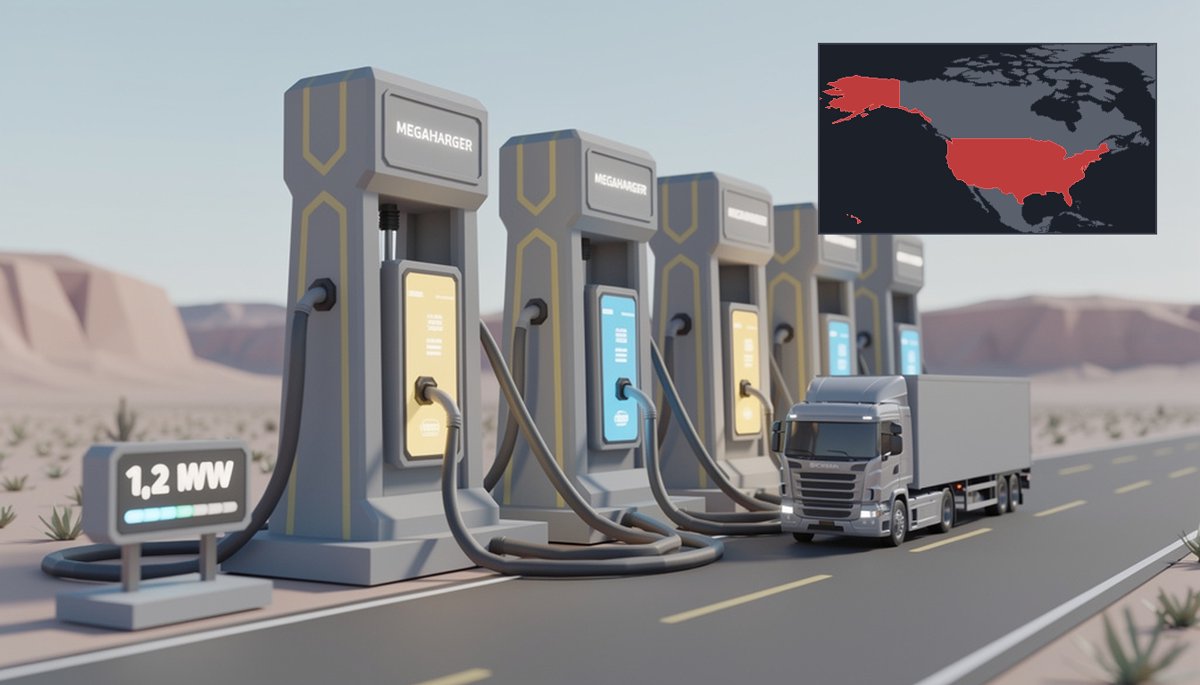
Tesla has switched on a full-power public Megacharger station for its electric Semi truck in Bloomington, California, the first public site to run at the Megacharger's full 1.2 MW rather than a grid-throttled fraction of it. Announced by Tesla Charging on 17 July 2026, it builds on the company's first customer-facing Megacharger — the 750 kW-limited site in Ontario that TeslAnt covered in Tesla's first public Semi charging site earlier this year — and marks the point at which the public network finally delivers the power the hardware was designed for.
What Bloomington offers
The station features six charging stalls, each capable of delivering up to 1.2 MW — roughly 2.4 times the peak power of a Supercharger V4 stall, and well above the 750 kW that the Ontario site was capped at by its grid connection. According to electrive, the site supports the latest-generation Tesla Semi using the MC2 charging connector, the interface designed for the redesigned truck now entering higher-volume production.
Tesla claims the 1.2 MW hardware can recover about 70% of range in roughly 30 minutes — deliberately matched to the mandatory rest breaks that long-haul drivers already have to take. In practice that means a driver can top up meaningfully during a legally required stop rather than losing extra hours to charging.
| Spec | Bloomington Megacharger |
|---|---|
| Stalls | 6 |
| Peak power per stall | 1.2 MW |
| Connector | MC2 |
| Range recovery | ~70% in ~30 min |
| Access | Public (any Semi operator) |
Why the location matters
Bloomington sits about 50 miles east of Los Angeles in one of Southern California's busiest freight corridors, where cargo moves from the ports of Long Beach and Los Angeles toward inland distribution centres. Placing a full-power public Megacharger there, as Drive Tesla Canada notes, gives independent operators — not just launch fleets like PepsiCo — access to genuine high-power charging on a heavily trafficked route rather than a throttled preview.
Public charging at full power is the piece the Semi has been missing. A truck can only run the lanes its charging network reaches, and until now that network was either closed or grid-limited. A public 1.2 MW site is what lets operators who do not run captive depots begin to consider the Semi in earnest.
What it means for Europe
The Bloomington site is in California, but the significance travels. Tesla has said the Semi is bound for European roads, and a public 1.2 MW standard — plus the MC2 connector and the rest-break charging model — is the template Tesla will need to replicate across European freight corridors for the truck to be viable here. For now it is a proof point rather than a European rollout, but it establishes the charging performance that fleets on the continent will eventually be able to plan around.
The launch also underlines how far ahead truck charging now runs versus passenger cars: at 1.2 MW per stall, a single Semi bay draws more power than several Supercharger stalls combined, a reminder of the grid demands that electric freight will place on the corridors it serves.