
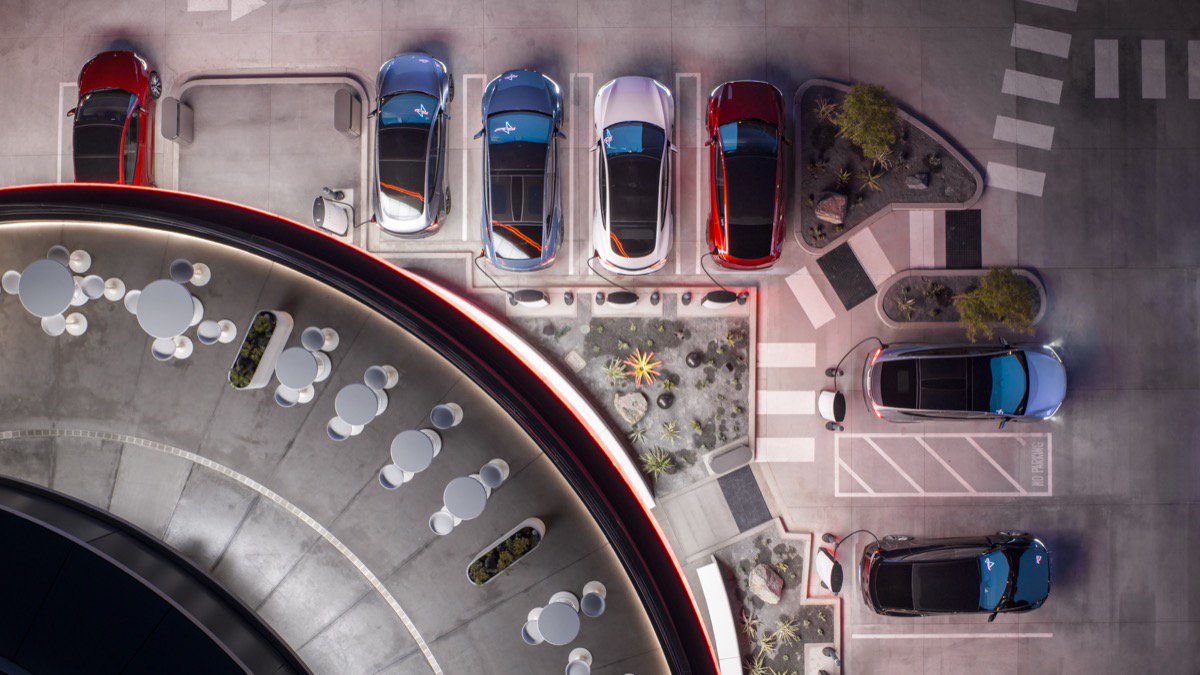
Tesla’s electric trucking ambitions have their first public charging anchor. The company opened its inaugural customer-facing Megacharger station in Ontario, California in early March 2026 — a concrete step from specifications to infrastructure.
Location and Strategy
The station sits at 4265 E Guasti Road in Ontario, in the heart of the Inland Empire — one of the busiest freight corridors in the world. The site is near the interchange of the I-10 and I-15 freeways, a critical link for electric trucks moving goods between the Ports of Los Angeles and Long Beach and major distribution centres further inland.
The location is deliberate: this is where the freight volume is, and where electrifying trucking has the most immediate impact on emissions.
Charging Capabilities
The Megacharger architecture supports up to 1.2 MW of charging power, capable of replenishing up to 60% of the Semi’s range in approximately 30 minutes. However, this first public station is limited to 750 kW — still fast enough to add meaningful range during a driver’s mandatory rest break.
The disparity between the 1.2 MW specification and the 750 kW initial deployment likely reflects grid connection limitations at this site rather than hardware constraints.
Network Expansion Plans
Tesla aims to deploy 37 Megacharger stations by end of 2026, scaling to 46 by early 2027. The company has also partnered with Pilot, the largest truck stop operator in the United States, to install Megacharger stalls at select Pilot travel centres along I-5, I-10, and other major corridors. The first Pilot sites are expected to open by summer 2026.
European Relevance
The Megacharger network is US-only for now, aligned with the Semi’s current US-only availability. However, with Tesla Semi expected to reach Europe by 2027 and CEO Elon Musk suggesting potential production at Giga Berlin, European charging infrastructure planning will need to follow.
The V4 Supercharger platform that Tesla is now exclusively manufacturing shares the same 1.2 MW power architecture as the Megacharger, meaning the hardware foundation for European truck charging is already being manufactured.
What It Means
One charging station does not make a network. But Ontario represents proof of execution: Tesla is moving from announcements to operational infrastructure. For fleet operators evaluating the Semi, visible charging infrastructure removes one of the biggest barriers to adoption.
Update: 2026-07-20
On 18 July 2026, Tesla expanded its public Megacharger network with a second California site, this time at full megawatt power. The new station in Bloomington — about 50 miles east of Los Angeles at 18434 Valley Blvd — has six charging posts, each delivering the Megacharger's full 1.2 MW peak, roughly 2.4 times a Supercharger V4 stall and well beyond the grid-limited 750 kW of the Ontario debut. It is the first site equipped for the redesigned Tesla Semi with the second-generation MC2 interface and is open to any operator. Tesla's public map now lists dozens of further locations across 15 states, led by Texas (19) and California (17), still targeting around 46 public stations by 2027.