
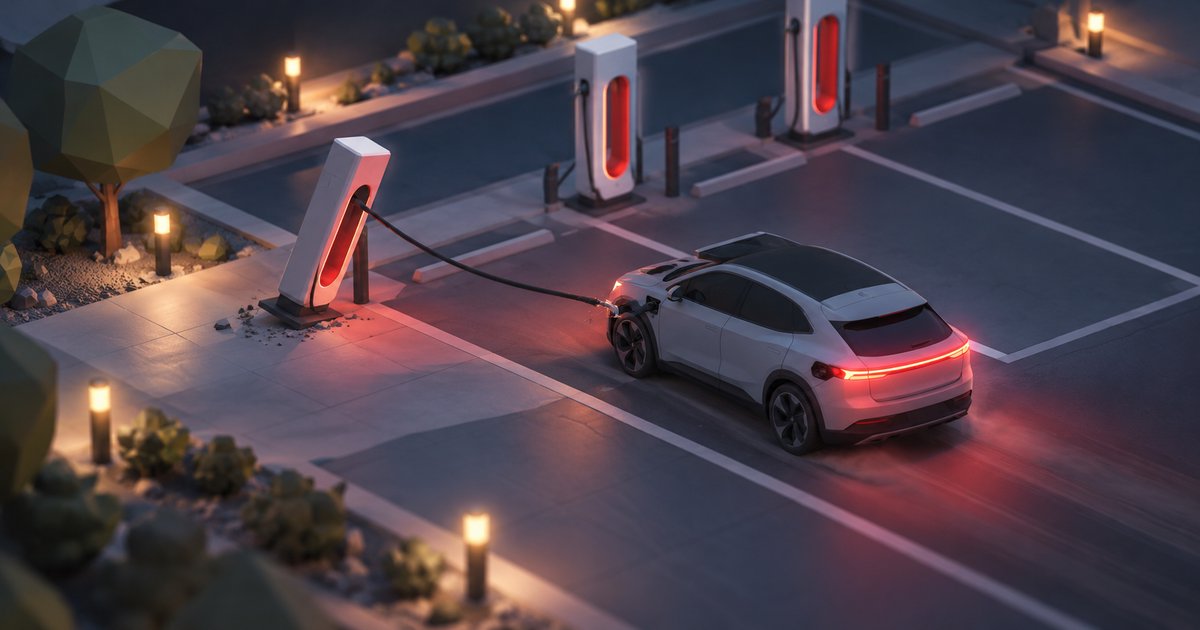
Tesla has added a way to drive out of a Supercharger bay with the cable still attached. The feature is called Emergency Drive Away, it is rolling out now in firmware 2026.38.3, and it arrives two months after a gunman opened fire at a Supercharger in Twin Falls, Idaho, where the driver of a Model Y was shot through his windscreen and could not simply leave.
This site covered that incident on 7 August, and the engineering question it raised: how do you make a safe disconnect fast enough to use under stress, without weakening the interlock that makes fast charging safe in the first place?
Tesla's answer is that it did not solve that problem. It went around it.
How it works
| Before 2026.38.3 | With Emergency Drive Away | |
|---|---|---|
| Shift out of Park while plugged in | Blocked by software | Permitted after confirmation |
| Steps required | Unlock the port from the touchscreen, the app or the handle button, wait for the latch, withdraw the connector | Shift to Drive, hold the brake, tap Activate |
| Driver must leave the car | Sometimes | No |
| Outcome | Clean disconnect | Damaged connector |
Shifting into Drive with the cable connected now raises an Emergency Drive Away prompt on the centre display. Hold the brake pedal, tap Activate, and the car will move.
Tesla chose damage over delay
The release does not pretend otherwise. Tesla's own wording is that "driving with the cable connected will cause damage to your vehicle and the Supercharger."
The physics described in August has not moved: contactors still take time to open, and the DC link still has to discharge before the pins can safely part. Tesla has instead accepted a wrecked charge port and a wrecked cable as the price of leaving at once. For the circumstances the feature exists for that is the right trade — but it is a trade, not a graceful quick-release.
It also means the feature carries a bill. Tesla has not said who pays for the damaged Supercharger.
It records you, and it is policed
Two conditions come attached. Tesla says short camera recordings of the event are shared with the company automatically, and that deliberate misuse will bring "additional penalties" — unspecified. Both follow from the first point: a function whose normal operation destroys hardware cannot be left unsupervised.
The feature does not reach every car. Model S and Model X built before 2021 are excluded.
Europe does not have this
Emergency Drive Away is live at US Superchargers only. Tesla's wording is "for now", which is an opening rather than a commitment, and it has given no European date.
The specific circumstances in Twin Falls are rare in Europe. The interlock is not: any driver who needs to abandon a bay at once — a fire, a medical emergency, a confrontation at an unstaffed site at night — meets the same lock on every CCS charger on the continent, not only on Teslas and not only at Superchargers.
And the European version of this is harder in one respect. Emergency Drive Away is a negotiation between a Tesla and a Tesla-owned charger. On a third-party European network, the two ends belong to different companies, with different liability for the hardware that gets destroyed. Tesla can authorise the destruction of its own equipment. Nobody has yet worked out who authorises it on anyone else's.
The first mass-market emergency release now exists. It is one brand, one country, and it breaks things.