
On Saturday 1 August, a gunman opened fire outside an In-N-Out Burger in Twin Falls, Idaho, killing three people including himself and injuring seven. Before reaching the restaurant, he shot through the windscreen of a Tesla Model Y parked at an adjacent Supercharger. The driver, a taxi operator, survived and faces a long recovery.
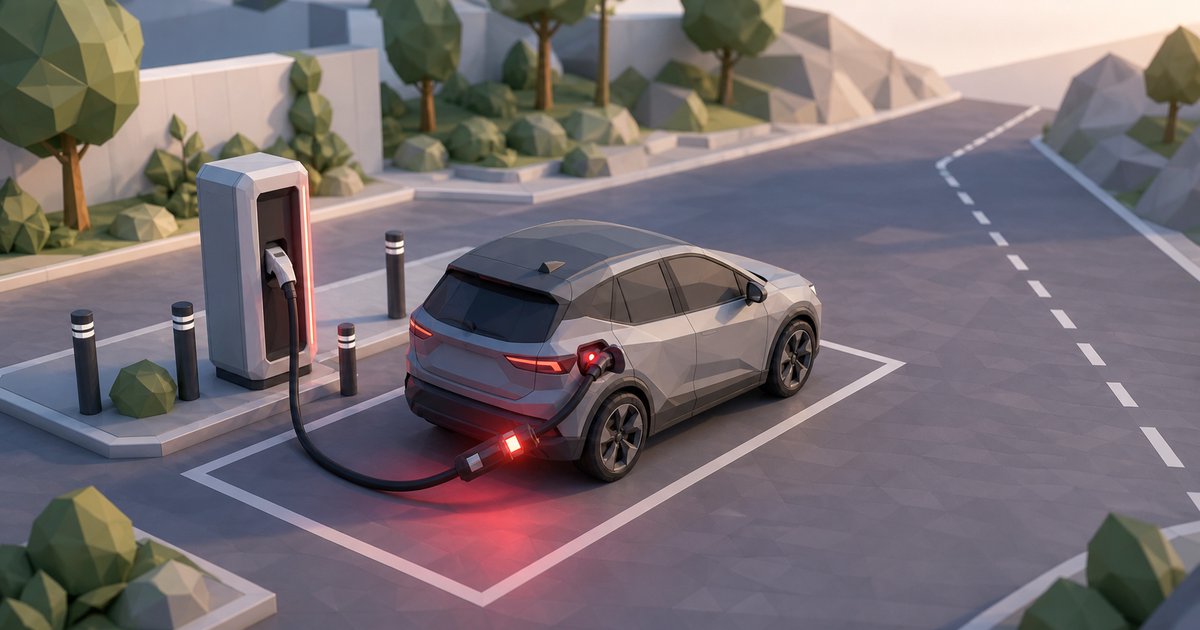
He could not simply drive away. His car was plugged in, and a DC fast-charging cable is locked to the vehicle until the session is ended from the touchscreen, the app, or a release on the connector itself. In the days since, Tesla owners have been asking the company for a way to break that connection instantly and go.
Why the lock exists
The charge-port latch is not a Tesla quirk. It is required behaviour, and it exists for good reasons.
A DC fast charger delivers several hundred amps at up to a thousand volts. Separating a live connector under load produces an arc capable of destroying the connector, the port and anything between them, and of injuring whoever is holding it. Every fast-charging standard — CCS, NACS, CHAdeMO — therefore requires the connector to be mechanically retained and electrically interlocked, so current stops before the pins part. The lock also stops a stranger unplugging your car mid-session, which is the mundane reason most owners meet it.
The normal sequence is: stop the session, let the contactors open and the voltage bleed down, release the latch, withdraw the connector. It takes a few seconds and nobody notices.
What owners are actually asking for
The request is not "remove the lock". It is a driver-initiated emergency sequence that collapses those seconds and requires no one to leave the car — a single control that stops the session, opens the contactors, releases the latch and lets the car pull away, dragging the connector clear if it has to.
Two details make this harder than it sounds. The electrical shutdown genuinely takes time — contactors must open and the DC link must discharge before the pins can safely part. That is physics rather than software, though the interval is short.
The other end is held by the charger. On most European CCS installations, and on Tesla's Superchargers, the cable is captive to the unit, so a car driving off with a released latch leaves the cable on the ground. The failure mode is damaged equipment, not a trailing live cable — the outcome you would choose in the circumstances.
What exists today
There is already an aftermarket answer. A US product called Evject sells a breakaway adapter that sits between the charger and the car and separates under load if the vehicle drives off. Its existence is evidence of demand, and of the fact that no manufacturer currently ships the feature.
Tesla has not commented on the incident or on whether an emergency release is under consideration. The car already has the software pieces — the app can stop a session remotely, and the touchscreen control is two taps deep. What is missing is a single unambiguous action, reachable without thought, that does all of it.
Why European owners should care
The specific circumstances in Twin Falls are, thankfully, rare in Europe. The general problem is not.
Any situation where a driver needs to leave a charging bay immediately — a fire on site, a medical emergency, a threatening confrontation, a vehicle rolling towards you — meets the same interlock. Sessions routinely last twenty to forty minutes, often at unstaffed sites, sometimes at night. European charging hubs are getting larger and more remote from buildings, not less, and Germany has just rewritten its grid rules to encourage exactly that kind of standalone charging park.
The engineering question is modest: how do you make the safe disconnect sequence fast enough and simple enough to use under stress, without weakening the interlock that makes fast charging safe in the first place? It is the sort of problem that gets solved once someone decides it needs solving.