
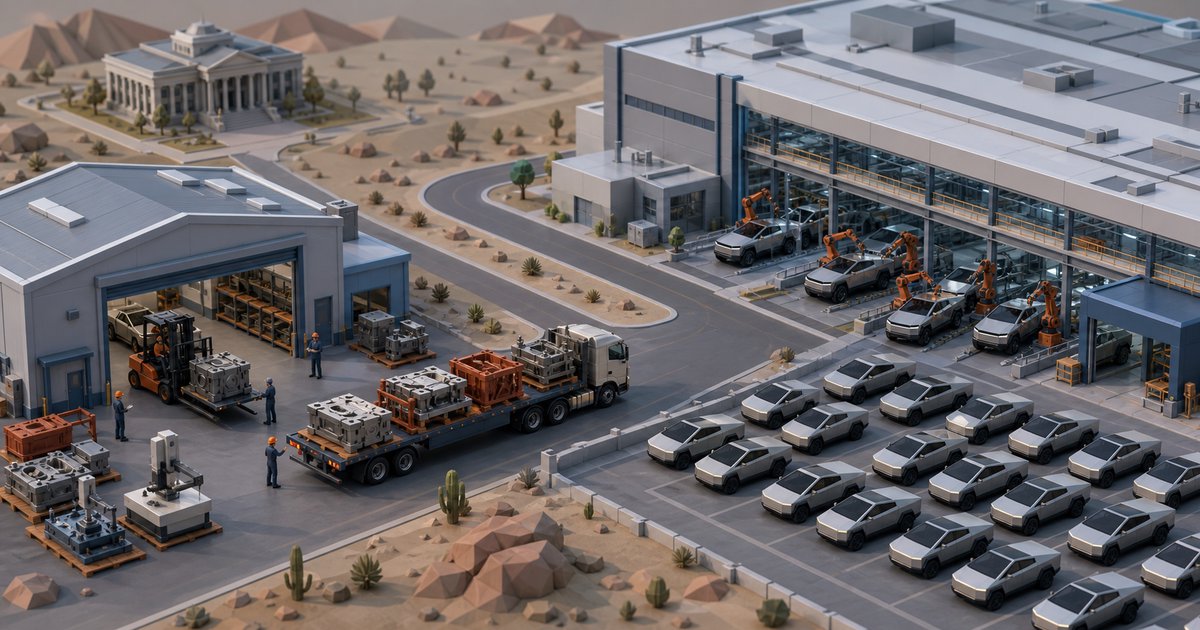
Cybertruck production has restarted at Giga Texas after a court let Tesla walk into a supplier's plant and take its own equipment back. Aerial observer Joe Tegtmeyer photographed the outbound lot on 6 August 2026 with roughly 100 Cybertrucks parked across it — a day after the order, and a visible reversal from the near-empty lot of the preceding weeks.
What the fight was about
The supplier is Angstrom Automotive Group, which ran a facility in Troy, Texas holding tooling that Tesla owns: die-cast tools, trim dies, fixtures, gauges and X-ray inspection equipment. On 13 July, Angstrom told Tesla it intended to close the plant.
What followed was not a price negotiation but a standoff over physical access. In its complaint, Tesla said Angstrom withheld roughly 700 finished parts and blocked the company from retrieving the tooling, then asked for an extra $250,000 a week to keep the line running. Tesla sued on 28 July, arguing that thousands of Cybertrucks already assigned to customers depended on those parts and that supply would run out "in mere days".
The ruling
US District Judge Christopher R. Wolfe, of the Western District of Texas, Waco Division, granted Tesla a temporary restraining order and a writ of replevin on 5 August 2026. A writ of replevin is the blunt remedy for exactly this situation: it authorises the owner to physically recover its property rather than wait for damages at the end of a trial.
Angstrom has not responded publicly to the allegations.
The speed of the rebound is the actual finding
Tesla did not announce a fix, add a shift or qualify a second supplier. It got its tooling back and the lot refilled within about a day. That timing is the informative part — it means the Angstrom parts were the binding constraint on Cybertruck output, not demand, not battery supply, not final assembly capacity.
It also means the constraint was a single set of dies sitting in one building that Tesla did not control. Nothing about the Cybertruck's design required that arrangement; it is a procurement outcome, and one that took a judge to unwind.
Why European readers should care anyway
The Cybertruck is not homologated for sale in the European Union — its rigid stainless bodywork and edge geometry sit badly against EU pedestrian-protection rules — so no European buyer is waiting on these trucks.
The relevant part is the pattern. Tesla's European fleet depends on the same style of supply chain, where a single supplier holds tooling for a part with no qualified alternative. Owners have already seen what that looks like from the other end: Cybertruck power-conversion-system failures produced repeat replacements and an extended warranty rather than a quick parts swap, because the queue for the component was the problem.
A vertically integrated manufacturer is only as integrated as the least-integrated part of its supply chain. This week that part was a building in Troy, Texas, and the fix ran through a courtroom.