
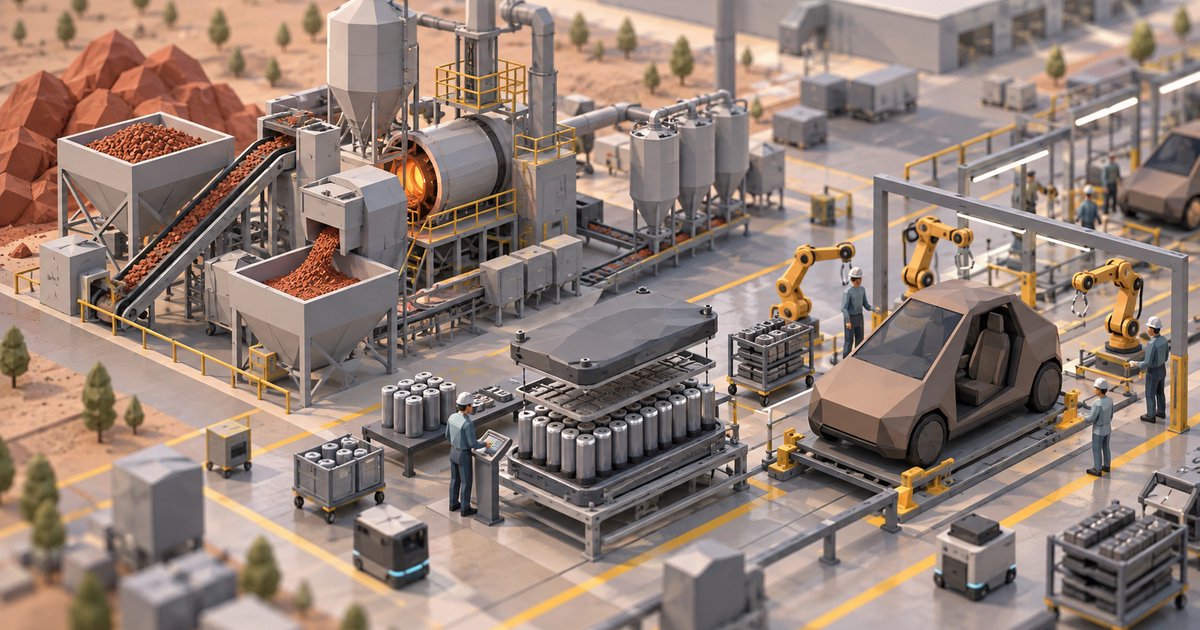
Tesla's Robotaxi account posted on 23 September 2026 that the company has built its first Cybercab using cathode material made in its own factory: "First Cybercab made using our in-house cathode material — from the first cathode plant in the Americas." The car in the photograph is gold.
Why cathode is the part that matters
A lithium-ion cell is anode, cathode, separator and electrolyte. The cathode is where the nickel, cobalt and manganese sit, and it is consistently the single most expensive material in the cell — the reason cell prices track metal prices more closely than they track factory productivity. Making it yourself removes a supplier's margin from every kilowatt-hour you build.
The plant is at Gigafactory Texas in Austin and feeds the 4680 cell line there. Tesla North America described it as "the first large scale cathode production facility in North America as part of our 4680 cell production in Austin, TX".
Those two descriptions are not the same claim. "The first cathode plant in the Americas" implies nobody had built one before. "The first large-scale cathode production facility in North America" allows for smaller plants, and for South America. The second is the defensible wording, and it is the one Tesla's corporate account used. Tesla has published no capacity figure for the plant.
The second material in three weeks
This is not an isolated announcement. On 4 September Tesla said the first Cybertruck built with 4680 cells using lithium from its own Gulf Coast refinery had come off the line. Cathode follows lithium, and both end up in the same 4680 cell.
| Date | Material brought in-house | First car |
|---|---|---|
| 4 September 2026 | Lithium — Gulf Coast refinery | Cybertruck |
| 23 September 2026 | Cathode — Gigafactory Texas | Cybercab |
What Tesla is assembling is a battery supply chain running from refined rock to a finished vehicle inside its own buildings. No other Western carmaker currently has both ends of it.
What it does not tell us
It does not tell us the Cybercab is cheap. A first car built with a material is a pilot-line milestone, not a cost result, and Tesla has given no figure for what in-house cathode saves per pack. Cybercab production began in the summer of 2026 and Tesla has published no rate.
It is, though, a firmer kind of claim than most of what Tesla has said about this car. The manufacturing numbers around the Cybercab have mostly been design targets rather than achieved rates — a line designed for a car every ten seconds, not a line running at it. A car either contains your cathode or it does not.
Why Europe should watch it anyway
No Cybercab will carry a passenger in Europe this year. The reasons to watch are cost and rules.
Cost, because vertical integration in battery materials is the lever behind any genuinely cheaper Tesla, and Europe is the market where Tesla most needs one. Every supplier margin removed from the cell is margin available to move the sticker price.
Rules, because European subsidy schemes are moving toward local-content tests. Germany's coalition agreed on 31 August to fold Made-in-EU criteria into its purchase bonus, though no such criteria exist yet and the reference point is a regime Brussels is still drafting. A carmaker that refines and processes its own battery materials in Texas is building answers for an American content test. Whether those answers count for a European one depends on rules nobody has written.
Tesla also builds 4680 cells at Giga Berlin, with capacity targeted to double to 18 GWh. Where the cathode for those cells comes from — Texas, a supplier, or eventually a European plant of Tesla's own — is the question this announcement raises and does not answer.