
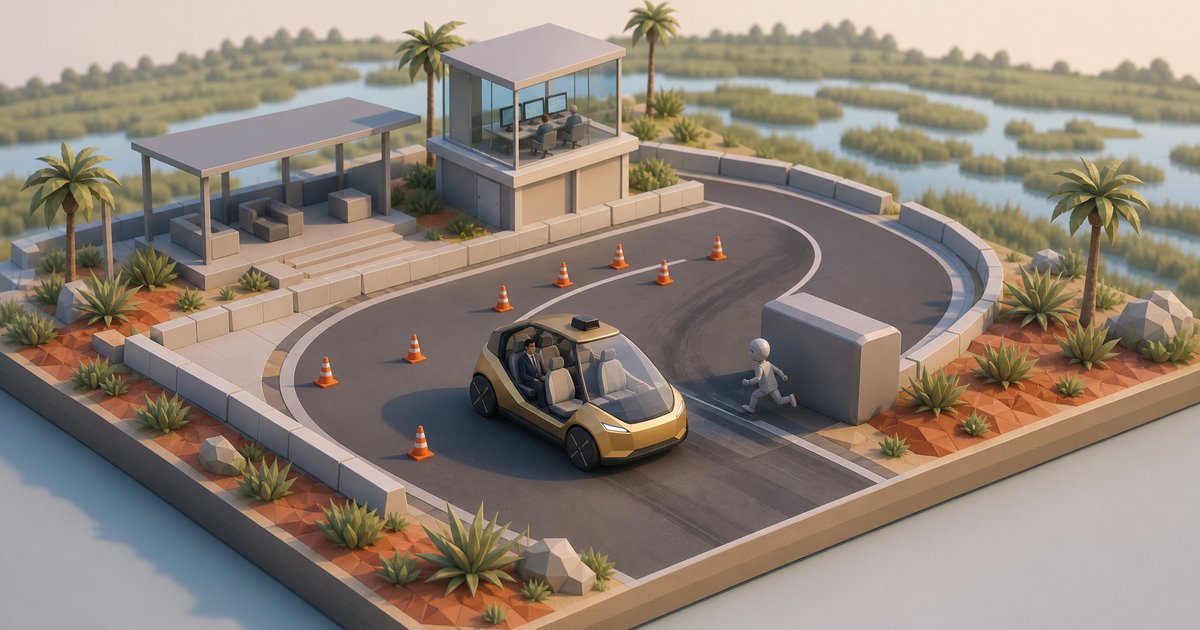
Florida governor Ron DeSantis rode in a Tesla Cybercab on 11 August 2026, at a state-owned proving ground built for exactly this kind of test, and came away endorsing it. For a vehicle with no steering wheel and no pedals, a sitting governor's ride is not really a publicity stunt. It is a regulator running the product demonstration himself.
What happened at SunTrax
The ride took place at SunTrax, a 775-acre facility in Auburndale that Florida built to test autonomous and connected vehicles before they reach public roads. It has a 2.25-mile oval and can reproduce interstate speeds, rain, pedestrian crossings, hills and crowded urban settings. DeSantis called it "the only high-speed autonomous vehicle test track in the United States".
Tesla did not run the gold, control-free Cybercab through a clean lap. It ran it through scripted failures, which DeSantis then listed himself: the car "successfully navigated all hazards — a kid running into the street, a crash with police stopping traffic, a Model S cutting us off, etc. Impressive!"
His description of the cabin was flatter and more useful: "You go in there and you just sit. You have a screen. There's no steering wheel, no pedals." So was the caveat he attached to the whole exercise: "You don't want to be in an autonomous vehicle and it drives you into a ditch."
Why the venue matters more than the praise
Florida is the most permissive US state for this. Statute 316.85 does not require a licensed human operator in a fully autonomous vehicle, and such a vehicle may use public roads whether or not anyone is inside it. That is the legal shape the Cybercab was designed around, and it is why Tesla's Model Y-based robotaxi service reached Miami in July before adding Orlando and Tampa a fortnight later. Waymo and Beep test at SunTrax as well.
So the story is not that a politician liked the car. It is that a production-intent Cybercab is being put through staged-failure testing at a state facility, in the one state where a car with no controls can already carry passengers without a permit fight — while Tesla's Nevada robotaxi permit came back capped at ten vehicles.
What Tesla appears to be scoring
Separately, an owner photographed a Cybercab's screen during on-road testing this week and posted the in-car review form its testers complete. The visible prompt reads "This trip is acceptable for unsupervised cars", with a ten-point rating and live camera feeds above it.
One photograph is a sighting, not a disclosure, and Tesla has published nothing about it. But the wording matches what a company assembling an unsupervised launch case has to collect — a per-trip verdict, at fleet scale. It is the same evidence problem Zoox chose to answer with a published safety case.
What this changes for European owners
Nothing directly, and that is the point. The Cybercab has no European launch date, no EU type approval, and no equivalent to Florida's statute anywhere in the bloc: a car built without a steering wheel has no straightforward route onto European roads, and driverless passenger services are authorised country by country rather than continent-wide. TeslAnt has covered what that gap is already costing, with Waymo and Pony.ai booking European cities while Tesla waits on FSD approval.
The useful reading is comparative. In August 2026 Florida let Tesla demonstrate a controls-free robotaxi to its governor on a state-owned track. European owners are, in the same month, working through a supervised FSD trial. The hardware is not what separates those two timelines.