
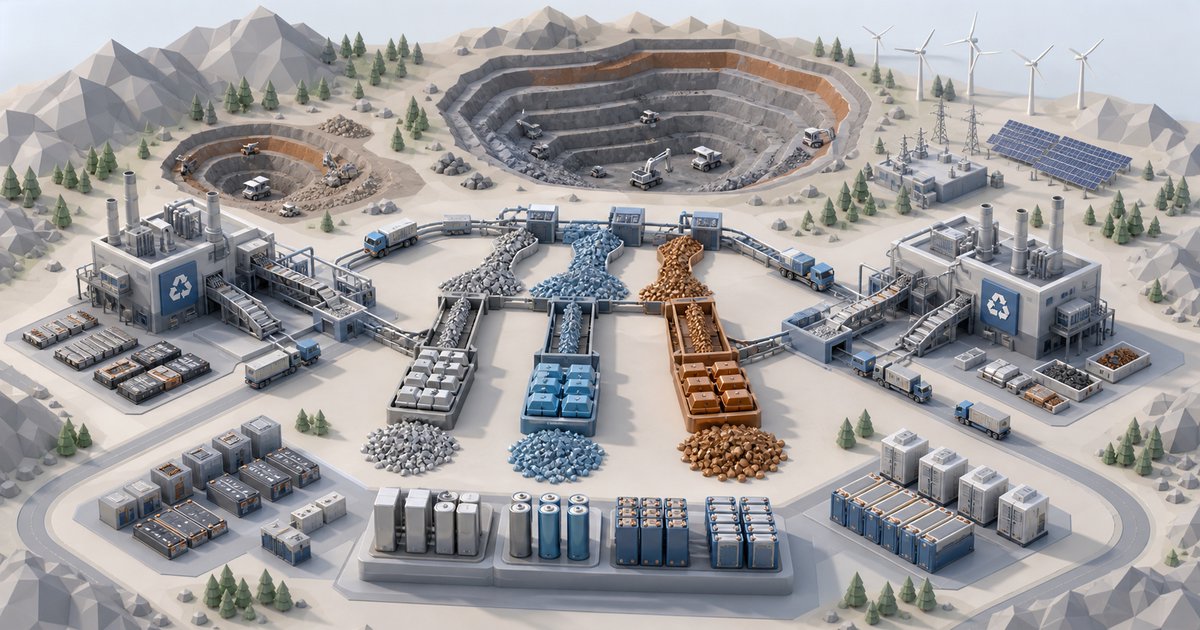
Tesla published its 2025 Impact Report this month, and the battery-recycling section contains a goal worth reading carefully: by 2030, the company wants the volume of battery material it recovers to match the total output of North American mining.
That framing is deliberately flattering, and it is useful to understand why before taking it at face value.
What Tesla actually processed
The concrete numbers are more modest than the headline. Tesla's Nevada recycling facility handled more than 3,000 metric tonnes of battery material in 2025 — the company puts that at roughly 9,000 Model Y RWD packs' worth of cells. Its Texas facility was expected to process a similar 3,000 tonnes over the same year. Counting material sent to external recycling partners as well as its own plants, Tesla says 14,000 tonnes went through recycling in 2025.
Alongside the volume figures, two process claims stand out. Tesla says it recovers "more than 90% of key battery materials like nickel and cobalt from cells that we recycle", and that 100% of its scrapped lithium-ion batteries go to recycling rather than landfill.
Why parity with mining is an easier target than it sounds
The comparison Tesla draws is against domestic extraction, and North American lithium extraction is very small. Current domestic output runs at roughly 5,000 tonnes of lithium carbonate equivalent per year. Matching that is not a demanding bar for an industrial recycling operation.
The bar moves considerably once new mines come online. Phase 1 of the Thacker Pass project in Nevada, due for completion in late 2027, is projected to add 40,000 tonnes of battery-quality LCE annually on its own — eight times current domestic production. A 2030 parity goal measured against that number is a materially harder commitment than one measured against today's 5,000 tonnes, and Tesla's report does not specify which baseline it means.
The European angle
For European readers the interesting part is not Tesla's American tonnage but the direction of travel. Recycled content is becoming a regulatory requirement in the EU rather than a sustainability talking point, and cell chemistry recovered from end-of-life packs competes directly with imported virgin material on cost. That is the same squeeze Europe's own cell industry is facing from the other side, as the state of the European battery industry makes clear.
There is also a timing point that gets lost in recycling coverage generally. Most of what Tesla recycles today is manufacturing scrap and warranty returns, not worn-out packs from customer cars — the fleet simply is not old enough to supply much of the latter yet. Independent diagnostics keep finding modern packs retaining well over 90% of capacity at 100,000 km, which means the genuine end-of-life wave is still years out.
So the recycling capacity being built now is largely speculative infrastructure: sized for a feedstock stream that has not arrived. That is the right way to build it, and it is also why volume claims in 2026 should be read as capability rather than throughput.