
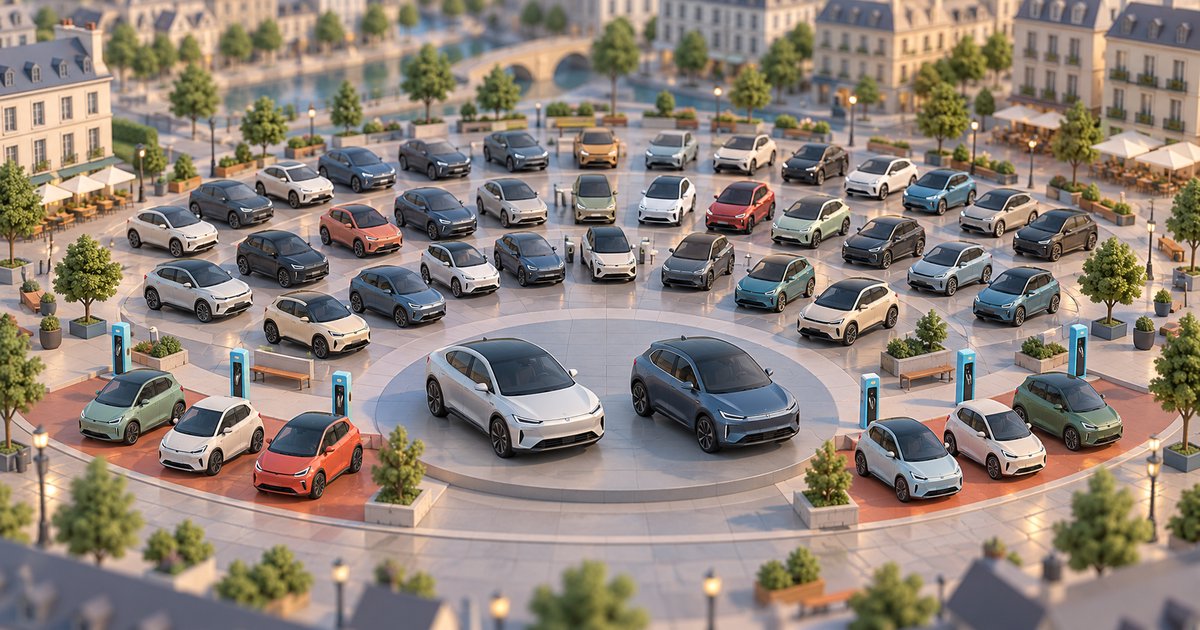
Transport & Environment published its latest EV progress report on 5 October 2026, and its headline finding is about choice rather than volume. Nearly 40 new battery-electric models reached the European market in the first half of 2026, taking the number of mass-market BEVs on sale past 150. T&E expects about 60 new models across the full year — roughly four times the 15-a-year average the market managed between 2021 and 2025.
In the group's own framing, model choice is up 50% in a single year.
The year in models
| Measure | 2026 | Context |
|---|---|---|
| New BEV models, January to June | about 40 | — |
| New BEV models expected, full year | about 60 | 2021-2025 average: 15 a year |
| Mass-market BEV models on sale | more than 150 | choice up 50% year on year |
| Share of models from European carmakers | 60% | 16 added in the first half |
| Share of models from Chinese carmakers | 21% | 11 added in the first half |
The split is the part worth pausing on. European manufacturers still supply three-fifths of the models on sale and added more of them in the first half than the Chinese brands did. That is a different picture from the registration tables, where Chinese brands have been taking share month after month — most recently a record 11.7% of the European market in August. Europe is not short of electric cars to sell. It is losing on the ones buyers pick.
The cheap end is where the movement is
T&E counts a doubling in the number of models priced below €25,000, and projects that sales of those cars will rise sevenfold in 2026 against 2024. The example it reaches for is Volkswagen's electric Polo, which it says has taken more than 40,000 orders against a ten-month waiting list — not a demand problem but a supply problem, at a price point that barely existed two years ago.
The sales line underneath it
Europe registered 1.64 million battery-electric cars between January and August 2026, up 45% year on year, for a 22% market share — six percentage points higher than the same period last year. In the second quarter, BEVs outsold pure petrol cars across a full quarter for the first time.
Where Tesla sits in a European market of 150
Tesla's European line-up is two mass-market cars: the Model 3 and the Model Y. In a year when the market added about 40 nameplates, Tesla added none, and the segment doing the most growing is the one it does not contest. The cheapest Tesla in Germany is the Model 3 Standard RWD at €36,990 — nothing in the range comes close to €25,000.
That is not automatically a problem: a narrow range of high-volume cars is what made Tesla profitable, and both still top national registration tables across Europe. But it explains the shape of the numbers. Tesla's third quarter was down 2.1% year on year globally while the European market it sells into grew 45%. Flat volume in a market expanding that fast is lost share, and the 150 figure is the mechanism.
Read the source with its interest in mind
T&E is an advocacy organisation, and this report credits the EU's CO2 standards with producing the model wave it describes — a conclusion that supports the group's own campaign to keep them. "Mass market" is T&E's own classification, and the sevenfold figure is a projection rather than a recorded result. The model counts and registrations are checkable; the causation is argument.