
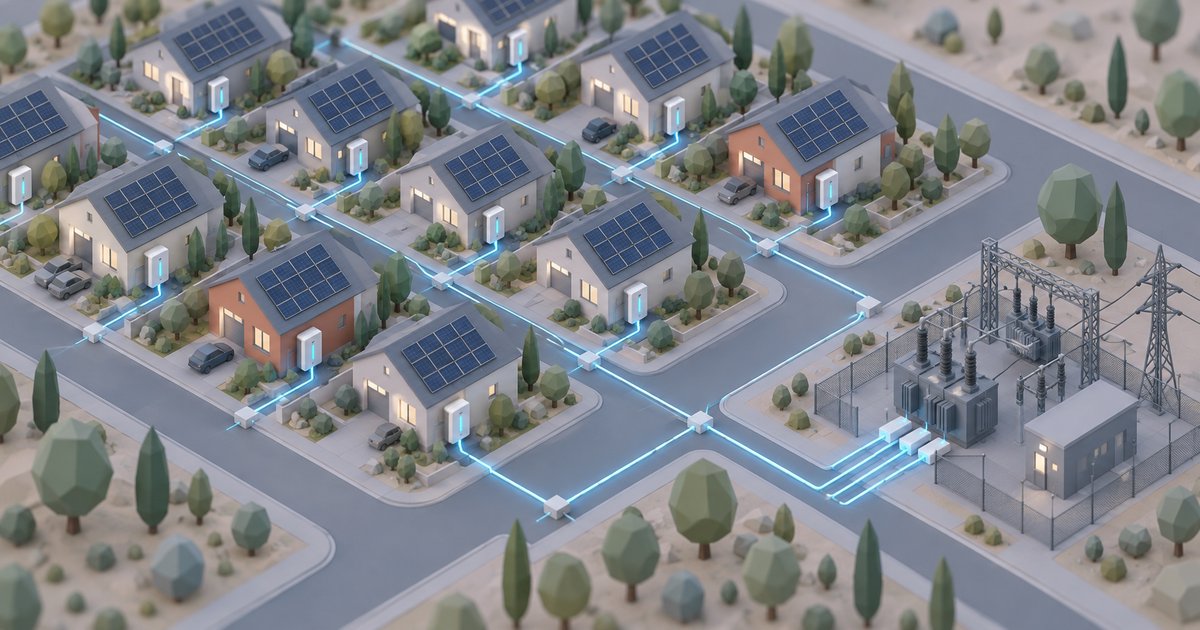
Sunrun and Tesla discharged 580 megawatts from home batteries onto California's grid on 9 September 2026, during a heat wave, in what Sunrun calls the largest residential distributed power plant event ever recorded. The dispatch ran for a three-hour evening window at the request of the California Energy Commission and the state's utilities, at the point in the day when air-conditioning load was straining supply.
Where the power came from
More than 140,000 home batteries took part. The split between them is the part worth reading twice.
| Fleet | Batteries | Power delivered |
|---|---|---|
| Tesla Powerwall | ~110,000 | 517 MW |
| Other manufacturers in Sunrun's fleet | 30,000+ | 63 MW |
| Total | 140,000+ | 580 MW |
Powerwalls were about 79% of the units but delivered about 89% of the power — roughly 4.7 kW per Powerwall against roughly 2.1 kW per battery from the rest of the fleet. Sunrun says it owns or operates 55% of the Powerwalls involved, which is the commercial arrangement that makes a dispatch of this size possible at all: the householder owns the battery in the garage, but somebody else holds the right to call on it.
Sunrun puts the scale at roughly the peak-hour consumption of every household in Sacramento County. A Brattle Group report the company cites projects up to $206 million in net savings for Californians by 2028 from dispatches of this kind.
Why a European owner should care
The hardware is not exotic and it is not American-only. The Powerwall in this dispatch is the same product Tesla sells in Europe, and the number that matters — about 4.7 kW of sustained export per unit across a three-hour window — is a property of the battery, not of California.
What Europe does not yet have at this scale is the market mechanism. A 580 MW dispatch requires an aggregator with contractual rights over six figures' worth of private batteries, a grid operator able to call on them, and a settlement system that pays for it. Europe is assembling those pieces one national market at a time: Tibber pays German drivers to let it shift their charging, and Audi and Octopus have switched on a vehicle-to-grid tariff in Germany that runs on the same logic with a car instead of a wall battery.
Tesla's own version of the commercial model is visible in Texas, where it leases two Powerwalls for $35 a month on condition the customer joins the virtual power plant. That is the trade being made here too, and it is worth stating plainly: a battery enrolled in a VPP is not fully yours to dispatch. On 9 September, 140,000 households had their stored energy sent to the grid on a regulator's request.
The honest caveat
This was a co-ordinated event on a hot evening, not a continuous capability. 580 MW for three hours is about 1.7 GWh — real, but a fraction of what a grid draws across a day, and it depended on batteries being full when the call came. The significance is directional: residential storage has become large enough that a state energy commission now treats it as a dispatchable resource, and the single biggest block of it is Tesla's.