
Norway's state metrology agency has started turning up unannounced at fast chargers to check that drivers pay for the energy they actually receive, and a Tesla Supercharger has now been through the test. Norsk elbilforening, the Norwegian EV Association, went along when Justervesenet inspected Tesla's V3 site at Kløfta, north of Oslo, and published its report on 24 October 2026. The Supercharger passed.
The result at Kløfta
Inspector Stig Stende compared the energy shown in the Tesla app with a reference meter connected between the Supercharger and the agency's test rig. On the first run the app showed 2.016 kWh and the reference meter 2.0114 kWh, so Tesla counted 0.22% more energy than it delivered. A second run came out at 0.27%. Justervesenet's tolerance for now is ±3.5%, and the stalls it measured were given a sticker that marks a passed inspection.
The rig drew about 70 kW from a site rated at 250 kW. Charging speed is not what the agency checks. "We concentrate on the right amount of money for the energy you buy," said Lars Holhjem, technical lead of Justervesenet's new field-services section.
How the checks work
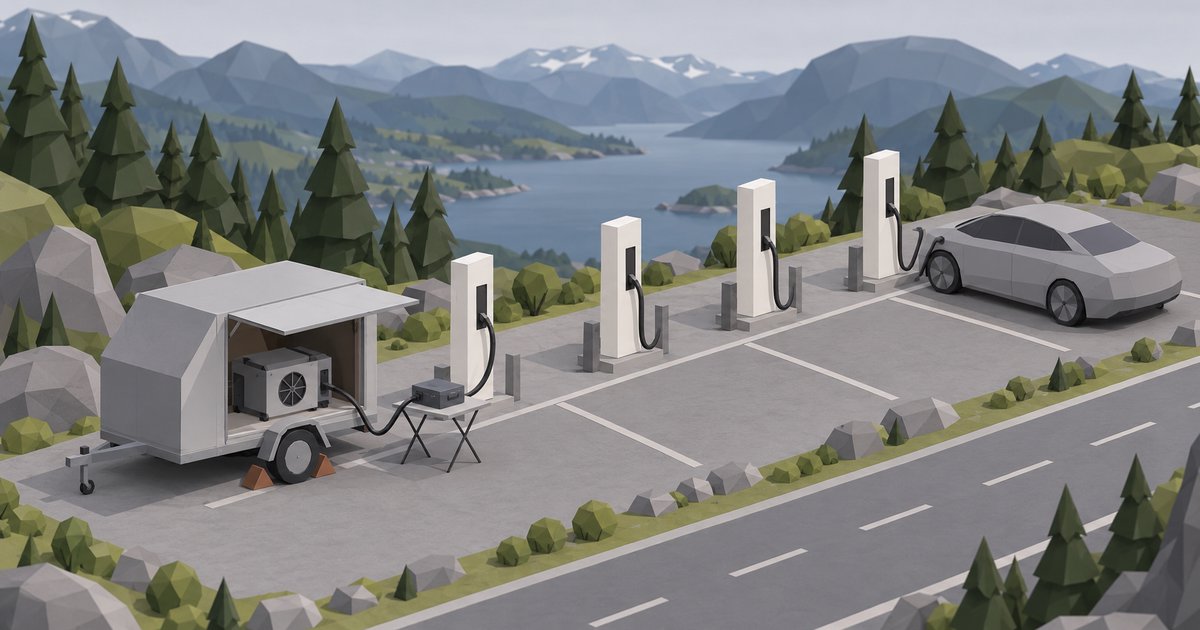
Justervesenet is a directorate under Norway's Ministry of Trade, Industry and Fisheries that already checks fuel pumps and shop scales. It launched its fast-charger tests in April 2026. A trailer carries an MBS 500 battery simulator from Germany's Aix Control, which poses as an electric car and turns the energy into heat, plus a Zera EMOB 500 reference meter that the agency calibrates. The kit plugs in like a car through a CCS2 connector, handles up to 1,000 V and 500 A, and runs a full multi-point test in under ten minutes. With procedures and staff training, it cost more than NOK 2 million.
Since the spring the team has towed it about 2,000 km and checked around 60 fast chargers in southern Norway, a small share of the more than 10,000 along Norwegian roads. Holhjem calls the results "very positive". The largest deviation so far was 5%, and it was in the customer's favour. Operators can book and pay for a test, or the agency can inspect on its own initiative, as it did at Kløfta.
The rules behind it
Norway regulates the energy meter inside a charger, not the charging station as a whole. Meters sold from 1 January 2025 must have a conformity assessment under the EU's Measuring Instruments Directive (MID). Older ones may stay in service, but the accuracy requirements apply to all of them. Justervesenet's test protocol follows EU rules that Norway has not yet adopted, and Aix Control tests to Germany's Eichrecht calibration law at home.
The EU is preparing changes to the MID for chargers, and some member states want whole stations, including payment and software, regulated as measuring systems. In an EEA EFTA comment, Norway, Iceland and Liechtenstein argued for limiting the rules to energy measurement. Holhjem says Norway can still choose either approach.
What it means for owners
At Kløfta the overcount was small. Elbil24's five-station average price for Tesla owners was NOK 3.93 per kWh, as TeslAnt reported on 22 October. At that price a 50 kWh stop costs about NOK 197, and 0.22% of it is roughly NOK 0.43, by TeslAnt's arithmetic. One site and two short runs cannot speak for the rest of Tesla's network in Norway. But a Justervesenet sticker on a stall now shows that it has been checked.