
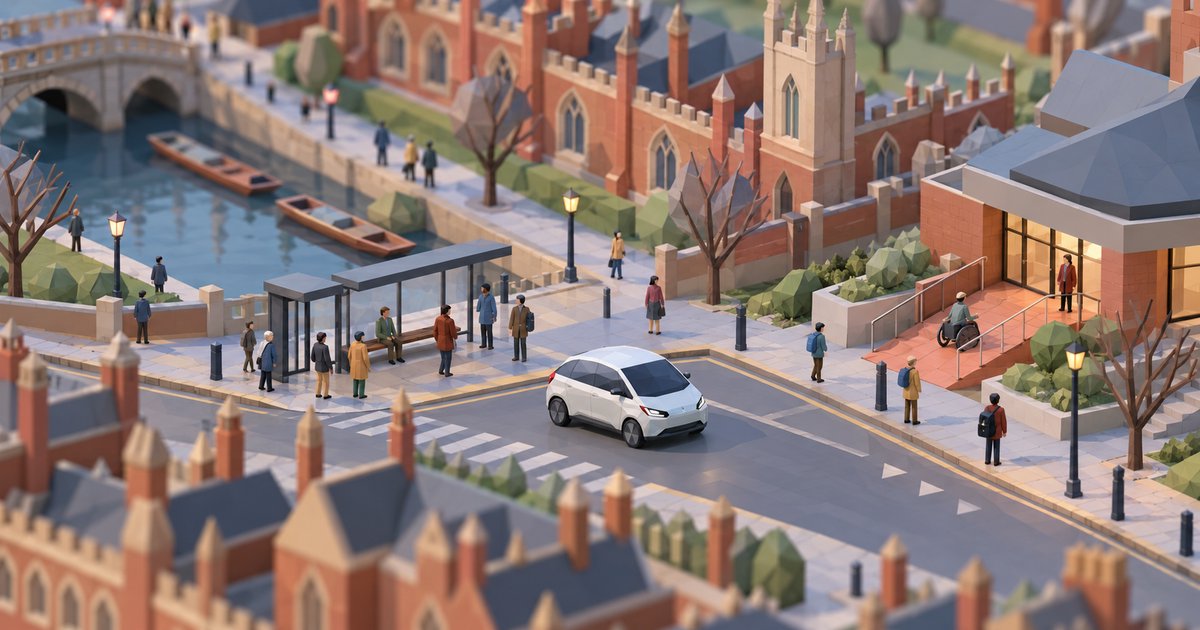
Nissan will put a driverless Leaf on public roads in Cambridge. The project, announced on 28 September 2026 and called ADventure, carries GBP 3 million of UK government money and ends in a public-road demonstration in the city.
The car is a specially equipped 2022 Nissan Leaf running Nissan's own autonomous driving software. The research partners are WMG at the University of Warwick and PAVE UK, the British arm of Partners for Automated Vehicle Education. Funding comes through the government's CAM Pathfinder programme.
The research question is the service, not the car
This is the part that separates ADventure from most autonomy announcements. The stated object is not to prove that a Leaf can steer itself down a road — Nissan has done that in Britain for years, across the earlier HumanDrive, ServCity and evolvAD programmes. It is to work out what an autonomous passenger service should look like before one exists.
The team will work with the local authority, residents and transport users on how a driverless service would sit alongside the buses and trains already running, and on who it is actually for. The example Nissan gives is someone who cannot drive using an autonomous car to reach a medical appointment.
"We will be able to co-create a safe mobility service design with the public," said Professor Siddartha Khastgir, Head of Safe Autonomy at WMG. David Moss, Nissan's senior vice-president for R&D in the AMIEO region, called it "an important step for autonomous mobility in the UK".
Why now
Britain's Automated Vehicles Act creates the legal regime for self-driving services, and the full framework is expected to be in force in late 2027. That leaves roughly a year of runway for the questions ADventure is asking — public acceptance, service design, accessibility — to be answered before anyone can operate commercially under it.
The UK is not short of companies working the technical end. Wayve and Uber are preparing a robotaxi service in London, and Wayve has since signed a production agreement with Mercedes and a deal with Volkswagen. Against those, GBP 3 million and one Leaf is a small programme. Its distinguishing feature is what it is measuring.
Where Tesla and Europe sit in this
Nowhere in it, and that is the point worth noting.
Tesla's route into Europe is type approval for FSD (Supervised) — a system with a driver in the seat and legal responsibility on that driver. That is a different regulatory object from a driverless passenger service, and it is moving slowly: the EU vote on bloc-wide recognition has slipped to December at the earliest. The UK runs its own approval process outside the EU system entirely.
So the two tracks do not compete yet. Tesla is trying to get a supervised driver-assistance system recognised across markets; ADventure is asking what a service with nobody in the driver's seat should do for a city. The Automated Vehicles Act regime is where those eventually meet, and Tesla has not publicly entered it.
For a British Tesla owner the near-term relevance is modest: no feature arrives, no price changes. The longer-term relevance is that the rules for driverless services in the UK are being drafted now, around research like this, by people Tesla is not sitting with.