
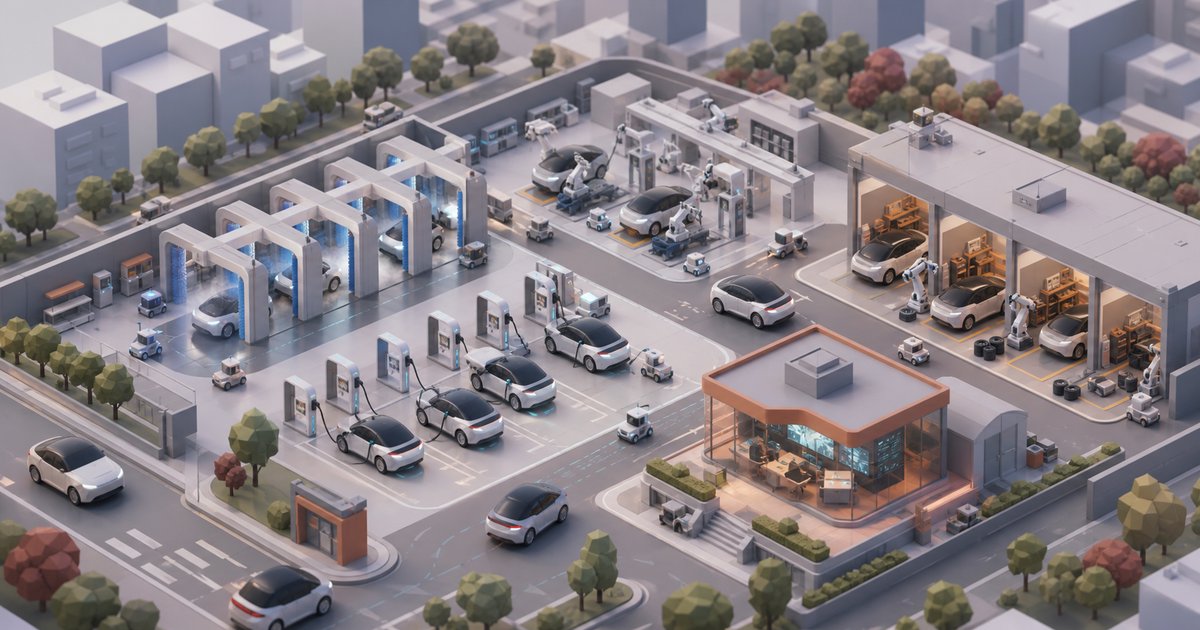
The robotaxi conversation is almost entirely about software. The company that just raised $250 million is betting the constraint is somewhere much less glamorous: the buildings where driverless cars get cleaned, charged and fixed.
Moove announced a $250 million Series C on 5 August 2026, valuing the fleet operator at $2.1 billion. Mubadala Investment Company led, with Woven Capital — Toyota's growth fund — and Ion Pacific co-leading. BlueCrest Capital Management and Sona joined, alongside existing backers including BlackRock, MUFG, Franklin Templeton and Uber.
What Moove actually does
Founded in 2020 by Ladi Delano and Jide Odunsi, Moove began by financing vehicles for ride-hailing drivers in Africa and has since become a fleet operator at scale. It runs roughly 42,000 vehicles across 29 cities in 13 countries, describes itself as Uber's largest global fleet partner, and reports around $420 million in annual recurring revenue.
The autonomous business is the newer half. Through a partnership with Waymo, Moove manages the physical operation of driverless fleets — Phoenix and Miami are running, with London announced.
| Metric | Figure |
|---|---|
| Round | $250M Series C |
| Valuation | $2.1B |
| Lead investor | Mubadala, with Woven Capital and Ion Pacific |
| Fleet | ~42,000 vehicles |
| Footprint | 29 cities, 13 countries |
| Waymo markets | Phoenix, Miami, London |
"Nests"
The money is going into autonomous fleets and into what Moove calls Nests: robotics-first depots where third-party driverless fleets are charged, serviced, maintained and coordinated for continuous operation. Around 350 people are being hired for the autonomous side of the business.
The thesis is straightforward once stated. A robotaxi with no driver has nobody to plug it in, nobody to clear a spilled drink off the back seat, and nobody to notice a warning light. Every one of those tasks becomes an operational function that has to happen somewhere, at high throughput, overnight, without human attention becoming the bottleneck. "Autonomous mobility needs vehicle fleets, charging infrastructure, maintenance, data systems and continuous operation in every city," co-founder and co-CEO Ladi Delano said.
That is a substantially different business from writing a driving stack, and it is capital-intensive in a way software is not — which is precisely why a sovereign wealth fund and Toyota's growth arm are the ones writing the cheque.
The European angle
London is the entry that matters here. Waymo has announced the city, and Moove would be running the depot layer beneath it — arriving in a market where Wayve and Uber have secured TfL licences for robotaxi trials. London is becoming the first serious European contest between competing driverless operators, and the winner will need depots regardless of whose software drives.
There is also a direct read-across to charging. Depot charging for commercial fleets is attracting infrastructure capital across Europe — Meridiam has just put €23 million into Chargepoly — and a robotaxi Nest is a depot with harder uptime requirements than a bus garage.
The contrast with Tesla is instructive. Tesla intends to run its own robotaxi fleet on its own vehicles with its own Superchargers, keeping the whole stack in-house. Moove is selling the opposite proposition: that the physical layer is a specialist business, and that everyone who is not Tesla will need to buy it from someone.