
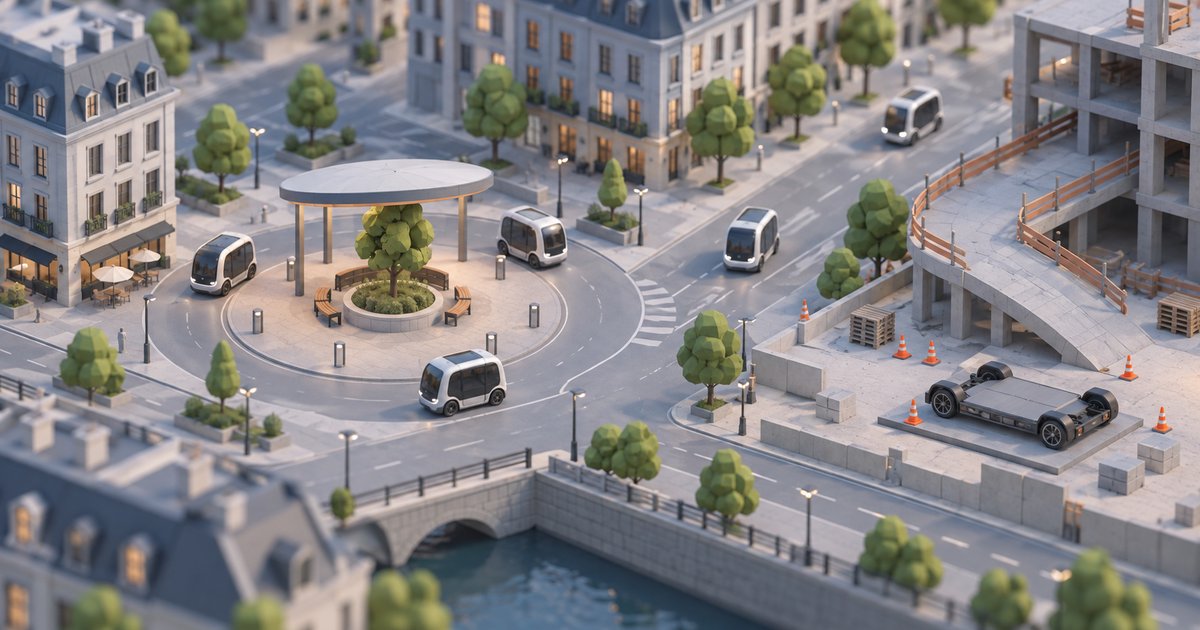
Bolt, the Estonian ride-hailing company that operates in more than 50 countries, said on 17 September 2026 that it intends to put at least 25,000 driverless cars on European roads. Lucid will supply them. It is the largest robotaxi number anyone has attached to Europe, and it is worth reading carefully, because almost none of it is dated.
What the announcement contains
| Element | What was said |
|---|---|
| Fleet size | at least 25,000 vehicles |
| Vehicle | Lucid's Midsize platform |
| Autonomy | SAE Level 4, on Nvidia's Hyperion architecture |
| Operator | Bolt Autonomous Driving Solutions owns and runs the fleet |
| Longer goal | 100,000 driverless cars on Bolt's platform by 2035 |
| Deployment date | none given |
| Cities or countries | none named |
| Financial terms | none disclosed |
Bolt brings genuine scale to the operator side: more than 200 million customers, 4.5 million drivers and couriers, and coverage of over 850 cities. If any European company has the demand-side footprint to absorb a fleet that size, it is this one.
The vehicle is the problem
The 25,000 cars are to be built on Lucid's Midsize platform, which does not exist yet. Lucid delayed that programme on 4 August 2026. Everything in the announcement is downstream of a car that has slipped once already and has no production date.
Lucid's own position adds weight to the caution rather than removing it. The company built 3,953 vehicles in the second quarter of 2026 and cut 18% of its workforce. A commitment to supply 25,000 autonomous cars sits oddly against that output, and this is Lucid's second such arrangement — it committed 20,000 vehicles to Uber in 2025.
There is a third gap. Lucid supplies the vehicle and Nvidia supplies the compute-and-sensor reference architecture, but neither is the driving software. The partners say they will work with autonomous-driving technology partners for the Level 4 capability itself. The company that will actually make these cars drive has not been named.
Measured against what already runs on European roads
The useful comparison is not with other announcements but with European roads today. WeRide has been running Level 4 vehicles at Zurich Airport, Pony.ai and Verne are working towards driverless service in Zagreb, and Waymo has asked Berlin for up to 50 test vehicles — 50 test cars, in one city, and Germany has never licensed a driverless fleet. Against that, 25,000 is not an increment. It is three orders of magnitude beyond anything European regulators have approved.
For a Tesla owner or buyer, the point is what it says about the race Tesla is not currently in on this continent. Tesla's Cybercab tours only Asia-Pacific venues through 2027, with no European stop, and what Tesla actually sells in Europe is the supervised product. A rival announcing 25,000 driverless cars sounds like Tesla being outflanked — but the approvals that would let any of them carry a passenger without a driver do not exist in any European market, for Bolt or for Tesla.
The number to watch is not 25,000. It is the first one: the first European city where Bolt names a date, and the first regulator that agrees to it.