
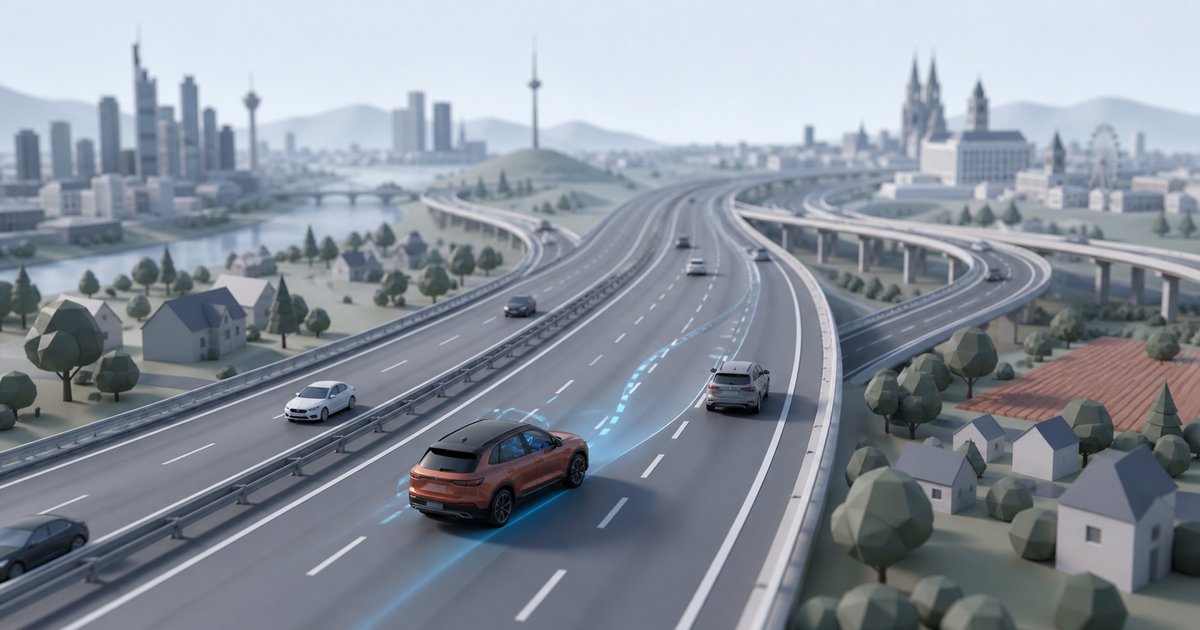
A rival to Tesla's Full Self-Driving has quietly gone live on German motorways this week, and it did so with the paperwork Tesla is still waiting on. Lotus has switched on Hyper Pilot for Eletre owners in Germany, an over-the-air release that lets the car centre itself in lane, adapt its speed and — the part that matters — change lanes to overtake, with the driver supervising rather than steering.
What the system actually does
Hyper Pilot is Lotus's name for the Highway Navigation Pilot function it began rolling out across Europe in June 2026. On an approved route it handles lane keeping, adaptive speed and supervised overtaking. Lotus is explicit that this is not autonomy: the driver remains responsible for the car at all times, and the system expects hands and attention on the road.
The geography is deliberately narrow. Hyper Pilot works only on approved motorway routes along the Frankfurt–Stuttgart–Munich corridor, covering sections of the A3, A5, A8 and A99. It also needs a specific car: the Highway Assist Pack, the LIDAR sensor suite, and either the Connectivity Prestige package or an external Wi-Fi connection, with navigation running. Lotus is including the HNP Premium package at no cost until 29 July 2027.
The certificate is the story
The reason a British-badged, China-built SUV is doing supervised overtaking on the A8 is UN R171. That regulation came into force in September 2024 as the first globally harmonised rulebook for Level 2 Driver Control Assistance Systems — the class of system that steers and changes lanes while a human supervises. It is the framework European type-approval authorities apply to exactly this kind of feature.
Lotus Technology obtained R171 certification in March 2026, becoming the second carmaker in the world and the first British one to hold it, and making the Eletre the first China-built model to comply. Certification is what turned a driver-assistance demo into a feature that can legally operate on a German autobahn.
What it means for a German Tesla owner
Tesla has the more capable system by reputation and the larger dataset by some margin, and it is the one without a green light in Germany. France refused approval pending an EU-wide framework, Germany's KBA has a review under way, and Tesla has argued its case with data showing FSD Supervised 5.2 times safer than manual driving over 65 million km in five EU countries.
The contrast is not about which software is better. It is that a competitor took the slower, narrower route — a bounded corridor, a certified system, a modest feature set — and is now shipping supervised lane changes to German customers while the more ambitious system waits. For a German Tesla owner, the practical position is unchanged: FSD Supervised is not approved for use there. What has changed is that "no one is allowed to do this in Germany" is no longer the answer.
The rest of the update
Hyper Pilot arrived inside a wider European release for the Eletre and Emeya. Both cars get Active Sound Design, a Drive Setup shortcut that applies saved preferences in one tap, and improved insulation-fault detection. The Eletre additionally gets retuned fatigue and distraction alerts aimed at cutting false warnings; the Emeya gains an Auto Hold status indicator.
Hyper Pilot itself stays German-only for now. Lotus has not committed to a UK timeline, and has not said which corridor comes next.