
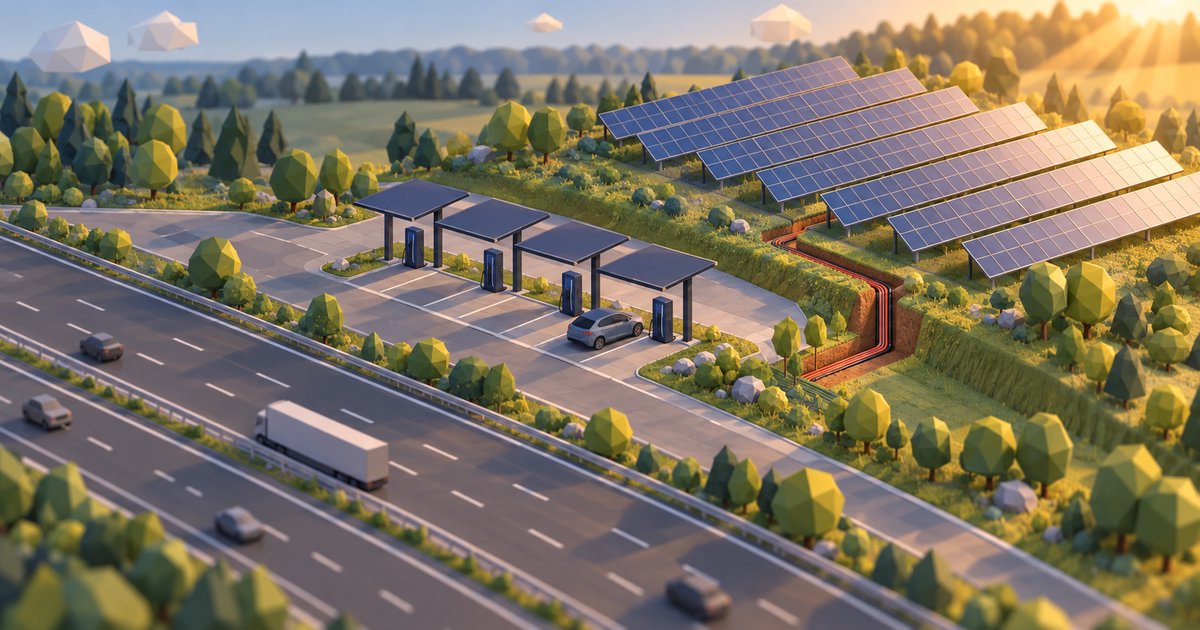
At the Autohof Schwarmstedt on the A7 in Lower Saxony, the charging price changes with the weather. When the sun is out, Ladesonne charges 29 cents per kWh. When it is not, the price follows the electricity spot market.
That is roughly half the German median for public DC charging, which sits near 59 cents per kWh. It is cheaper than EnBW's benchmark 56 cents and well under Fastned's 69-cent ad-hoc rate.
How the price is actually built
The site is fed by a 4.6 MWp solar park about 300 metres away, wired straight to the chargers rather than routed through the public grid. Skipping the grid is the whole trick: it is what removes the network fees, levies and margins that sit between a solar farm and a charging cable everywhere else.
| Supply condition | Price |
|---|---|
| Solar park supplying | 29 ct/kWh |
| No sun | dynamic spot-market price |
| Partial solar | blended in proportion |
A price board at the entrance shows the current rate, the way a filling station posts diesel. That matters more than it sounds. A dynamic tariff you cannot see before committing is a gamble; one posted at the entrance is a decision.
Ladesonne, a Bremen company founded in 2021, opened the site in April 2026. Since then it says more than 70% of the energy it has delivered came directly from the solar array — which is the figure that decides whether 29 cents is the normal price or the marketing price. On that number, it is close to normal.
What the operator has not published
No charge-point count, no power ratings, no connector detail, nothing on blocking fees, and nothing about roaming or third-party apps. For a site on the A7 — Germany's north–south artery, Hamburg to Füssen — those are not small omissions. A driver planning a stop needs to know whether their usual roaming card works here at all, because if it does not, 29 cents is unreachable.
The spot-price half of the tariff is also unquantified. German day-ahead prices swing widely, and "dynamic" without a published cap means the cheap case is documented and the expensive case is not.
Why this matters beyond one Autohof
European charging pricing has spent two years moving in one direction: subscriptions, tiers and loyalty rates that reward committing to one network. Switzerland just consolidated four operators into one, and Polestar is selling discount charging subscriptions. Ladesonne is doing the opposite — pricing by physical cost of supply at that moment, with no membership in it.
Direct-wired generation is not a trick most sites can copy. It needs a solar farm next to a motorway junction and a grid connection you are allowed to bypass. But the number it produces is the argument: when generation sits beside the charger, the retail price can be half the national median and the site still works.
For a Tesla owner
Nothing here replaces a Supercharger stop, and Tesla's own German pricing is usually competitive against the 59-cent median. The case for Schwarmstedt is narrower and real: it is on a corridor Tesla drivers use constantly, and on a sunny afternoon it undercuts essentially everything, Superchargers included.
The honest caveat is the one Ladesonne leaves open. Arrive under cloud and you are on a spot price nobody has published a ceiling for. Check the board at the entrance before you plug in — which is, to be fair, exactly what the board is there for.