
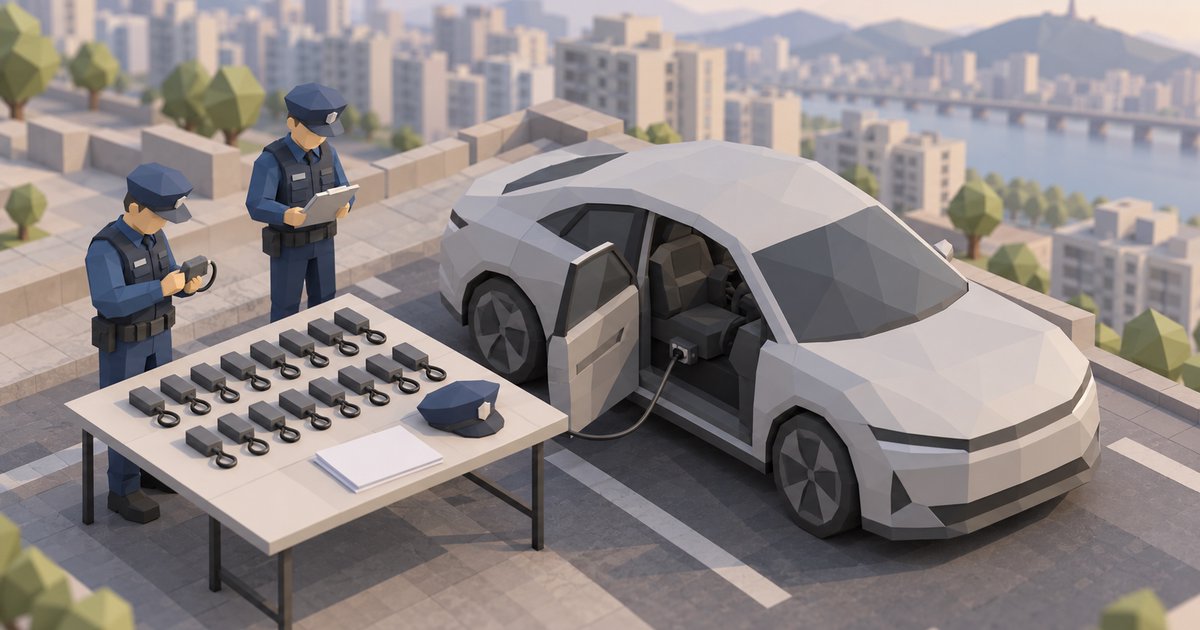
South Korean police have sent 80 Tesla owners to prosecutors for switching on FSD (Supervised) with devices that get around Tesla's software locks. The Seoul Metropolitan Police Agency's traffic crime investigation team announced the referrals on 27 October 2026 and said it had seized 21 of the devices, Financial News reported. The owners are accused of breaching Korea's Automobile Management Act.
Which cars, and how
FSD is legal in Korea only on the US-built Model S, Model X and Cybertruck. Those cars are exempt from Korean safety certification under the Korea–US free trade agreement. The devices went into China-built Teslas, among others, which cannot switch the feature on, according to Chosunbiz.
Police described two routes. Some owners bought activation devices sold abroad, including in Europe and China, and connected them to their cars. One suspect bought a device sold in Europe. Another, who works in IT, built his own from open-source code he found on GitHub, using technical information about the car's electronic control system.
Some suspects also shared, in online communities, how to switch FSD on and how to leave no trace of it on the car. Police said they had secured those posts and chat records.
Police argue that a function switched on this way, without the manufacturer's software updates or certification, may not recognise driving situations correctly and may act against the driver's intention.
The law and the penalty
Chosunbiz says that switching FSD on without authorisation falls under the Act's ban on arbitrarily changing, installing, adding or deleting software that can affect a vehicle's safe operation. The maximum penalty is two years in prison or a fine of up to 20 million won, about €13,500 at the European Central Bank's 26 October reference rate. A referral sends each case to prosecutors, who decide whether to indict.
The investigation began at the request of the transport ministry, MOLIT. Korea Report says the ministry asked in April. Tesla Korea had been remotely disabling cars switched on this way, but the attempts continued. Police then asked MOLIT and the Korea Transportation Safety Authority for technical advice.
Five days after Tesla's approval request
The referrals come five days after Tesla Korea formally asked MOLIT to approve FSD (Supervised). By Tesla Korea's own count, 185,491 of the 238,968 Teslas registered in Korea at the end of September, or 77.6%, cannot use the system. Of those, 183,407 are China-built Model 3s and Model Ys, the kind of car police say was unlocked.
The 80 is a separate figure from one EBN reported earlier this month: Tesla's own software updates had blocked 93 cars that had been "jailbroken" to switch the feature on.
What it means in Europe
The devices are not new. In April, Tesla began detecting them and removing FSD remotely from cars in Europe, China, South Korea and Turkey, and warned owners that they would be fully liable for any accident.
In Europe, the system, which Tesla's European websites now call Tesla Assisted Driving, is approved in ten EU countries, most recently Latvia on 26 October. An EU-wide decision is not expected before December. Some of the devices in the Korean case were ones sold in Europe. In Korea, an owner who fits one now risks more than losing the feature: a criminal referral.