
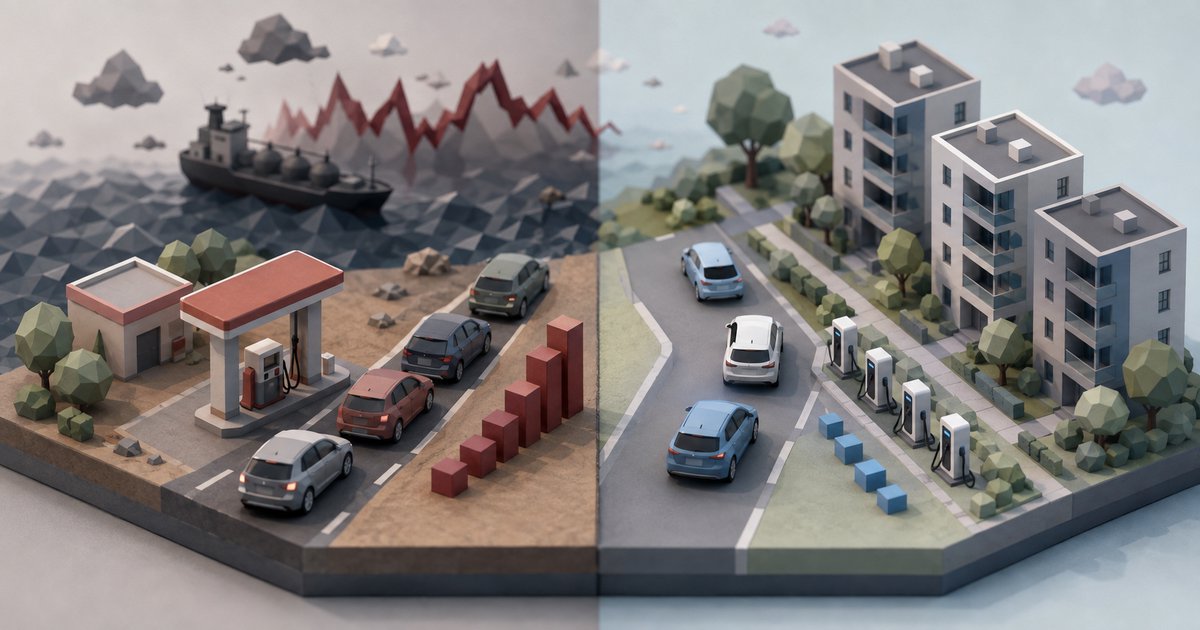
The International Council on Clean Transportation published its EV Transition Check 2026 on 7 September, and the headline is a running-cost number: across the EU in 2025, a battery-electric car cost 33% less to run than a petrol equivalent.
The more useful figure is the second one. Strip out cheap home charging and assume a driver who only ever uses public chargers — no driveway, no wallbox, no overnight tariff — and the advantage narrows but does not vanish: 28% cheaper than petrol. That is the case for buyers who cannot charge at home, and it is the number most cost comparisons quietly assume away.
The oil crisis moved one side of the ledger
The 33% is 2025 data, which means it predates February 2026. Since the oil crisis, the ICCT records combustion operating costs rising 12% to 36% depending on market and fuel, while electric energy costs stayed broadly unchanged. The gap for 2026 will be wider than the figure the report leads with — how much wider depends on where you buy electricity.
Purchase price, not just running cost
| Metric | Change |
|---|---|
| BEV purchase cost, Germany, 2020-2025 (inflation- and feature-adjusted) | down 18% |
| Combustion vehicle prices, same period | up 2% |
| Global battery cell costs, 2020-2025 | down 35% |
| BEV models available in Europe, 2020-2025 | roughly 4x |
The ICCT's assessment is that by 2025 electric cars had reached price parity with petrol in the three largest vehicle segments — the first time it has said that. On its numbers, fully electric powertrains held an 18% share of the European market in 2025.
That 2025 share is a floor rather than a current reading. TeslAnt's own tracking of 2026 registrations has Europe's BEV share at 25.6% in June, and Germany at 29.3% in July. The report is measuring a completed year, not this one.
Trucks are the slower half
The report also covers freight, where the picture is less settled. Electric long-haul trucks come out 86% lower on lifecycle emissions than diesel, and in Germany they already run 11% cheaper than diesel in long-haul work — but that advantage is built on toll exemptions rather than on the vehicles themselves. The ICCT expects genuine EU-wide cost parity for electric versus diesel trucks around 2030. For passenger cars it puts lifecycle emissions 73% below petrol.
What it means for a European buyer
The report names no manufacturer and no model. It is a market-wide assessment built on segment averages, so it will not tell a prospective buyer what a specific car costs to run, and nothing in it speaks to Tesla's position specifically — for that, per-market registration data is the better source.
What it does settle is the shape of the question. The objection to buying electric in Europe has moved on from running costs, which are now a third cheaper and getting cheaper relative to petrol, and from purchase price in the mainstream segments, where the ICCT says parity has arrived. What is left is charging access — which is exactly why the 28% public-charging figure is the one worth remembering.