
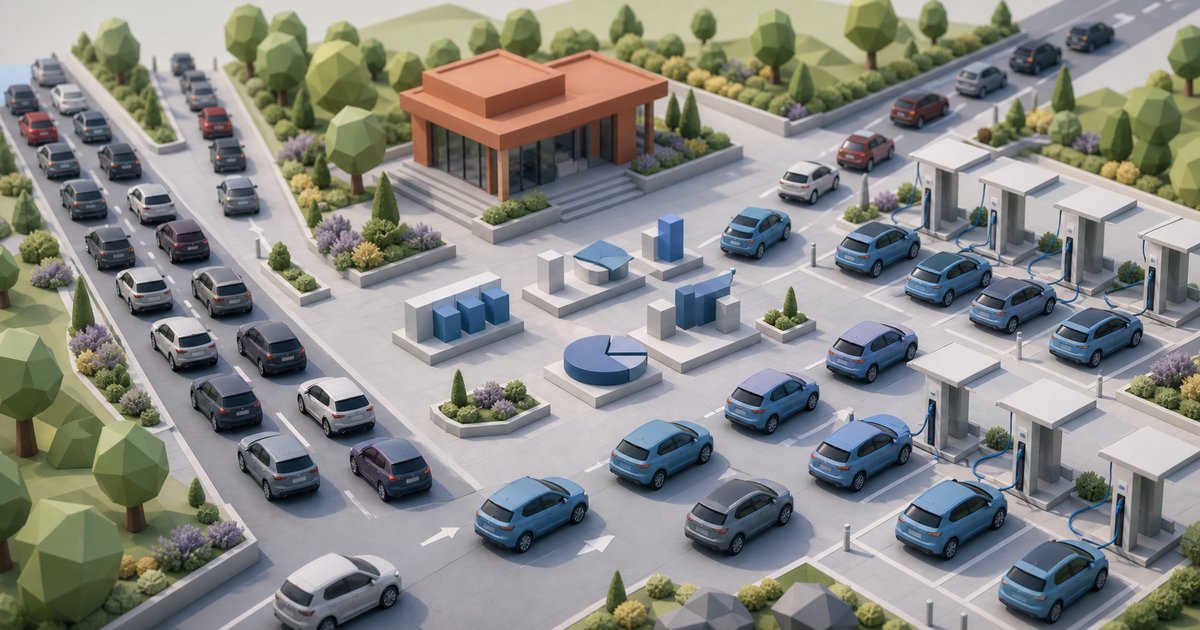
Almost one in three new cars registered in Germany last month was fully electric. The Kraftfahrt-Bundesamt (KBA) published its July 2026 figures on 6 August: 268,068 new passenger cars in total, of which 78,609 were battery-electric — a 29.3% share, and 61.7% more BEVs than in July 2025.
What makes the month notable is not the electric growth on its own. It is that the overall market barely moved while the combustion side fell off a cliff.
The July numbers
| Powertrain | July 2026 | Share | Change vs July 2025 |
|---|---|---|---|
| Battery-electric (BEV) | 78,609 | 29.3% | +61.7% |
| Plug-in hybrid | 30,609 | 11.4% | — |
| All hybrids (incl. PHEV) | 105,284 | 39.3% | — |
| Petrol | — | 18.9% | −29.7% |
| Diesel | — | 11.8% | −21.8% |
| Total market | 268,068 | 100% | +1.2% |
The KBA reports petrol and diesel by share and year-on-year change rather than by unit count in this release, hence the gaps above.
Substitution, not expansion
A market growing 1.2% while its largest incumbent fuel type drops nearly 30% is a market changing its mix, not its size. Petrol and diesel together now account for 30.7% of registrations — less than the BEV-plus-PHEV total of 40.7%. Two years ago that ordering was reversed.
Hybrids of all kinds remain the single biggest block at 39.3%, but the plug-in slice of that is what is moving: 30,609 PHEVs is a meaningful number in a market where the full-hybrid badge is often applied to cars that never see a cable.
The purchase premium is doing work
Germany reopened a state purchase premium for electric cars on 19 May 2026. By 5 August, 103,500 applications had been filed with the administering agency — a rate of roughly 1,300 a day across the scheme's first eleven weeks. July is the first full month in which cars ordered under the reopened scheme would plausibly have been delivered and registered, and the 61.7% jump is consistent with that timing.
That also means the figure deserves caution. Subsidy-driven months pull demand forward, and the comparison base of July 2025 was itself weak. The trend line matters more than any single month.
Chinese brands and the import table
BYD posted the strongest growth of any import brand at +365.4%. Off a small base, that multiple is easier to achieve than it looks, but it lands in the same quarter that several Chinese manufacturers moved from pilot imports to genuine dealer networks in Germany.
Where July sits against June
June 2026 was the stronger month in absolute terms, with 84,057 BEVs and Germany's highest electric volume since 2023. July's 78,609 is lower in units but higher in share, at 29.3% against June's 28.4% — the total market shrank faster than the electric part of it did, which is ordinary summer seasonality in Germany.
For context on how differently Europe's large markets are tracking, the UK managed a record 27.5% share in July and still missed its ZEV mandate. Germany has no equivalent mandate, and is currently ahead of it anyway.
What it means for buyers in Europe's biggest market
Rising BEV share tightens supply of the popular trims first and softens residuals on petrol cars you might be trading in. If you are shopping in Germany this autumn, the premium is the variable worth planning around: it is application-based, funded to a cap, and the application rate above suggests the window is not indefinite.