
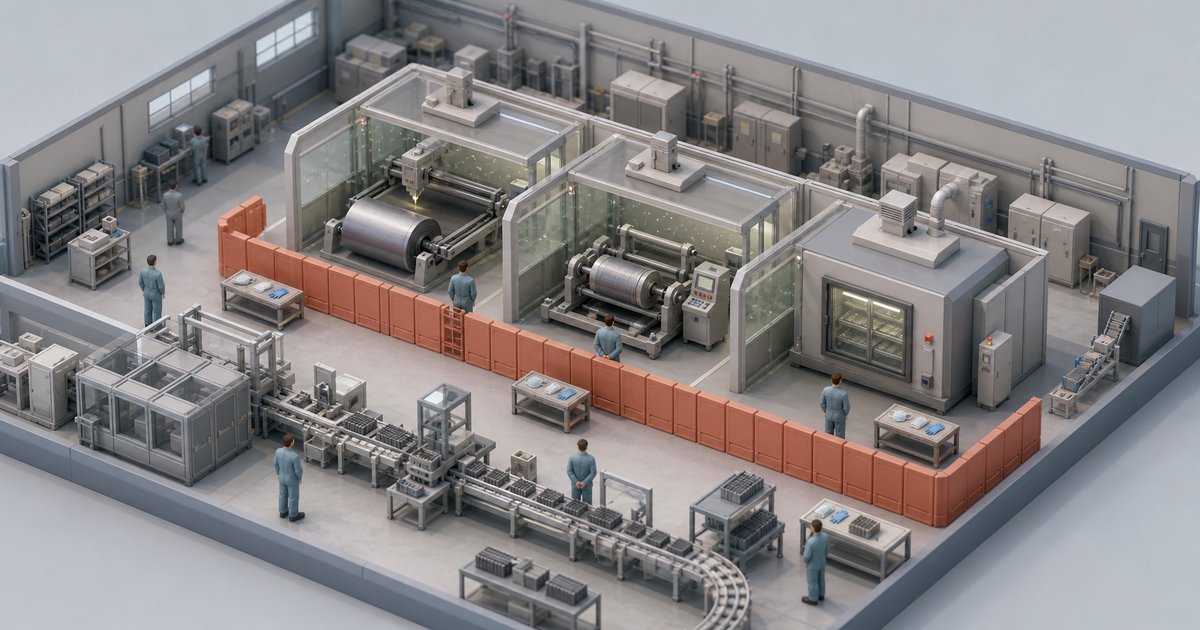
Hungary's occupational safety authority has temporarily banned work in three areas of the cell manufacturing building at CATL's battery plant in Debrecen, after nine employees were found to have elevated nickel levels during mandatory health screening.
The Hajdú-Bihar County inspectorate acted after CATL Hungary Kft reported seven cases on 10 August and two more on 13 August. The cases surfaced through a biological exposure monitoring programme covering more than 400 employees at the site. Inspectors concluded that workers had not been adequately provided with protective equipment, and a fine procedure is now under way.
What was actually stopped
| Authority | Hajdú-Bihar County occupational safety inspectorate |
| Cases reported | 7 on 10 August, 2 on 13 August |
| Workers in the monitoring programme | more than 400 |
| Areas suspended | laser cutting of cathode and anode foils, winding of electrode foils, cell drying |
| Finding | protective equipment not adequately provided |
| Duration | until the identified deficiencies are rectified |
The order stops three process steps, not the factory. Nickel compounds are used in cathode material, and all three suspended steps sit on the electrode side of cell making — cutting and winding the coated foils, then drying them.
The plant is not making cells yet
This is the detail that puts the stop-work order in proportion, and it is not a flattering one for CATL. Debrecen has not begun cell manufacturing at all. Module assembly started in May 2026 on a line rated at 5 GWh a year, and those modules are built from cells shipped in from other CATL plants. The company had projected that cell production would start in March or April 2026.
The permitting record from the same fortnight shows how closely the site is now being watched. On 19 August authorities refused a usage permit over problems with site-plan documentation. On 25 August they approved the first expansion stage.
Who is waiting for these cells
Debrecen was designed for 40 GWh of annual capacity, with a stated ambition to reach 100 GWh. Two German carmakers are in the queue, and only one of them is still waiting patiently:
- Mercedes-Benz now takes the batteries for its electric van from China rather than from Debrecen.
- BMW expects cells from the plant beginning in 2027 and is so far unaffected.
What it means for a European Tesla buyer
Tesla is not a Debrecen customer, and nothing here delays a car anyone has ordered. The reason to watch it anyway is structural.
CATL supplies around 40% of the world's EV batteries, including the LFP cells in a large share of Model 3s and Model Ys. Debrecen is the test of whether a Chinese cell maker can move cell production into Europe at scale rather than shipping finished cells in — the same question that hangs over every localisation promise, including CATL's 2027 solid-state pilot.
So far the answer at Debrecen is: not yet. A plant that was supposed to be making cells in spring is assembling modules from imported ones in late summer, and its cell building is now partly under a stop-work order. Every month that slips is another month in which European-built electric cars, Tesla's Berlin output included, depend on cells that arrive by sea and carry the cost and tariff exposure that comes with them.