
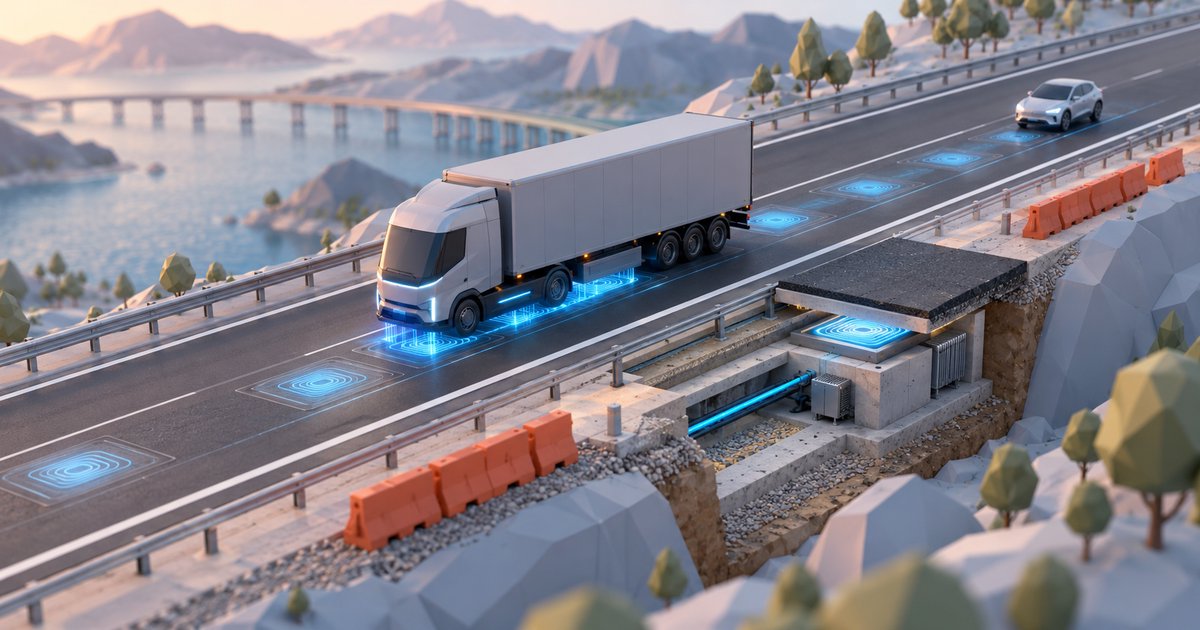
Honda R&D has built a stretch of road that charges an electric vehicle while it drives over it, at up to 150 kW. The company announced the system on 5 October 2026 with two construction partners, Taisei Corporation and Taisei Rotec, and says public-road demonstrations will start in the Japanese 2027 fiscal year — from 1 April 2027.
Dynamic wireless power transfer is not a new idea. What Honda is claiming is a packaging result that makes it buildable, which is a different thing from a physics result.
What is actually new
In previous in-motion charging designs, the inverters sit in roadside cabinets and feed coils buried in the carriageway, which means a great deal of high-frequency wiring under the road surface. Honda has put the inverter and the coil inside the same ground assembly unit and calls it the world's first such unit. The units are then linked to each other by plain DC distribution.
The consequence is the interesting part. Fewer components and far less cabling go beneath the tarmac, and the units are shaped to drop into sections milled out of existing pavement rather than requiring a road to be rebuilt around them. A retrofit is a very different proposition to a greenfield smart motorway.
The specifications Honda has published
| Item | Figure |
|---|---|
| Maximum power transfer | 150 kW |
| Target vehicles | Passenger EVs through to large commercial EVs |
| Pavement load rating | About 20 tonnes gross vehicle weight |
| Durability test | Equivalent to 1 million wheel loads, at 49 kN per wheel |
| Test road construction | Later in 2026 |
| Public-road demonstration | Japanese FY2027 onward |
| Test sites | Taisei's Future Technology Field at Tamura, and the Tateyama Expressway in Chiba |
Why the number is 150 kW, and why trucks
Most in-motion charging work has been aimed at topping up passenger cars, at power levels in the tens of kilowatts. Honda is explicit that the 150 kW figure exists for heavy commercial vehicles — the case where the economics are least bad.
A 40-tonne truck cannot carry enough battery for a long haul without giving up payload, and it cannot afford to stop for 45 minutes. Energy delivered continuously along a motorway corridor solves a problem that stationary charging solves badly. A passenger car has no equivalent difficulty, which is why it is the trucks that justify the civil engineering.
What a Tesla owner should take from this
Nothing for several years, and possibly nothing ever in Europe. This is a Japanese research programme, its demonstration phase has not started, and no road authority anywhere has committed to installing it. Honda has published no cost per kilometre, and that single unpublished figure decides whether the technology is a motorway standard or a museum piece.
It does say something about where inductive charging is heading, though — and the contrast with Tesla is sharp. Tesla's own published wireless work is two patents about keeping foreign metal off a stationary inductive pad, aimed at Cybercab. That is a parked vehicle charging itself without a human; Honda's is a moving vehicle charging itself without stopping.
Both are bets that the cable eventually goes away. Tesla's is the one that could ship to a driveway this decade.