
Three weeks ago LG Energy Solution published a fix for the degradation that has kept lithium-manganese-rich cathodes out of production, and attached neither an energy figure nor a timeline to it. Its joint venture with General Motors has now supplied both.
What was announced
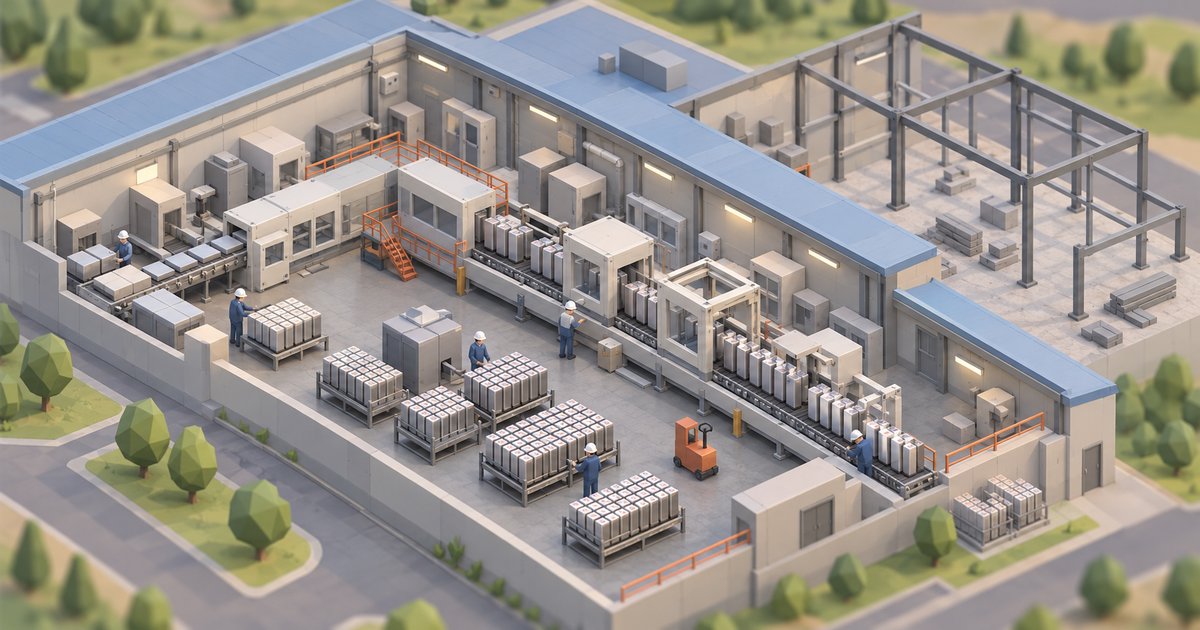
Ultium Cells — the GM and LG Energy Solution joint venture — said on 29 September 2026 that its Spring Hill plant in Tennessee will build prismatic LMR cells, which it claims will make it the first facility in the world to mass-produce them. Conversion work starts later in 2026 and completes in 2028. The site adds about 500 jobs, taking its workforce to roughly 1,700.
| Claim | Figure |
|---|---|
| Energy density vs LFP | 33% higher |
| Cost vs LFP | Comparable |
| First vehicles | 2028 |
| Target range | Over 400 miles (about 640 km) |
| Segment | Electric trucks and full-size SUVs |
Kurt Kelty, GM's vice president of battery and sustainability, said adding LMR "positions us to leapfrog today's more affordable chemistries and deliver lower costs with better performance".
For scale, GM's current high-nickel Chevrolet Silverado EV is rated up to 478 miles (769 km) and starts at $55,895.
Why this is news and the LG paper was not
LG's September result was a durability fix: narrowing the charge window from 4.6 V to 4.3 V raised oxygen recovery and left 40 Ah cells at 92.2% capacity after 883 cycles. We wrote at the time that two things were missing — an energy density figure and a commercialisation date — and that without them it belonged in the research column.
A named plant, a conversion schedule and a 2028 vehicle launch move it out of that column. The 33% figure is still a relative one, quoted against LFP rather than as an absolute Wh/kg, and a joint-venture press claim is not an independent measurement. But it is a number attached to a factory, which is a different class of statement from a number attached to a paper.
The Tesla angle
LMR is not aimed at the top or the bottom of the range. It aims at the middle: more energy than LFP, materially cheaper than nickel-cobalt, and with the cobalt supply chain removed. That middle is exactly where Tesla's European line splits — LFP in the cheaper cars, high-nickel in the longer-range ones, and nothing in between.
LG Energy Solution is also one of Tesla's cell suppliers, producing the 2170 cells used in Model 3 and Model Y production. A chemistry LG can manufacture in volume is a chemistry that could plausibly reach a Tesla. That is the honest limit of the claim: nothing here says Tesla has chosen LMR, and Tesla has not commented.
What does not travel to Europe
The cars do not. Full-size electric trucks and SUVs chasing 640 km are a North American product category; GM sells none of them in Europe, and its 2027 switch to native NACS is likewise a US-market decision.
What travels is the cost floor. If prismatic LMR really delivers a third more energy than LFP at LFP money, it resets what an affordable long-range pack costs for everyone building one — including whoever specifies Tesla's next European battery. The date for finding that out is 2028, and nothing about a car on sale today changes because of it.