
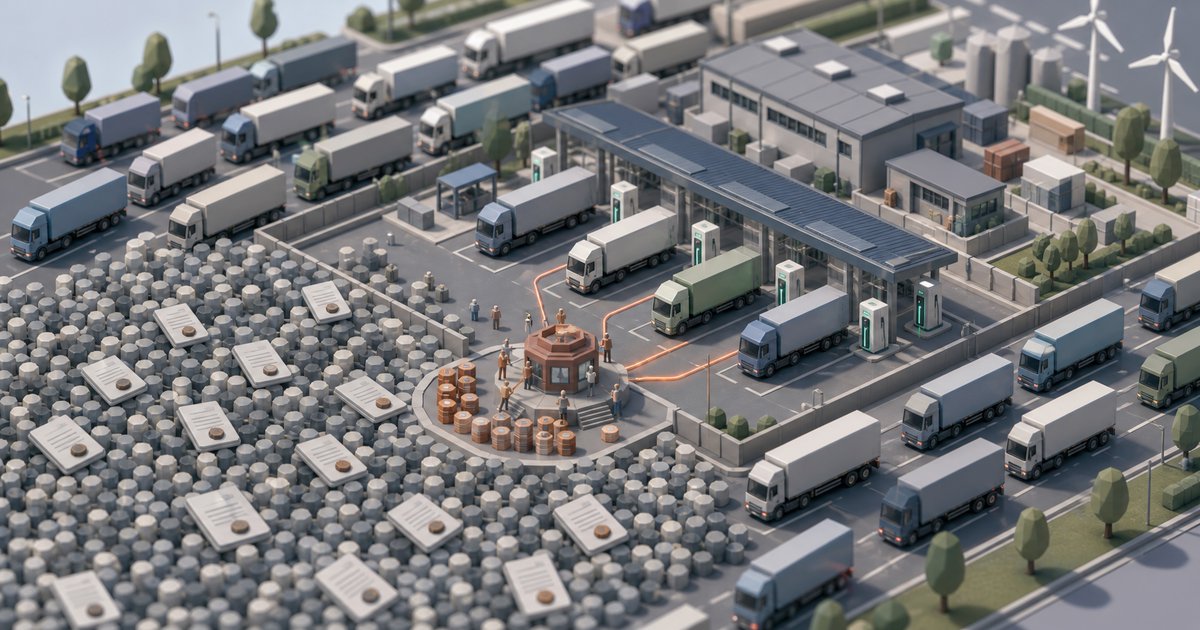
Germany's new subsidy for heavy-truck charging infrastructure has been oversubscribed in all three of its opening rounds, and one of them was exhausted within hours of opening. The federal programme has about €1 billion to spend over four years; the first three calls put roughly €300 million on the table and attracted well over a billion euros of requests.
What happened in each round
The programme is administered by Projektträger Jülich on behalf of the federal transport ministry, and it splits into non-public (depot) charging and public charging, with separate calls for smaller companies.
| Call | Window | Budget | Applications | Requested |
|---|---|---|---|---|
| A — depot charging, SMEs | 5 June 2026 only | €50m, raised to €150m | ~430 | ~€150m |
| B — depot charging, all firms | 12 June – 7 July 2026 | ~€67m | ~1,050 | ~€400m |
| C — public charging | 12 June – 7 July 2026 | €83m | ~380 | ~€500m |
Call A is the one that tells the story. It opened on a single day, ran first-come-first-served, and was so heavily subscribed that the budget was tripled from €50 million to €150 million on the same day — and still closed within hours against roughly 430 applications.
Calls B and C were competitive rather than first-come, which produced a visible price for public money. In Call B, 206 projects were approved, all at or below €230 per kilowatt of installed capacity. In Call C, 67 applications got through at or below €289 per kilowatt. The scheme's ceiling is €500 net per installed kilowatt, so competition drove the effective subsidy to roughly half the maximum. Applicants who asked for the full rate lost to applicants who asked for less.
Minimum power thresholds differ by call: 50 kW per charging point for depot charging, 100 kW for public sites.
What the oversubscription actually signals
Two readings, and both are probably true. The first is straightforward demand: hauliers and charge point operators have projects ready to build and were waiting for capital support. Roughly 1,860 applications across three rounds is not a market that needs persuading.
The second is that depot charging is where electric trucking is really happening. Calls A and B — both depot charging — drew about 1,480 of those applications between them. That fits the operational reality: most trucks return to a yard nightly, and charging them there is cheaper and simpler than building megawatt-class public sites. Public charging drew the largest per-euro overshoot, about €500 million chased for €83 million, but the smallest number of applicants.
The European gap this is filling
Public truck charging in Europe is close to nonexistent. TeslAnt reported on Italy's national picture in the RSE map showing six active truck charging stations, all of them in the north. Germany starting from a stronger base does not change the fact that the EU's Alternative Fuel Infrastructure Regulation obliges member states to put heavy-vehicle charging along their main corridors on a timetable.
Further calls are due shortly, with no dates announced yet. The pattern from the first three suggests operators should expect competition on price rather than a queue, and that asking for the maximum rate is a way to lose.