
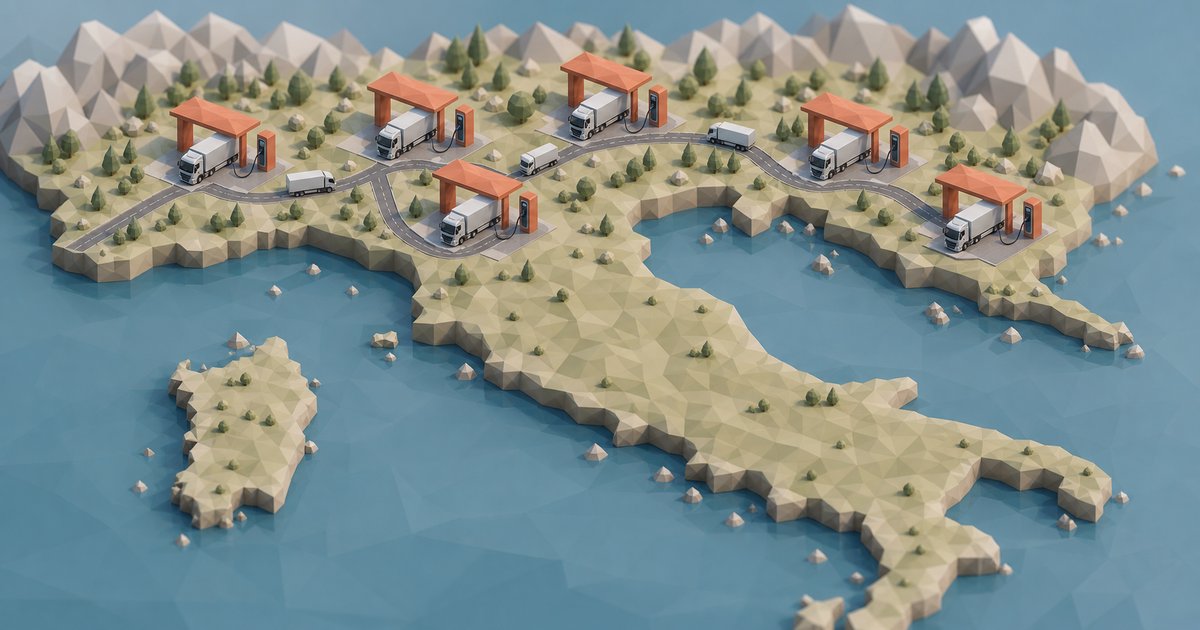
Italy has six charging stations for heavy goods vehicles. All six are in the north. That is the finding of a new map published by RSE, the Italian energy system research body, and it is the starting point for a country that has to build a national truck-charging network under EU law.
The six active sites break down as two in Alto Adige, two in Emilia-Romagna, one in Veneto and one in Liguria. Below Emilia-Romagna there is nothing.
Why six is the number that matters
Electric trucks are not a rounding error in Europe's emissions arithmetic. Heavy vehicles make up 2.2% of the European vehicle fleet and produce 28% of road transport greenhouse gas emissions. That ratio is why the EU's Alternative Fuel Infrastructure Regulation (AFIR) obliges member states to put heavy-vehicle charging along their main corridors rather than leaving it to operators to choose.
Truck charging is also a different engineering problem from car charging. RSE's map is drawn around the Megawatt Charging System (MCS), the standard built for above one megawatt so that a truck can take useful energy during a stop that was going to happen anyway.
The map follows drivers' hours, not traffic
The interesting part of RSE's method is what it uses to place the stations. Rather than putting chargers where trucks are densest, it places them where drivers are legally required to stop.
European rules cap continuous driving before a break and cap the daily total. Assuming an average speed of 80 km/h, RSE derives candidate sites at roughly every 360 km and every 720 km along a route — the points corresponding to the mandatory break and the daily rest — and searches within a 15 km radius of each ideal position for somewhere a station could actually go.
This is the same logic that made Tesla's Supercharger network work for cars, applied to a fleet whose stops are set by law rather than by preference. A charger that is not at a stop a driver already has to make costs the operator time, and time is the whole economics of freight.
The south is the gap
Many of the locations RSE identifies as necessary have no existing infrastructure at all, and the deficit is concentrated in the south. Sardinia does not appear on the map despite carrying heavy vehicle traffic, which for an island means electric freight has no route at all.
RSE's position is that the money is not the obstacle: funding for expansion in southern Italy already exists under EU regulation 2022/1012, which set out support for safe and secure truck parking areas and related infrastructure. What is missing is delivery.
What this means for European routes
For anyone routing an electric vehicle through Italy, the practical read is that the country's heavy-vehicle charging is currently a northern corridor and not a network. Freight operators running south of Bologna cannot plan an electric leg on public infrastructure today.
It also sets a marker for how far Italy has to travel before AFIR compliance. Six stations is not a network that a regulation can be measured against — it is the first entry in a build-out that has to reach the whole peninsula.