
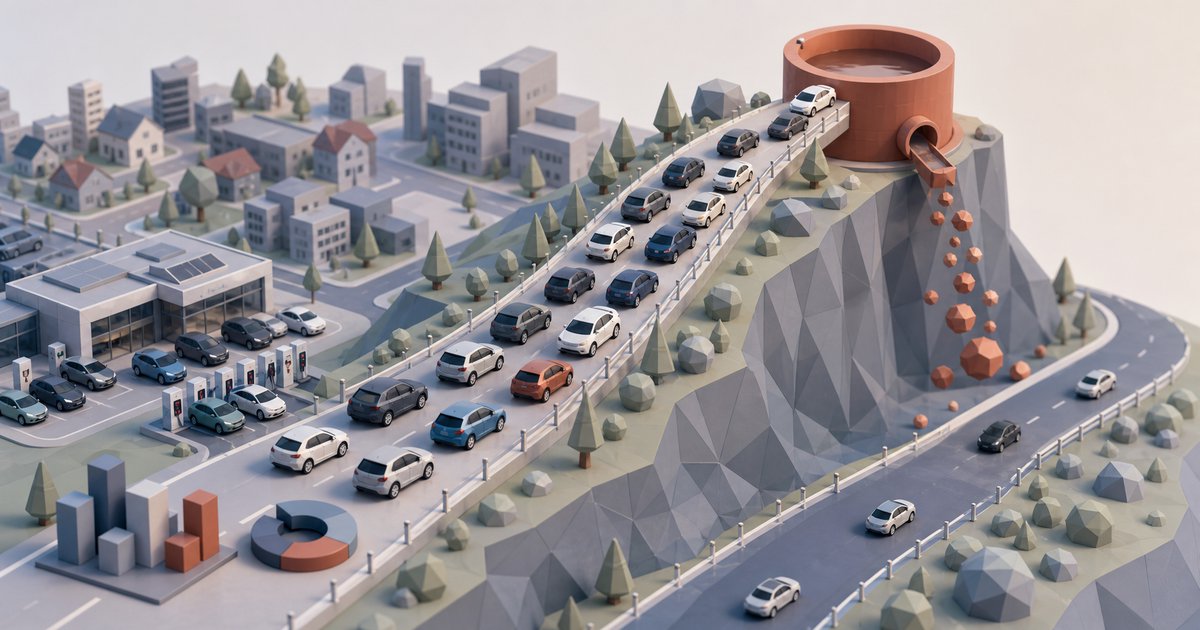
Germany's electric car market is having its best year since the subsidy pause of 2024, and one of the country's more closely watched analysts thinks that is precisely the problem.
Constantin Gall of EY describes the current growth in the German new car market as "Scheinwachstum" — pseudo-growth. His argument is that the expansion is not demand finding its own level but demand being bought, and that the bill comes due when the buying stops.
What the premium pays
The programme behind the surge took effect on 1 January 2026, with applications opening in May once the federal portal went live. It is funded with around €3 billion through 2029 and is targeted by income rather than offered flat.
| Element | Terms |
|---|---|
| Base grant, battery-electric | €3,000 |
| Maximum grant | up to €6,000 |
| Income ceiling | €80,000 taxable, +€5,000 per child (max €90,000) |
| Plug-in hybrids / range extenders | up to €4,500, subject to CO₂ and electric-range criteria |
| Funding envelope | ~€3 billion to 2029 |
The effect on registrations has been substantial. As TeslAnt reported in July's German registration figures, BEVs took a 29.3% share of the German market last month.
Why EY is not celebrating
Gall's case rests on the base the growth is measured from. Even with the premium running and BEV share near 30%, total July registrations were 19.4% below the 2019 level. The German car market is not booming; it is recovering part of a decade-long shortfall, and doing so with public money.
EY expects around 3% total market growth for 2026 against 2025, leaving volumes roughly 18% below where they were before the pandemic. Against that backdrop, a subsidy-fuelled jump in one powertrain looks less like a structural shift and more like purchases pulled forward.
The prediction that follows is straightforward: once the funding lapses, registrations decline. Germany has run this experiment before. The abrupt end of the Umweltbonus in December 2023 was followed by a sharp contraction in BEV registrations through 2024, and the market took most of two years to recover the ground.
What it means for buyers and for Tesla
For German buyers the practical reading is that the grant is finite in both budget and time, and that the best terms are available while the envelope lasts. For anyone weighing a purchase against waiting for a cheaper car, the subsidy is a bird in the hand.
For manufacturers the risk is asymmetric. Brands that price into the grant and build volume assumptions on it are the most exposed to the cliff; brands whose products stand up without it are the least. Tesla's position in Germany is unusual here — as covered in Tesla's July collapse to 367 German registrations, the company is capturing very little of the subsidy-driven volume and has correspondingly little to lose when the programme ends.
That is not a comfortable place to be either. It means the strongest month German electric demand has had in years is one Tesla is largely watching from the sidelines, while international brands took record share.
EY's warning is about the shape of the market, not the direction of it. Electrification in Germany is advancing. The question Gall raises is how much of the current pace survives contact with an unsubsidised price list.