
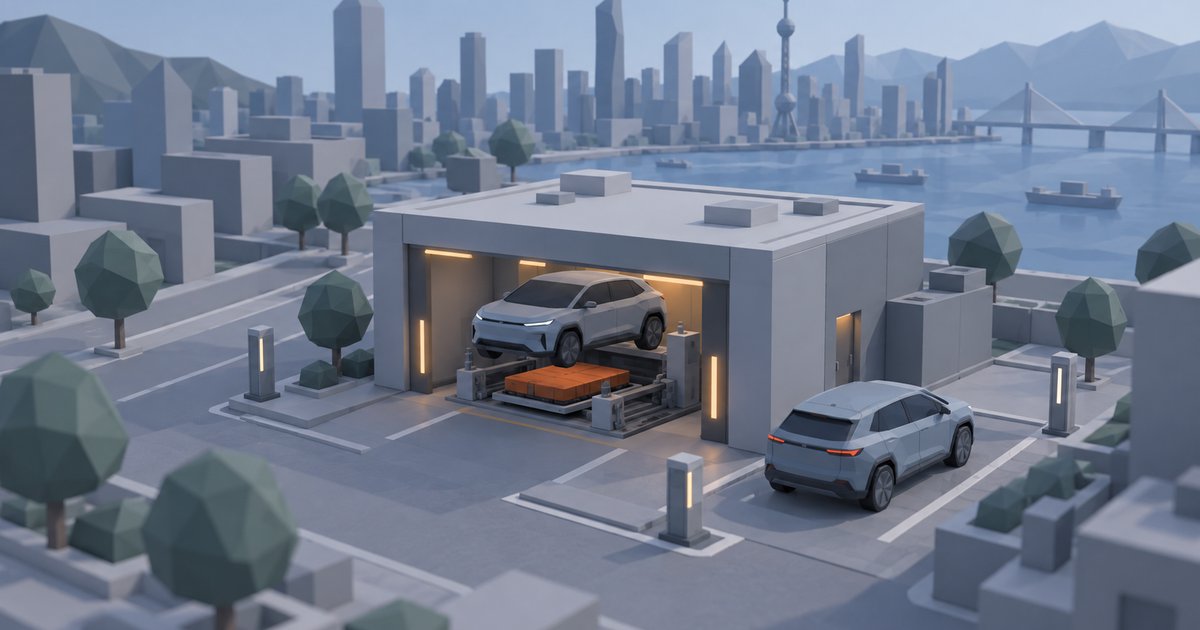
NIO announced definitive agreements on 27 September 2026 handing a Geely Holding subsidiary 30% of NIO Power, the unit that runs its battery swap stations and chargers, at a post-money valuation of about RMB 16 billion (roughly $2.4 billion). It is the largest outside bet battery swapping has ever attracted — and it is almost entirely a bet on China.
What Geely is actually paying
Most of the consideration is not cash.
| Item | Value |
|---|---|
| NIO Power post-money valuation | RMB 16 billion (~$2.4 bn) |
| Geely stake at closing | 30% |
| Yiyi Internet Technology (Chongqing), contributed | |
| Cash from Geely | RMB 640 million (~$94 m) |
| NIO China stake after closing | 63.6% |
| Wuhan Guangchuang fund | 6.4% |
Yiyi is a commercial battery swap operator, and its fleet swap business will be folded into NIO Power. Geely also holds an option to put in a further RMB 640 million within two years, which would take it to 34%; in the other direction, its stake can ratchet down to a floor of 20% if NIO Power misses operational milestones. NIO, in turn, takes 10% of Zhejiang Haohan Energy Technology, Geely's charging business. Geely separately unveiled a 2,250 kW charging station in Ningbo on 23 September.
Why this matters more than the money
The two companies say they will jointly develop unified battery swap technologies and standards, and that Geely will build battery-swappable models that use NIO Power's stations.
That is the part worth noticing. Battery swap has been a NIO-only proposition for a decade — a reason to buy a NIO and nothing else. A second group the size of Geely, building cars to the same swap standard, turns it into something closer to a shared refuelling standard. NIO reached 4,006 swap stations in China on 7 August 2026 and 120 million cumulative swaps, and NIO Power is targeting 10,000 stations by 2030.
Tesla went the other way. It demonstrated a roughly 90-second Model S battery swap in 2013, ran a single pilot site in California, and quietly abandoned the idea in favour of building Superchargers. Every argument since about how to refill an EV quickly has been settled, in Tesla's world, by charging harder.
What Europe gets from this
Nothing, for now — and that is the honest answer.
NIO said in June 2026 that it does not plan to build additional battery swap stations or its own charging stations in Europe, relying on partnerships instead, and that its first NT3-platform 900-volt cars are not expected here before late 2027 or early 2028. It is shifting to an asset-light dealer model in Germany, the Netherlands and Sweden, keeping direct sales only in Norway. Its European swap network exists, it is small next to the Chinese one, and NIO has said it will not grow it.
So a deal that accelerates swap in China lands in a European market where the same company has already stopped investing in it.
What it means for a European Tesla owner
Practically, nothing changes at a Supercharger this year.
Strategically, it widens a gap that already matters. China is converging on two answers to refuelling — megawatt charging and multi-brand swap — while Europe is converging on one, and a European Tesla still peaks around 250 kW. Geely's brands sell here: Volvo, Polestar, Zeekr, Lotus and smart. If swap becomes a standard those brands build to at home, whether it follows them to Europe stops being a hypothetical question. It is not on the table today. This deal is the reason to expect it to be asked.