
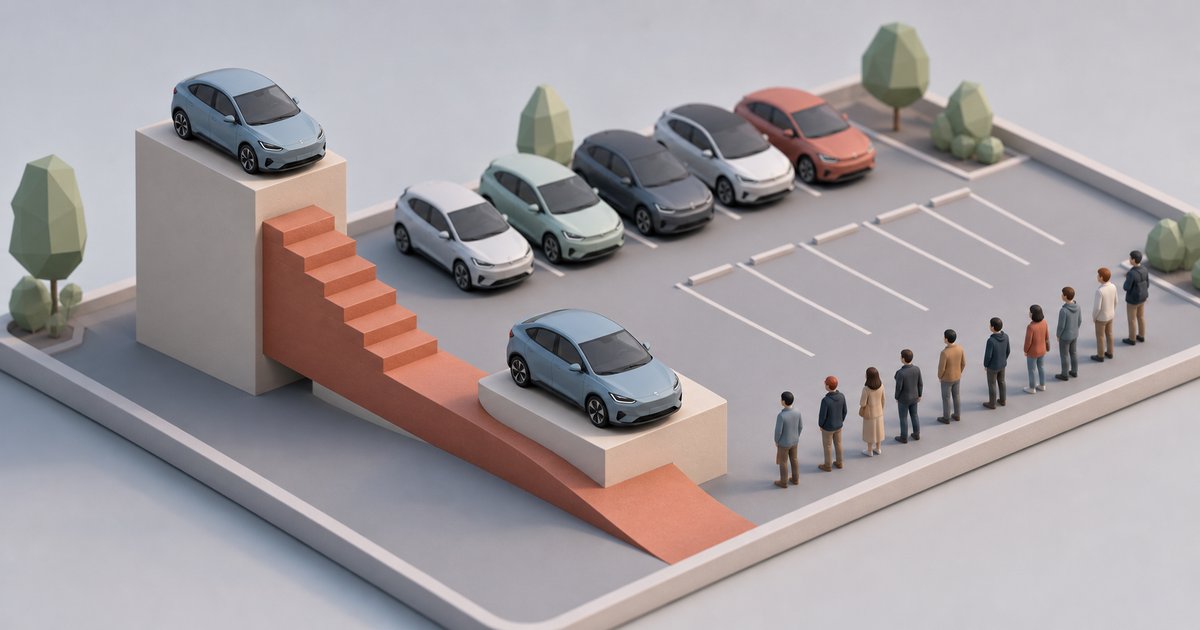
A five-year-old Tesla Model 3 sells in France for about €23,180. New, the same car averaged €52,136. That is a loss of 56% — and among the ten most widely sold electric cars on the French used market, it is the second-smallest loss of the group.
The figures come from an analysis by Leboncoin, France's dominant classifieds platform, comparing 2020 new prices against current used prices for ten high-volume electric models. The average across all ten is a 59% fall over five years.
The ten, ranked by what they kept
| Model | Five-year value loss |
|---|---|
| Dacia Spring | 53% |
| Tesla Model 3 | 56% |
| Fiat 500e | 56% |
| Volkswagen ID.3 | 57% |
| Mini Cooper Electric | 57% |
| Kia e-Niro | 58% |
| Peugeot e-208 | 60% |
| Renault Twingo E-Tech | 62% |
| Peugeot e-2008 | 62% |
| Renault Zoé | 65% |
| Average | 59% |
The Zoé is the hardest hit and also the most common: €32,445 new in 2020, about €11,477 now. It was the car that put France on electric power, and it has paid for that with the steepest curve in the set.
Nothing in the list escapes. The spread between best and worst is twelve percentage points, which is narrow enough to say the pattern is not really about the cars. A 2020-model-year electric car of any badge is competing against 2026 cars with more range, faster charging and, frequently, a lower list price than it had when new.
Why the Model 3 sits where it does
Two reasons, pulling in opposite directions. Tesla cut new prices aggressively from 2022 onwards, which drags used values down with them — a used car cannot be worth more than the discount on a new one. Against that, the Model 3 holds a real advantage in the things that decide a used electric purchase: measured battery degradation, Supercharger access, and software that still receives updates six years on.
The net result is 56%, better than the 59% average and better than every mainstream European hatchback in the table. For a Tesla owner in France reading this as a valuation rather than a statistic, that is the number that matters: worse than a combustion car, better than the alternatives you might have bought instead.
The demand side is moving the other way
Leboncoin's Q2 2026 barometer describes a used market down 5% overall, while used electric cars went the opposite direction: demand up 80% at its peak, sales up 85% over the final two months of the quarter, and available stock down 30%.
The platform is candid about the cause. The surge tracked a fuel-price spike driven by Middle East instability, and once petrol prices settled, searches for electric cars drifted back toward pre-conflict levels. Leboncoin calls the acceleration largely circumstantial rather than structural. Petrol also overtook diesel as the most-searched fuel for the first time in twenty years, at 44% of demand.
Electric cars are still only about 4–5% of French used-car transactions, trailing the new market by four to five years — the ordinary lag of a fleet ageing into resale.
What it means for owners and buyers elsewhere in Europe
Falling stock and rising interest is the combination that firms prices, so the 56% figure describes where the Model 3 has been, not necessarily where it is going. Elsewhere in Europe the same tension is visible from the other end: used EVs now sell in 25 days in Britain, and the Model Y is Sweden's best-selling used EV. Cars that sell in three weeks are not cars nobody wants.
If you are buying, a 2020–2021 Model 3 at a bit over €23,000 is the cheapest route into Tesla ownership France has offered. If you are selling, you are doing so into the strongest used-electric demand the platform has recorded — for reasons that may not last.