
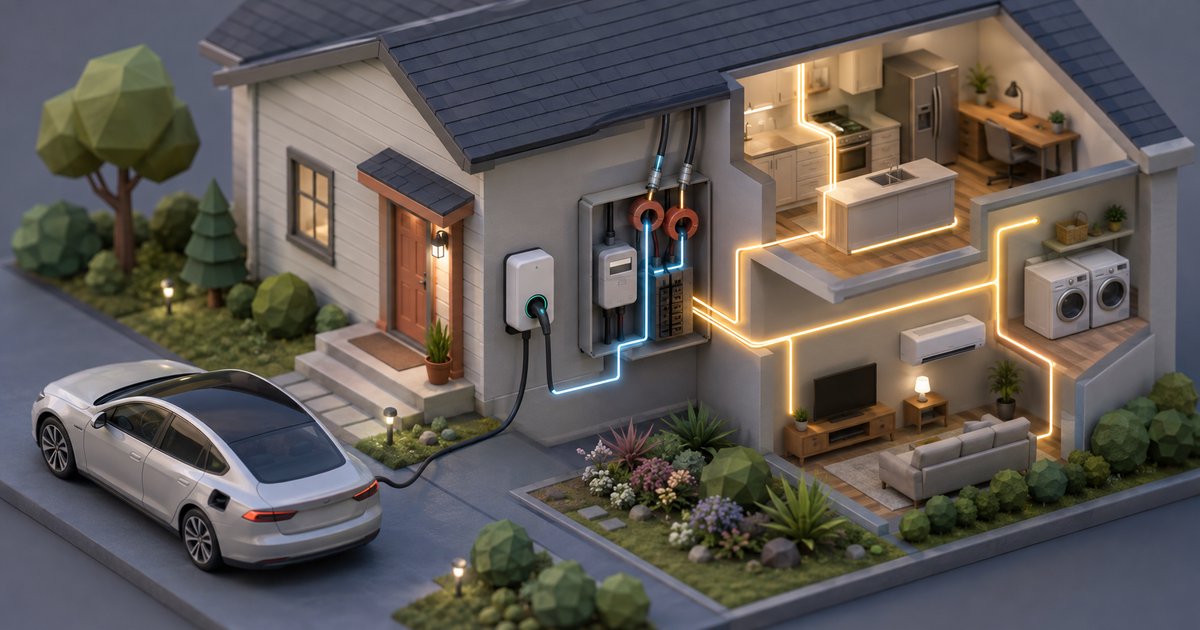
Schneider Electric has launched a home charger that bundles the one component Tesla charges extra for. The Schneider Charge arrives at $695 with the current-transformer clamps for dynamic load balancing in the box — the function a Tesla Wall Connector can only perform once you have also bought a Remote Meter.
The comparison
| Setup | Hardware bill | Load balancing |
|---|---|---|
| Schneider Charge | $695 | Included — two CT clamps supplied |
| Tesla Wall Connector + Remote Meter | about $745, per InsideEVs | Requires the Remote Meter, $210 separately |
InsideEVs, which reported the launch, puts the complete Tesla setup at roughly $745 once the meter is added — about $50 above the Schneider for the same capability. On the charger alone Tesla is still the cheaper box; it stops being cheaper the moment load balancing is part of the requirement.
The rest of the Schneider's specification is conventional: up to 11.5 kW at 48 A, indoor or outdoor mounting, an app for scheduling, and a choice of NACS or J1772 connector at order time.
Why load balancing is the feature worth arguing about
Dynamic load management is the difference between a charger sized to your spare capacity and one sized to your whole supply. The clamps read the total load on the panel in real time and the charger backs off when the house draws more elsewhere, then ramps back up when it does not.
The practical consequence is that a constrained supply need not mean a slow charger or an expensive upgrade. Tesla describes the same behaviour for its own Dynamic Power Management: charge as fast as possible while keeping total draw inside safe limits.
It is not a universal purchase
Worth saying plainly, because the comparison invites over-buying: plenty of homes have enough headroom that no meter is needed at all, and Tesla's own guidance is to have an electrician establish that before spending anything. If your supply comfortably covers a charger at full output, the $210 line item and Schneider's bundled clamps are both solving a problem you do not have. The comparison matters for the homes where the margin is thin — which, in practice, is a lot of them.
The European footnote
This is a North American launch. Dollar pricing and a NACS-or-J1772 connector choice place it there, and Tesla's Remote Meter is likewise a US and Canadian product, at $210 and CA$285.
The structure of the Tesla side is the same in Europe, though. Tesla's own support documentation states that Dynamic Power Management requires the purchase and installation of a Tesla-approved power meter sold separately from the Wall Connector, obtained through a Tesla Certified Installer. So a European owner faces the same split — charger first, metering hardware second — without the option of this particular rival on the shelf beside it.
For anyone specifying a wallbox in Europe now, the more consequential question is the one TeslAnt raised around ISO 15118-20 and AFIR's 2027 deadline: what the hardware will still be allowed, and able, to do in a few years.
Bottom line
A $50 gap is not a reason to switch chargers. What the Schneider launch usefully exposes is that the Wall Connector's advertised price is not the price of a load-managed installation, and that the gap between the two is large enough for a competitor to aim at.