
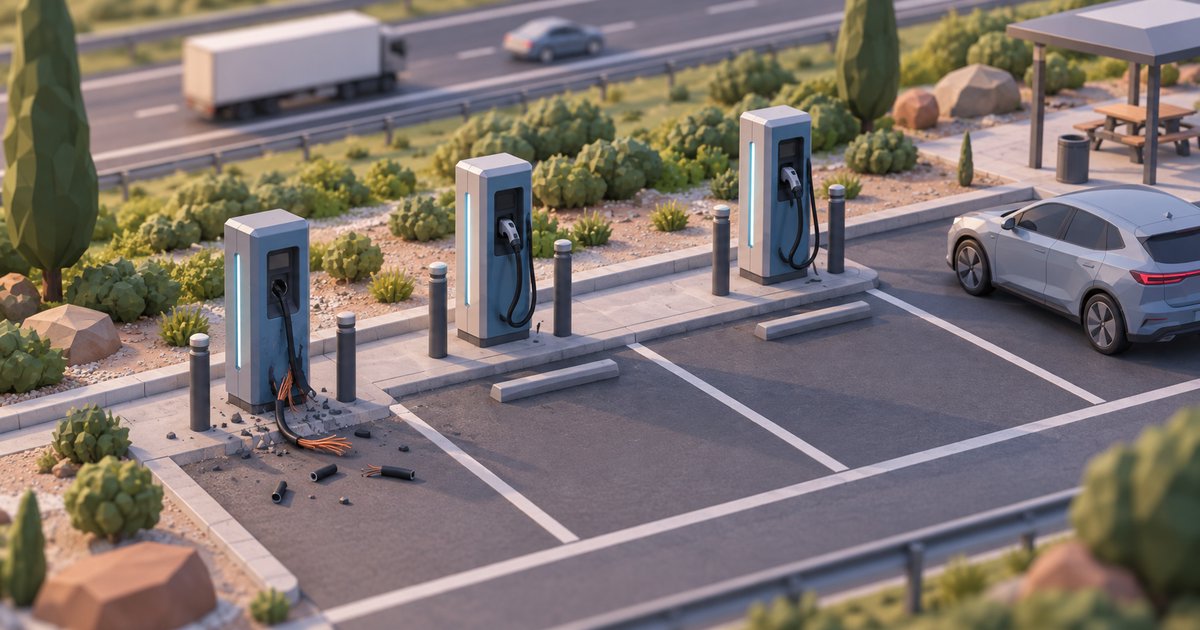
Charge France, the trade body for the country's charge point operators, says 21 of its members filed 427 criminal complaints over stolen charging cables in the first seven months of 2026, for cumulative damage of close to €9 million. That is the first national number France has had for a crime that until now was described anecdotally.
The method does not vary. Cables are cut at the base, stripped, and the copper sold as scrap. Copper is trading near €9,000 a tonne, which is what has turned an opportunistic nuisance into a routine one — but the economics remain absurd at the level of the individual theft. A cut cable yields the thief a few dozen euros. Repairing the charge point costs the operator thousands.
What the damage looks like locally
| Where | Incident | Damage |
|---|---|---|
| Bouches-du-Rhône | 52 cables stolen | €120,000 |
| Seine-et-Marne | 8 charge points targeted | €260,000 |
| Oise | 8 thefts | not disclosed |
Engie Vianeo is among the operators named as hit. In the Var, where eborn and Territoire d'Énergie Var are rolling out close to 250 charge points across Toulon, Fréjus, Hyères, La Seyne-sur-Mer and the Saint-Tropez gulf, the thefts are arriving alongside the deployment.
Arrests are not the bottleneck
Cable theft in France carries two years' imprisonment and a €30,000 fine. Arrests have been mounting through 2026. Convictions have not kept pace: the case usually cited as the landmark came in June 2026 at the tribunal d'Évry-Courcouronnes, where two defendants received twelve months' immediate custody under electronic tag and twelve months suspended respectively. Most arrests are still awaiting judgment.
Who actually pays
Not, in the main, the insurer. Operators carry most of the cost themselves, because policy deductibles are high and vandalism is frequently excluded from the contracts between operators and the site owners hosting the hardware. The second cost is larger and less visible: a charge point out of service earns nothing, and the revenue lost while it waits for a part is not recovered from anyone. What remains works its way into per-kWh pricing.
Why this matters to a Tesla driver in Europe
None of the reporting names Tesla, and no Supercharger losses have been reported in this tally. Superchargers are tethered units, usually on monitored commercial sites, which is a harder target than a roadside CCS post.
That is not much comfort on a long drive. Tesla's own network does not cover every French route, and Tesla drivers use Ionity, Fastned, TotalEnergies and Engie Vianeo sites like everyone else — while Superchargers now stand open to other brands, so the traffic runs both ways. A vandalised site is not a degraded site; it is a hole in the map until the cable is replaced, and the operator has no obligation to tell a driver in advance.
This is the same crime we reported spreading across the Netherlands in August, where Dutch police do not record it as its own category and no national figure exists. France now has the figure the Netherlands lacks, and it is larger than the Dutch anecdotes suggested. In Belgium, thieves took eight fast chargers out of service in Ieper in a single night.
The practical advice has not changed: check a station's live status before committing to it, and plan a fallback within range.