
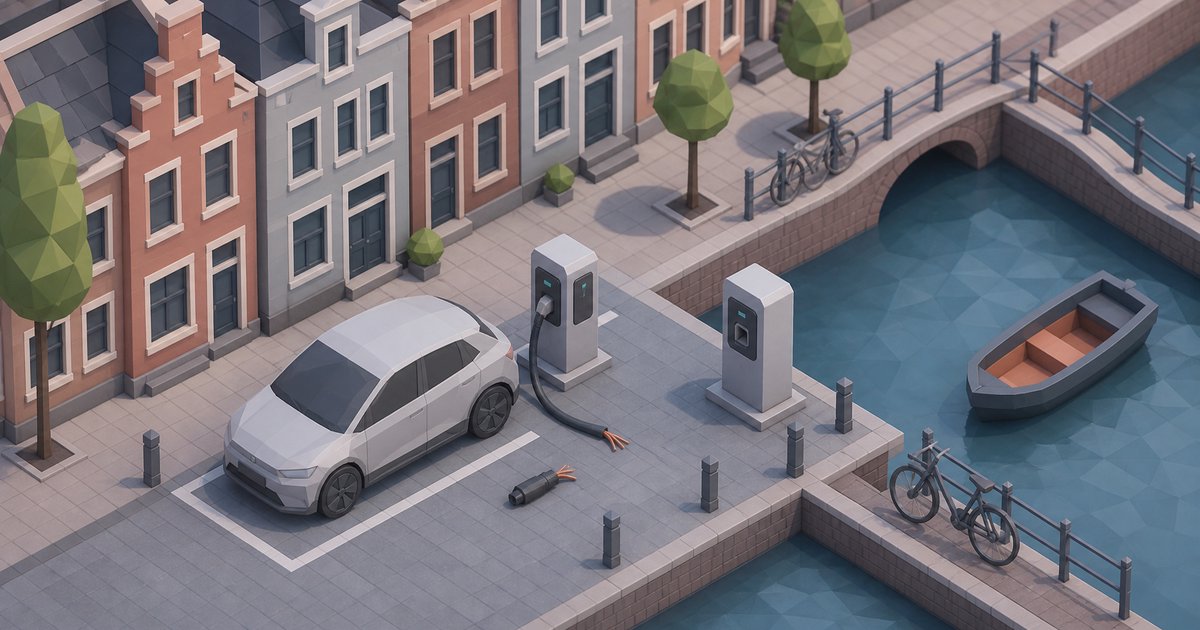
Drivers who leave an electric car charging on a Dutch street are increasingly coming back to find the cable cut through. Charge point operators, insurers and the Vereniging Elektrische Rijders all report the same trend, and none of them can put a reliable number on it.
What is actually known
The hard figures do not exist, and the reason is administrative. Dutch national police do not record charging cable theft as its own category — the incidents are logged under the broader headings of vandalism and destruction of property, where they become invisible.
What is available is fragmentary and local. Rotterdam police recently took dozens of reports covering car break-ins together with cut charging cables. Amersfoort alone recorded around forty incidents over the course of last year. Roughly ten cables have been taken from various Dutch locations since the start of this year. Leasing companies, asked directly, describe a handful of claims each — enough to notice, not yet enough to quantify.
The economics are absurd
This is a crime with a terrible ratio between damage and reward. A replacement cable costs the owner or operator around €300 to €400. The copper inside, once stripped and sold as scrap, is worth a few tens of euros.
That mismatch is the whole problem. There is no realistic way to make the cable not worth stealing, because it is already barely worth stealing — the theft is driven by opportunity and low effort rather than by a serious payday. The cost lands almost entirely on the victim.
There is also a genuine safety dimension that has little to do with money. Cutting into a cable that may be carrying live current is dangerous for whoever is holding the tool, and a partially damaged cable left in place is dangerous for the next driver who plugs into it.
Belgium has seen the organised version
The Dutch pattern is opportunistic. Across the border, the same crime has appeared in a more deliberate form. In Ieper, thieves worked through a single night and put eight fast-charging stations out of service: two Allego units at a Lidl and six DATS 24 units at a Colruyt.
Fast chargers are the richer target because their cables are considerably thicker and carry substantially more copper than a standard AC unit. DATS 24 spokesperson Vedran Horvat said the operator regretted that customers could not use the stations and was working on repairs, expecting them back within days. The replacement cost to the operators ran into thousands of euros; the cables were worth perhaps €50 to €100 each to the people who took them.
That is the shape of the risk for the charging network rather than for individual drivers. One night's work can remove an entire fast-charging site from the map, and a site that is offline for even a few days is a real gap on a route.
What drivers can practically do
The honest answer is: not much, and nothing that costs nothing.
- Use the operator's tethered cable where one exists. A cut cable then becomes the operator's problem rather than a €400 bill of yours.
- Prefer overseen locations. Supermarket and retail-park chargers with cameras and passing traffic are a harder target than an unlit residential kerbside bay overnight.
- Check the cable lock setting in your car. Most EVs can be configured to keep the cable latched at the vehicle end for the whole session rather than unlocking when charging completes — that does not stop a cutter, but it removes the easy theft of an unsecured cable.
- Check your insurance before you need to. Whether a cut charging cable is covered, and under which section of the policy, varies. It is worth knowing the answer in advance rather than at the roadside.
- Report it anyway. Given that police do not track the category, individual reports are currently the only route by which the scale of this becomes visible enough to act on.