
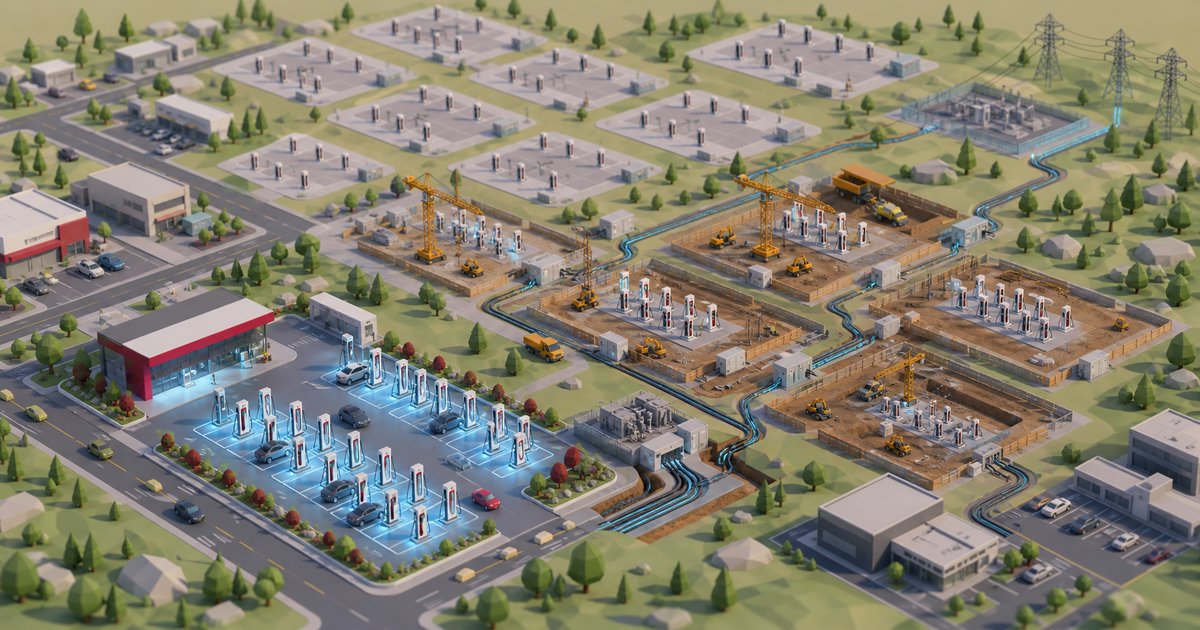
Tesla's Supercharger network is usually discussed as something Tesla builds. Increasingly it is something other companies build, and a single operator's pipeline shows how far that has gone.
EVIO, a certified Supercharger operator under Tesla's Supercharger for Business programme, currently has 22 Supercharger site locations in its deployment pipeline according to its own charging-location tracker, totalling 176 stalls.
What is in the pipeline
The 22 sites sit at three different stages, and the hardware split between them tracks Tesla's own generational shift:
| Stage | Sites | Hardware |
|---|---|---|
| Operational | 1 | Up to 325 kW |
| Under construction | 5 | One at 325 kW, four all-V4 up to 500 kW |
| Upcoming | 16 | All-V4, up to 500 kW |
Twenty of the 22 sites are specified as V4 hardware capable of delivering up to 500 kW. That is the same 500 kW figure Tesla has been rolling out with its own partners — including the EVgo deal for 500 kW Tesla Superchargers announced this week. No completion date has been published for EVIO's pipeline; the tracker describes construction phases rather than milestones.
The franchise economics
The commercially interesting detail is not the stall count but the terms. These are white-label installations: third-party owned and third-party operated, carrying Tesla's hardware and network integration without being Tesla-owned locations.
Site owners set their own charging prices for visiting drivers. Tesla collects $0.10 per kWh charged.
That single number explains a great deal about how the Supercharger network is scaling now. Ten cents per kilowatt-hour is a licensing fee on someone else's capital expenditure. Tesla supplies the hardware, the payment rails, the routing integration in every Tesla built, and the brand that makes drivers trust an unfamiliar site — and takes a per-unit cut without paying for the land, the grid connection, or the construction.
For the operator the trade is equally clear. Building a competitive fast-charging site from scratch means solving reliability, payment, and driver-trust problems that Tesla has already solved. Paying $0.10 per kWh to skip all three is cheap if it fills the stalls.
Why this matters beyond one operator
The Supercharger network's advantage was always that Tesla owned it end to end: one operator, one standard, one failure mode. Franchising dilutes that. A site owner setting their own prices means the network is no longer uniformly priced, and a third party handling installation and maintenance means reliability now depends on partners of varying quality.
The upside is speed. Tesla's own capital can only build so many sites per year; other people's capital multiplies that, and a pipeline of 176 stalls from one operator is real volume.
What European drivers should watch
The pricing consequence is the one to watch in particular. A network where the operator sets the tariff site by site behaves like every other European charging network — which is to say, unpredictably. The thing that made Superchargers pleasant was never only the reliability; it was knowing the price before arriving.