
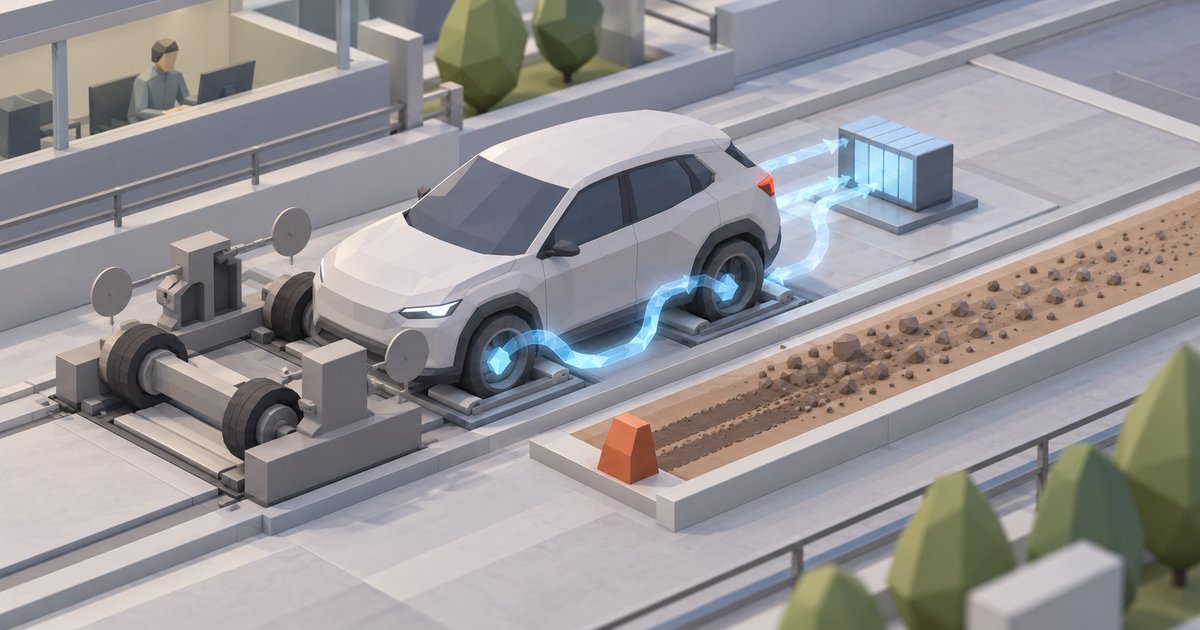
From 29 November 2026, no new car type can be approved for sale in the European Union without meeting a limit on how much dust its brakes shed. Euro 7 — Regulation (EU) 2024/1257 — is the first EU emissions law to regulate particles that never pass through an exhaust pipe, and the lowest figure in it applies to battery-electric cars.
TeslAnt has already covered the Environmental Vehicle Passport and the battery durability floors that land on the same date. The brake and tyre provisions are the other half of Euro 7, and for an electric car they pull in opposite directions.
What the limits are
| Vehicle | Brake PM10 limit |
|---|---|
| Battery-electric cars (M1) | 3 mg/km |
| Combustion, hybrid and fuel-cell cars (M1) | 7 mg/km |
| Large combustion vans (Class III) | 11 mg/km |
The limits cover PM10 particles measured across all four corners of the car. They apply to newly approved vehicle types from 29 November 2026, and to every new car and van sold from 29 November 2027 — the same two-step the passport follows.
The strictest number is the easiest one to meet
At first reading, 3 mg/km against 7 looks like the EU holding electric cars to a harder standard. It is closer to the opposite.
A battery-electric car does most of its slowing on the motor rather than on the pads. Regenerative braking turns momentum back into charge, and the friction brakes engage mainly in hard stops, at very low speed, and when the pack is too cold or too full to accept the energy. A Tesla driven on one pedal can go weeks without the discs doing meaningful work. The legislator set the electric limit at roughly the level regeneration already delivers, which is why it is lower rather than in spite of it.
There is a real counterweight. Electric cars are heavy, so when the friction brakes do take the load, they take more of it. Lightly used discs also corrode, which is why Tesla and others periodically run cleaning routines. Neither effect looks likely to push a regen-braked car past 3 mg/km, but the margin is not infinite.
Tyres are where an electric car actually loses
Tyre wear is the non-exhaust emission that scales with exactly what an EV has more of: mass and torque. A two-tonne crossover that reaches peak torque from a standstill abrades more rubber than a lighter combustion equivalent, and tyre particles are the larger share of non-exhaust pollution to begin with.
Euro 7 brings tyres into the type-approval framework and requires abrasion to be measured. It does not set a numerical abrasion limit. The number that would actually constrain a heavy electric car is the one the regulation leaves for later work.
So the part of Euro 7 that bites electric cars is deferred, and the part that arrives in November is the part they already pass.
What it means for a Tesla owner
Nothing to do, and nothing to pay. Brake particulates are a type-approval obligation on the manufacturer, not a test an owner sits.
The effect is competitive. Once brake dust is a published, comparable figure, the regenerative-braking advantage becomes a line in a type-approval file rather than a talking point. The cost pressure falls on combustion makers, who have to reformulate pads and in some cases coat discs to reach 7 mg/km. Estimates of what Euro 7 adds to a car's price vary by an order of magnitude: the Commission's own figure is EUR 180 to 450, while industry studies have claimed around EUR 2,000.
Watch the tyre file. That is where the next number lands, and it is the one written for the weight an electric car carries.