
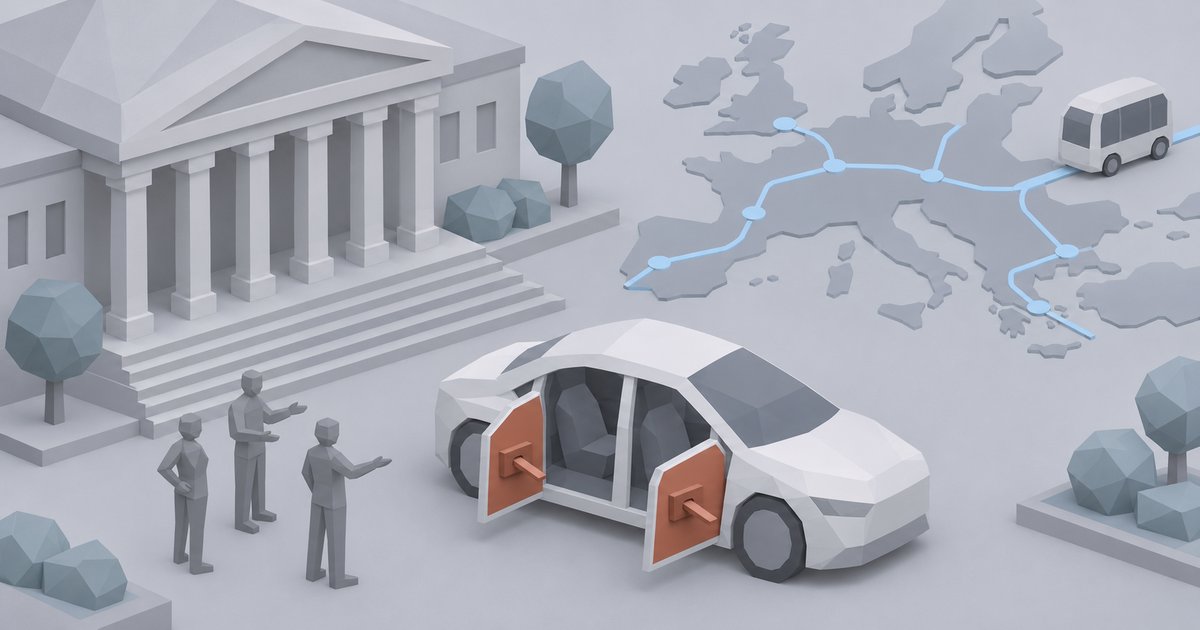
Car doors in the EU would have to open mechanically from both inside and outside in an emergency, under a position that three European Parliament committees adopted on Wednesday. On 4 November 2026 the Environment, Internal Market and Transport committees backed the "automotive omnibus", a package that simplifies EU vehicle rules, by 105 votes to 39, with 21 abstentions.
The door requirement was not in the Commission's December 2025 proposal. The committees added it, together with a child presence detection system for cars and vans up to 3.5 tonnes that keeps working after the vehicle is switched off or locked.
Why the door rule matters to Tesla
Tesla's doors open electrically. A US defect petition argued that the manual backup release is hidden, unlabelled and hard to find in a panic, and Tesla said in June that it is redesigning both its interior and exterior handles. China has gone further. Its draft rules would ban fully hidden door handles on new cars from 2027.
The Parliament's text points the EU in the same direction. The press release does not say when the requirement would apply or how the release would have to work.
Automated driving and charging
The committees also want mutual recognition of national authorisations for testing and deploying automated vehicles, with harmonised minimum requirements, so that permission granted in one member state would count in others. That category covers driverless robotaxis such as the Cybercab, which Tesla is touring through Europe from Zürich on 5 November.
Tesla Assisted Driving, the supervised system formerly called FSD, has been approved country by country, and Latvia became the tenth EU country to approve it in October. It is a driver-assistance system, not an automated vehicle, and the release does not say whether such approvals would be covered.
On charging, the Commission would have to adopt technical requirements by 31 December 2027 so that electric cars and plug-in hybrids work with charging infrastructure and the electricity grid.
Small, efficient and made in the EU
The committees would create a category of "small electric vehicles", passenger cars up to 4.2 metres long and made in the EU. They would also define "highly efficient EVs" as EU-made cars that meet strict energy-consumption thresholds. Both would qualify for targeted support and for super-credits, which would sit in the separate update of the CO2 standards. "Made in the EU" is still to be defined under the Industrial Accelerator Act.
Neither the Model 3 nor the Model Y is small enough for the first category. Of the two, only the Model Y is built in the EU, at Grünheide; the Model 3 sold in Europe comes from Shanghai. The release does not give the efficiency thresholds.
EU-made plug-in hybrids would keep the current method for calculating their CO2 emissions until the end of 2029. From 2030 the method would be updated every year based on real-world driving data.
What happens next
This is the committees' position, not law. The full Parliament is expected to vote on its negotiating mandate at the December 2026 plenary, and must then agree a final text with EU governments. The Commission estimates that the package would save industry, citizens and public authorities €706 million a year.