
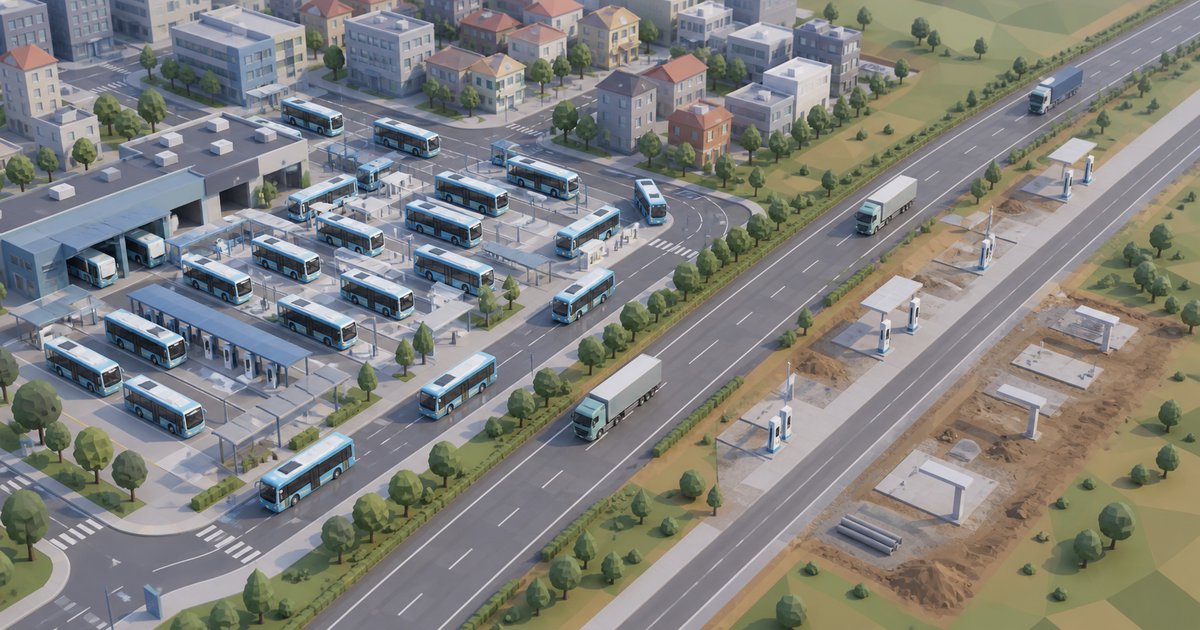
The European Automobile Manufacturers' Association has published its commercial-vehicle registrations for the first half of 2026, and the two halves of the heavy-vehicle market are moving at completely different speeds.
Electric buses took 27.7% of EU bus registrations. Electrically-chargeable trucks took 4.8%. Both are up on a year ago — the truck figure was 3.6% in the first half of 2025, and grew 47.7% in volume, faster in percentage terms than buses. But one segment is approaching a quarter of its market and the other is not yet at one twentieth.
| EU, first half of 2026 | New registrations | Change year on year | Electric share |
|---|---|---|---|
| Trucks | 171,933 | +9.8% | 4.8% (from 3.6%) |
| Buses | 22,590 | +22.7% | 27.7% |
A note on the terms, because they are not interchangeable. ACEA's truck figure counts "electrically-chargeable" vehicles, a category wider than battery-electric alone. The bus figure is for electric buses. Comparing the two shares is still the right comparison to make, but they are not measured identically.
Buses electrify first because the hard problem is already solved
A city bus runs a fixed route and comes back to the same depot every night. That single fact removes most of what makes heavy-vehicle electrification difficult: the charging infrastructure is one installation the operator owns, the duty cycle is known to the minute, and the vehicle never needs to charge anywhere it has not been before.
Procurement helps too. Buses are bought by municipalities and transport authorities in multi-year tenders, often with an explicit emissions requirement written into the specification. Electric buses do not have to win on total cost of ownership alone; they win tenders that ask for zero tailpipe emissions.
Trucks have the opposite version of every one of those problems
Long-haul freight has no depot at the far end of the journey. The energy per stop is far larger, the vehicle is away for days, and the public charging network that would make it work — megawatt-class charging on freight corridors — is still being built rather than used.
ACEA's own framing of its numbers is that enabling conditions need to improve if zero-emission heavy transport is to move in line with Europe's climate targets. That is an industry body arguing for infrastructure and support, and it should be read as such, but the underlying constraint is real: a truck operator cannot buy a vehicle it has nowhere to charge.
Vans are the segment where it already works in Europe
EU van registrations rose 1.9% overall in the half — that is a total-market figure, not an electric one. But last-mile delivery is where the economics land most easily, for the same reason buses do: predictable daily distances, and a depot to return to. Royal Mail reaching its 9,000th electric van is what that looks like at scale, and fleets of that shape are electrifying without needing a public network at all.
What to watch next
The heavy-duty CO2 targets biting later this decade are the forcing function, and they apply to manufacturers rather than operators — which means the pressure to sell electric trucks will arrive before the infrastructure that makes them easy to run. Whether the gap between 4.8% and the targets closes depends less on the trucks than on the corridors, and on whether Europe can supply the cells to build them at a price that works: cell sourcing is still heavily concentrated outside Europe.