
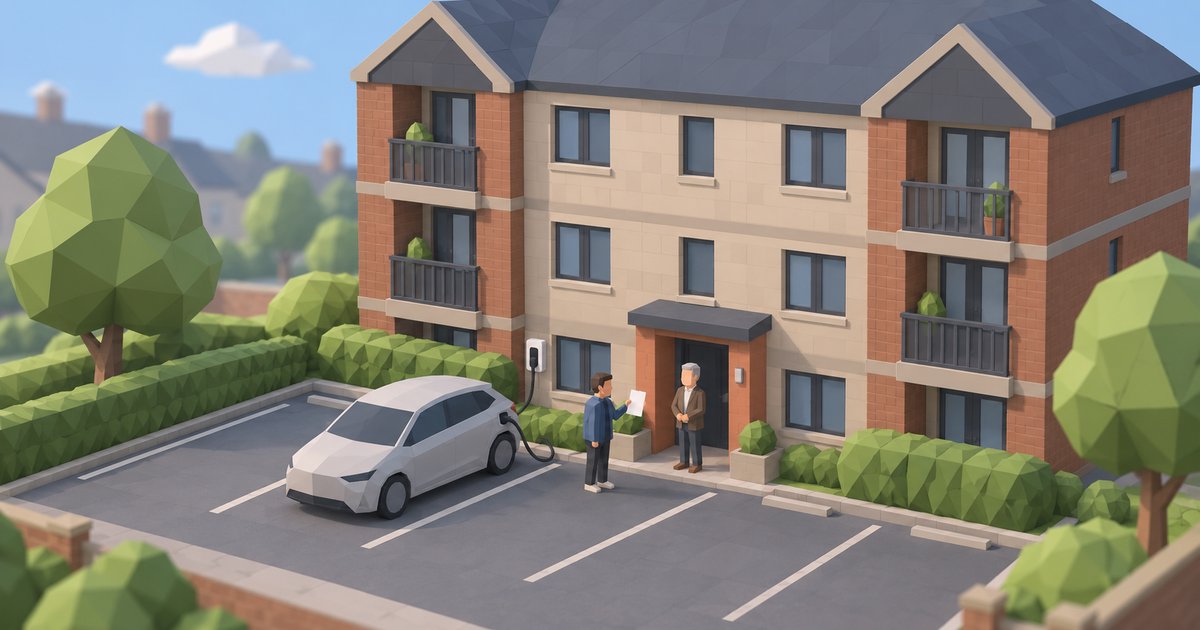
Tenants and leaseholders in England need permission from a landlord or freeholder before they can put a charger on their parking space, and the government says they often struggle to get it, sometimes being refused without a clear reason. On 21 October 2026 the Department for Transport and the Ministry of Housing, Communities and Local Government opened a consultation on an "ability to charge" to change that. A second consultation, published the same day, proposes changes to Part S, the building regulation that puts charge points into new homes. Both close at 23:59 on 16 December 2026.
Guidance or a legal duty
The government offers two routes. The first is non-statutory guidance for tenants, leaseholders, landlords and freeholders. Guidance alone would oblige nobody to agree. The second is legislation that requires landlords and freeholders to decide on a request in good time and not to refuse it unreasonably. The paper's example process is an acknowledgement, then a written decision within a period "such as 28 calendar days", with reasons for any refusal.
The resident would arrange and pay for the charge point, including installation and any fee for permission to alter the property. Who pays for maintenance, electricity and eventual removal is left open. It would cover owned and allocated parking spaces, and private and social tenants, leaseholders and shared owners; communal parking is still under discussion. The government notes that policies of this type, with differing scope, exist in France and Norway, and that a legal duty would need new primary legislation, "subject to parliamentary time".
A refusal could still be reasonable in these cases:
- the request breaches the lease or another statutory obligation
- the local electricity network would need an upgrade, including where the property has a looped supply
- the resident has no off-street parking
- a block of flats is adopting a building-wide charging scheme
- the installation would not meet BS 7671, the national wiring standard
- the building does not have enough parking
Who it could reach
| England | Figure |
|---|---|
| Leasehold dwellings (2023–24) | 4.8 million |
| Private rented households | 4.6 million (19%) |
| Social rented households | 4.0 million (16%) |
| Sockets funded by the £500 flat and renter grant since 2022 | 26,504 |
| Sockets funded by the residential landlord grant | 5,564 |
The building regulations
Part S has required charge points in new homes and major renovations since 2021. In covered car parks, enclosed or open-sided, it only requires cable routes, an exemption made at the time to allow more research into fire safety. The second consultation proposes requiring charge points there too, citing research that EVs are less likely to catch fire than combustion cars. It also reviews the £3,600 average connection-cost cap, which has not moved since 2021, and asks whether it should rise with inflation each year. Other ideas raised in the review include wiring new homes for vehicle-to-everything (V2X) charging and more flexibility for tethered chargers.
What it means for a Tesla owner
The last point matters to Tesla buyers. Approved Document S says a new-build charge point should have a universal socket. A tethered unit is acceptable only "in exceptional circumstances", such as a self-build where the car is already known. Tesla's Wall Connector has a fixed cable, so a new-build home in England normally comes with a socketed charger instead. The consultation asks whether that should change.
For renters the change is further off. Nothing is law, and a legal right would need a new bill, so a landlord can still say no today. The same announcement brought England's cross-pavement charging change into force on 21 October, which the government says saves up to £300 on installation for homes without a driveway.