
Around four in ten UK households have nowhere to park off the street, and for all of them the cheapest electricity a Tesla ever drinks has been a planning question rather than an electrical one. That is now set to change — though not yet.
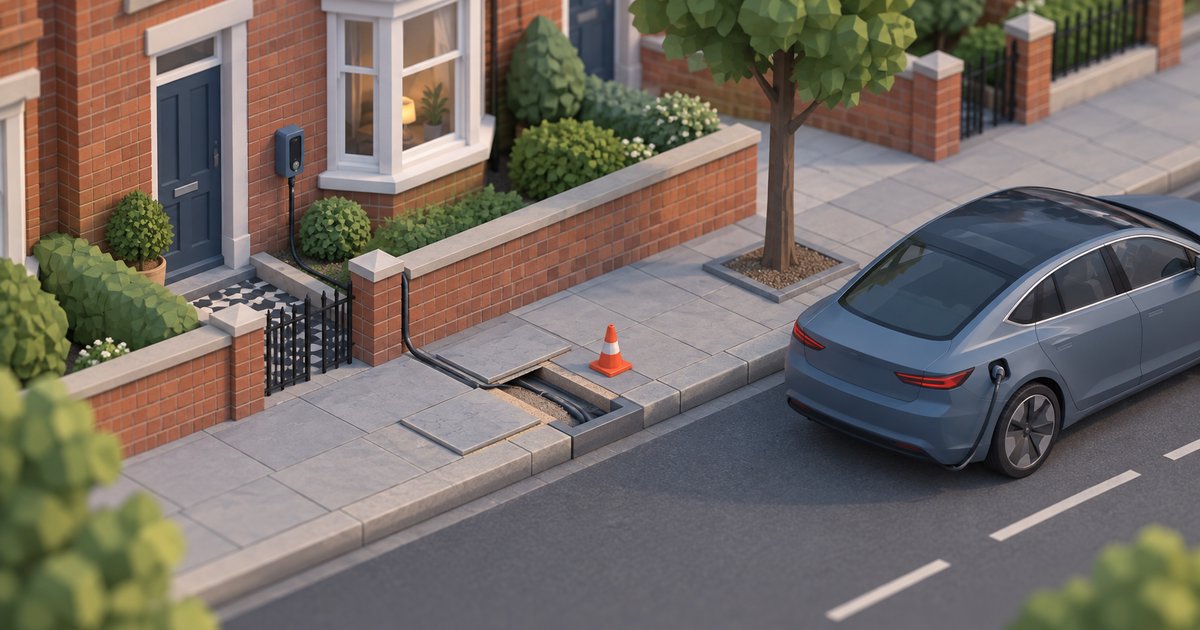
On 11 September 2026 the Department for Transport published its response to the cross-pavement charging consultation and confirmed it will create a new permitted development right in England covering cross-pavement solutions and the domestic charge points that go with them. A cross-pavement solution is deliberately mundane hardware: a channel or gully set into the footway so a cable runs under the walking surface instead of over it, gaffer-taped down and waiting to catch an ankle.
What the change actually does
| Today | After the legislation | |
|---|---|---|
| Planning application | Required | Not needed for eligible installations |
| Highway authority consent | Required | Still required |
| Equipment housing volume | 29 m³ | 45 m³ |
Until now the permitted development rights in Class E, Part 2, Schedule 2 of the Town and Country Planning (General Permitted Development) (England) Order 2015 only reached installations on land lawfully used for off-street parking — which is precisely the land a kerbside household does not have. The volume allowance for supporting equipment housings rises from 29 to 45 cubic metres, counted cumulatively, and multiple units become permissible in non-domestic car parks. The existing limits are untouched: three metres in height, five metres from the highway, ten metres from a dwelling, with listed-building curtilages and scheduled monuments still excluded.
The part that has not happened
The right does not exist yet. The Order remains unamended, and the government intends to lay the secondary legislation before Parliament in autumn 2026, subject to parliamentary time and commencement arrangements. Nor does the announcement remove the council from the process. Street-works approvals still apply, licensing under Section 50 of the New Roads and Street Works Act 1991 is still needed, and cables crossing a highway remain subject to Section 178 of the Highways Act 1980 — the department's stated priority is "maintaining safe and accessible pavements", and a local authority that does not want gullies in its footways retains the tools to say so.
That is the caveat the trade bodies went straight to. Vicky Edmonds, chief executive of EVA England, called the change "great news for drivers without a driveway", saying people who park on the street "should not face unnecessary extra hurdles just to access the cheaper and more convenient charging available to people with driveways". James Court of Octopus Electric Vehicles was blunter about what survives: a "postcode lottery" decided council by council.
Why a Tesla owner should care
The gap being addressed is a price gap. Public charging in Britain can cost up to ten times what the same kilowatt-hours cost on a domestic tariff, so a Model 3 parked at a kerb and a Model 3 parked on a driveway are not running the same car economically. Kerbside charging is also the half of the problem that public infrastructure has conspicuously failed to solve — as our look at council on-street provision found, half of Britain's councils offer no on-street charging at all.
For a UK Tesla owner without a driveway, the practical reading is this: the planning barrier is going, the highway paperwork is staying, and nothing at all changes until the statutory instrument is actually laid.