
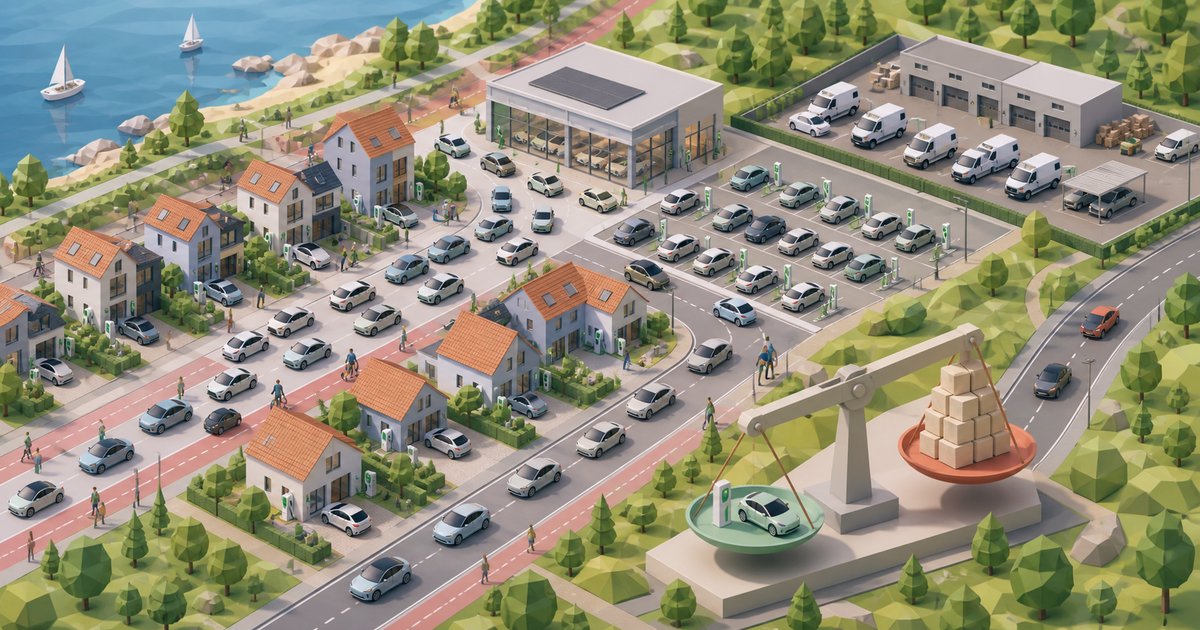
Denmark is no longer a distant second to Norway. In July 2026, battery-electric cars accounted for 11,672 of the country's 14,562 new passenger car registrations — an 80.2% share. Among private buyers specifically, 97% chose an electric car, the highest private share Denmark has ever recorded.
That private figure is the one worth pausing on. It means that when a Danish household walked into a showroom last month and bought a car for itself, the chance it left with anything other than a battery-electric vehicle was roughly one in thirty.
Where Denmark now sits in Europe
| Market | July 2026 BEV share | Detail |
|---|---|---|
| Norway | 97.6% | 9,379 BEVs registered |
| Denmark | 80.2% | 97% among private buyers |
| Germany | 29.3% | 78,609 BEVs |
| UK | 27.5% | Record month, still short of mandate |
Norway remains in a category of its own, and took a record 97.6% share in July while Tesla registered just 24 cars. But the gap between Norway and Denmark is now narrower than the gap between Denmark and every other market in Europe.
Tax, not mandate
Denmark did not get here through a sales mandate or a purchase grant. It got here by making the registration tax on combustion cars punitive and the equivalent on electric cars light. Mads Rørvig, managing director of Mobility Denmark, credited the reduced registration tax with making electric cars the economically rational choice and moving the country closer to its climate targets.
This is the mechanism that separates the Danish and Norwegian results from the German one. A purchase premium lowers the price of the car you want to encourage. A registration tax differential raises the price of the car you want to discourage — and it keeps working without an annual budget line, because it collects revenue rather than spending it.
The fleet gap
The 80.2% overall share against 97% for private buyers implies that commercial and fleet registrations are still substantially combustion. Fleet buyers optimise for different things: residual value guarantees, nationwide service coverage, and in Denmark's case a company-car tax treatment that has historically lagged the private incentive. That gap is where the remaining 20 percentage points of the Danish market sit, and closing it is a harder policy problem than the private side was.
What it means for Tesla in Denmark
A market where nearly every private buyer is already shopping electric is a market where Tesla competes purely on product against every other EV, with no residual advantage from being the obvious electric choice. Denmark is small — 14,562 cars in a month is roughly a twentieth of Germany's volume — but it is a useful preview of what Tesla's competitive position looks like once the electric-versus-combustion question stops being the decision a buyer is making.
For European buyers watching their own market, the Danish result is the clearest evidence yet that the private-buyer transition can move very fast when the tax arithmetic is unambiguous.