
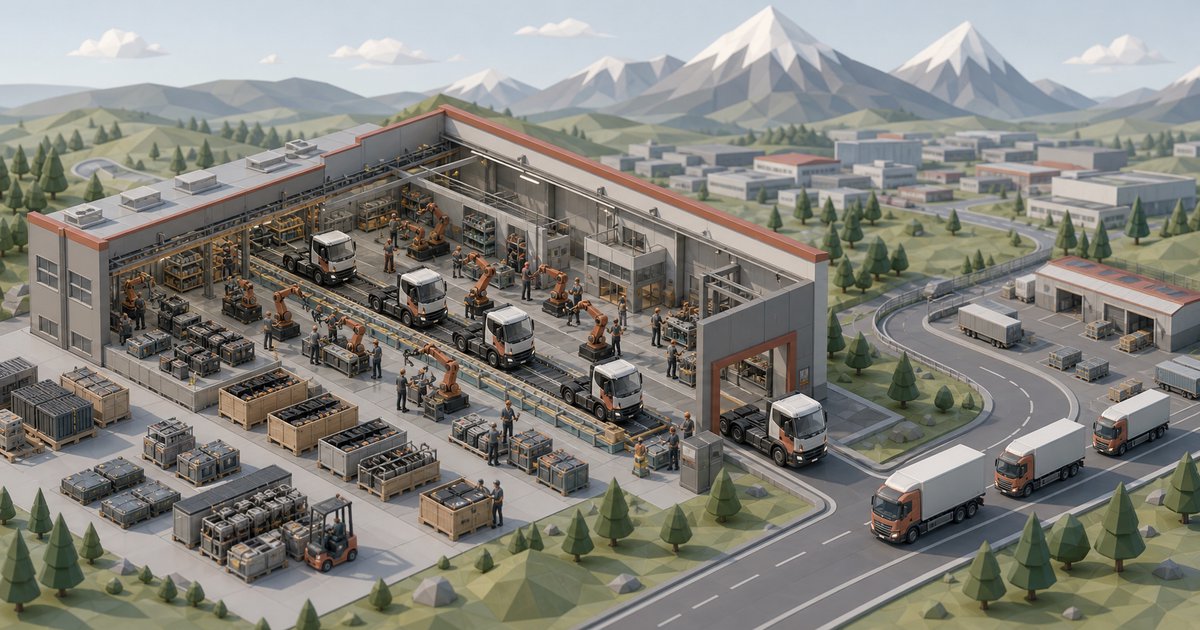
Chinese electric trucks have been arriving in Europe as imports for a while. As of this week they are also being built here. On 27 July the first series-produced battery-electric 4x2 tractor unit from the Chinese brand SuperPanther rolled off the line at Steyr Automotive's plant in Upper Austria, under a contract manufacturing agreement that puts a Chinese commercial-vehicle marque on an EU assembly line.
What is actually being built
The arrangement is semi-knocked-down assembly, not full manufacturing: major components arrive from China and are put together in Austria. That distinction matters for how much local industrial value the deal creates, but it also matters commercially — a vehicle assembled inside the EU sits in a very different tariff and procurement position from one shipped complete from Changzhou.
The truck is the eTopas 600, a two-axle electric tractor unit aimed at regional and long-haul freight. Four operators took the first vehicles: DHL, Gress, Temmel and Lontex. Those trucks are not demonstrators — they have gone into regular commercial service across Germany, the Netherlands, Austria, Poland and the Czech Republic, which is a notably wide first deployment for a brand most European fleet managers had not heard of two years ago.
SuperPanther itself was founded in Changzhou in 2022 and has set out a target of selling up to 16,000 electric trucks in Europe by 2030. Treat that figure as ambition rather than forecast; it is the company's own number and there is no delivery record yet to test it against.
Steyr is becoming the shared route in
SuperPanther is not the only Chinese manufacturer using the Austrian plant. Steyr Automotive also builds trucks for Sinotruk under a contract manufacturing deal signed earlier this year, assembling both diesel and fully electric variants. The pattern is what makes this more than a single-brand story: rather than each Chinese manufacturer building its own European factory, they are renting capacity at an established European truck plant that has spare industrial capability and knows how to certify vehicles for this market.
For Steyr the logic is straightforward. The plant is the former MAN Steyr site, and contract assembly for incoming brands keeps a skilled workforce and a truck line busy without the risk of owning the product.
The competitive picture for European truck makers
This lands in the same month that MAN began series production of megawatt-charging electric trucks in Munich — European incumbents are not standing still, and their advantage remains service networks, residual values and financing that a two-year-old brand cannot yet match.
What the Chinese entrants bring is price. Reporting on their European push has centred on undercutting incumbent electric trucks substantially, and for fleet operators running fixed regional routes — exactly the duty cycle DHL and the other launch customers are using these vehicles for — acquisition cost weighs heavily against brand familiarity. Assembling inside the EU sharpens that pitch further by taking import friction out of it.
Nothing here yet threatens the established order: a handful of trucks with four operators is a pilot, not a market shift. But the route into Europe is now open and demonstrably in use, and it runs through Austria.