
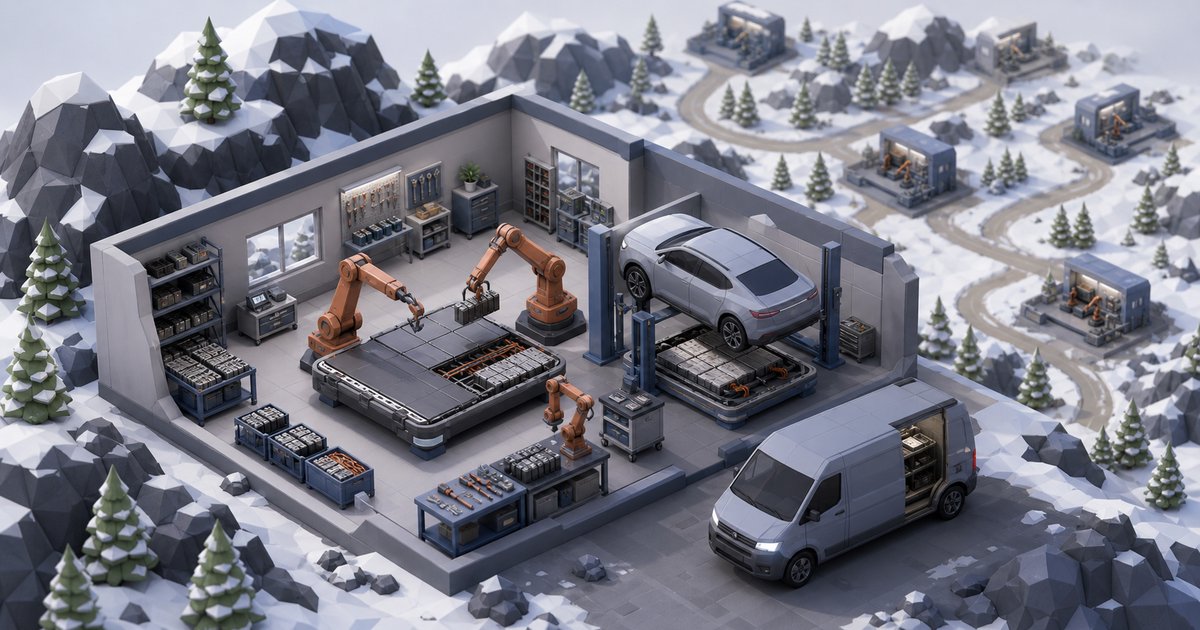
CATL used the annual brand day for its aftermarket arm, Ning Service, in Haikou on 10 August 2026 to make a claim that matters more to European owners than most Chinese battery announcements. The world's largest cell maker says it intends to repair damaged packs rather than replace them, at roughly a tenth of the cost — and it has opened its first directly operated centre in Norway.
The numbers CATL is putting its name to
The headline pledge is a tenfold cut in what a pack repair costs: from about 100,000 yuan to 10,000 yuan, roughly $14,800 to $1,480. Target turnaround is 72 hours or less, and CATL says its mobile service trucks bring complex faults down from 72 hours to 48.
| Before | CATL's target | |
|---|---|---|
| Pack repair cost | ||
| Complex-fault turnaround | 72 hours | 48 hours |
| Chinese NEV models covered | 47% | 76.8% |
What a Ning Service centre actually does
The technical claim underneath the price is cell-to-pack repair — opening a pack and replacing individual cells rather than swapping the whole assembly. Most manufacturers avoid that step, because a modern pack is bonded, sealed and structural, and reopening one reliably is a production problem rather than a workshop one.
CATL's answer is automation: repair-line robots that cut, paint and apply adhesive to packs without human intervention. Alongside the fixed sites are all-electric mobile repair vehicles with 800 km of range, able to run 30 diagnostic items and 50 kinds of repair, covering about 90% of scenarios short of deep repair.
The European footprint is thin, but it is real
Ten directly operated centres opened simultaneously, including new sites in Hong Kong, Norway and Türkiye — Norway and Istanbul being the two outside Greater China. Behind them sits a much larger franchised layer of 1,376 service centres across 84 countries, and agreements now cover 100 cities, which is the end-2026 target.
Starting the European end in Norway is not an accident. It is the continent's most EV-dense market and the one with the oldest large fleet of out-of-warranty electric cars, which is exactly where pack repair stops being a talking point and becomes a bill someone has to pay.
What it means if you drive a Tesla
Not much yet, and it is worth being straight about why. The 76.8% coverage figure is measured against NEV models sold in China, CATL has not said which non-CATL packs it will touch in Europe, and a structural Tesla pack is a hard case for third-party cell work.
The direction of travel is the point. Tesla's own answer to an out-of-warranty failure is an exchange unit — a remanufactured Model 3 and Model Y pack listed at $8,000 against about $14,500 new — which is a better price for the same idea of replacing the pack. Repair at cell level is a different idea, and if it works at scale it moves the write-off threshold for every used EV on the road. Insurance pricing and residual values both sit downstream of that number, and Europe has already started building the capacity: BCA opened a dedicated EV battery repair centre in Doncaster earlier this month.
The caveat
An announced network and a delivered one are different things, and 100 cities by the end of 2026 is four and a half months away. CATL has published no European price, no list of supported non-CATL packs, and nothing on whether carmakers will honour a battery warranty after third-party cell work. Until those answers exist, the Norway centre is a signal of intent rather than a service most European owners can book.