
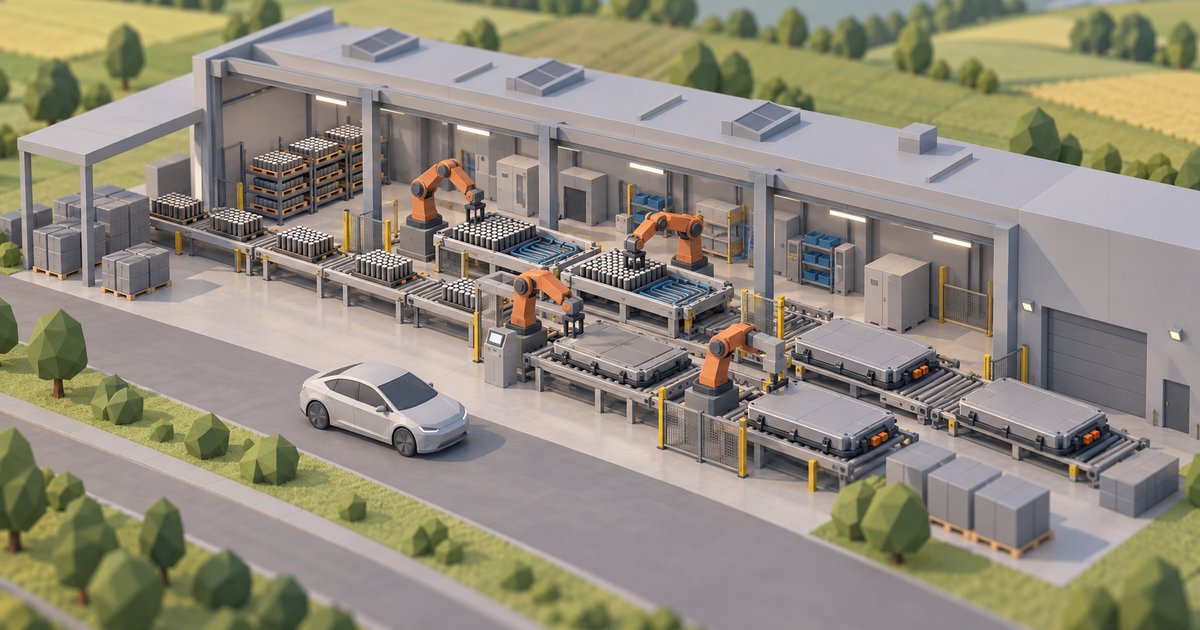
BMW opened its new high-voltage battery plant at Irlbach-Strasskirchen in Lower Bavaria on 1 October 2026 and started series production of sixth-generation packs the same day. Demand for Neue Klasse cars pulled the ramp forward, so the site went straight to two shifts rather than easing in on one.
What the plant actually does
The distinction that matters is in the job description. Irlbach-Strasskirchen is a pack assembly plant: BMW buys the cylindrical cells from external cell manufacturers, then inspects them, groups them into clusters, fits the cooling, welds the assemblies and runs end-of-line testing. No cells are manufactured here.
That is the opposite of the route Tesla took with the 4680, where the point of the exercise was to own cell production outright. BMW has chosen to own the pack and buy the chemistry — a lower-capex, lower-control position that leaves cell supply, and cell pricing, in someone else's hands.
| Measure | Value |
|---|---|
| Investment | ~EUR 1 bn |
| Site area | ~60 ha |
| Production space | 50,000 m² |
| Employees at full operation | ~1,600 |
| Production lines | 2 |
| Construction started | April 2024 |
| First pre-series packs | March 2026 |
Output runs to several hundred packs a day. Around 500 robots do the assembly, and BMW says it monitors more than 3,500 data points per battery in real time.
The Gen6 specification
Gen6 is BMW's move to 800 volts and to 46 mm cylindrical cells, replacing the prismatic cells of Gen5. BMW puts the energy density gain at around 20% and the CO₂ footprint per watt-hour at roughly 33% lower than Gen5, with recycled cobalt, lithium and nickel in the mix.
The packs use a cell-to-pack layout and a pack-to-body design, so the battery is a structural element of the car rather than a module bolted underneath it — the same structural logic Tesla applies to its own packs.
| Gen6 figure | Value |
|---|---|
| System voltage | 800 V |
| Peak DC charging | 400 kW |
| First pack size | 108.7 kWh |
| i3 50 xDrive range | 906 km WLTP |
| Peak range added in 10 minutes | 423 km |
Why a Tesla owner should care
The first customer is the new i3, built in Munich — the car aimed squarely at the Model 3, and the one BMW priced from EUR 59,900 with up to 912 km of range. Those numbers now have a factory behind them, which is the part that was missing: a launch specification is a claim until someone is building several hundred packs a day to meet it.
The charging figures are the sharper comparison. 800 volts and 400 kW put the i3 above what a Tesla can draw on today's Supercharger hardware, and the 10-minute, 423 km claim is a direct answer to the pitch Tesla has owned for a decade. European Tesla owners will meet this in the only place it counts — at a 400 kW stall on a motorway, next to a car that can use all of it.
What the plant does not settle is cost. BMW has confirmed a cheaper entry Neue Klasse model for 2028, and buying cells rather than making them is the variable that will decide whether it can hit a price that bites.