
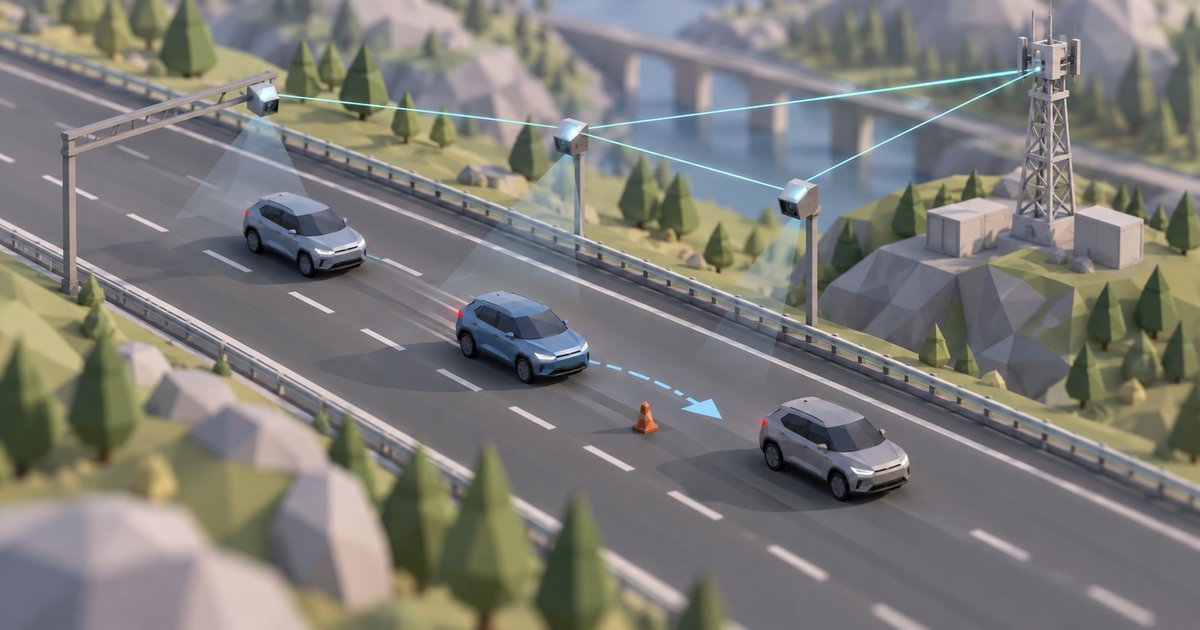
BMW Group said on 7 September that from mid-September it will start collecting event-triggered video from customer cars across every EU member state, using the exterior cameras already fitted to its newest models. The cars record the seconds around a near-miss and send the clip to BMW to train driver-assistance software.
This is fleet learning — the mechanism behind Tesla's Full Self-Driving — being built on European roads, by a European manufacturer, under European consent rules.
What the cars send
| Models | iX3, i3, X5, 7 Series, later models to follow |
| Starts | mid-September 2026 |
| Coverage | all EU member states |
| Per event | up to 120 seconds |
| Captured | exterior camera video, environmental sensor data, speed, direction of travel, steering angle |
| Consent | opt-in, via the vehicle's Privacy menu or the My BMW app |
Recording is event-based, not continuous. BMW names four triggers: an assistance system preventing a collision during a motorway lane change, automatic emergency braking firing, the driver braking hard, and a sudden swerve around an obstacle. In other words, the interesting few seconds — the ones where a system either worked or nearly did not.
The anonymisation detail worth reading twice
BMW leads with privacy-by-design, and the measures are real. The vehicle identification number is deleted immediately after the data reaches BMW's backend, so a clip cannot be traced back to a car. Faces and licence plates of other road users are obscured "prior to playback" when authorised employees open a recording, "to the extent technically possible".
The wording matters. Blurring is applied when a human watches. The training runs on the original footage: BMW states that "unaltered image data is used to further develop driver assistance systems and partially-automated driving functions" through machine learning.
That is not a contradiction and it is not a scandal — a model that learns to recognise pedestrians benefits from unblurred pedestrians. It is simply a narrower claim than "the footage is anonymised", and worth separating from it.
Why this matters for Tesla in Europe
Tesla's lead in driver assistance has never rested on a single sensor or chip. It rests on a large fleet sending back the rare, awkward moments no test track produces. Europe is where that advantage is thinnest: FSD (Supervised) is recognised in only six member states after Slovenia became the sixth, Tesla has published its Article 39 safety case ahead of an October committee vote, and European cars run a separate firmware branch behind North America's.
BMW is not claiming autonomy. It is claiming a data pipeline — consented, EU-wide, and feeding systems it already sells here. It starts with the Neue Klasse cars whose order mix the company has been keen to talk about.
What BMW has not said
How many owners opt in, which is what decides whether this is a dataset or a gesture. How long clips are retained. Whether anything is shared beyond BMW. The programme was trailed in April; September is when the cars actually start sending.
Until BMW publishes a participation figure, nobody outside Munich knows how much data this buys. But the direction is clear enough: the fleet-learning argument for autonomy is no longer one that only Tesla is making in Europe.