
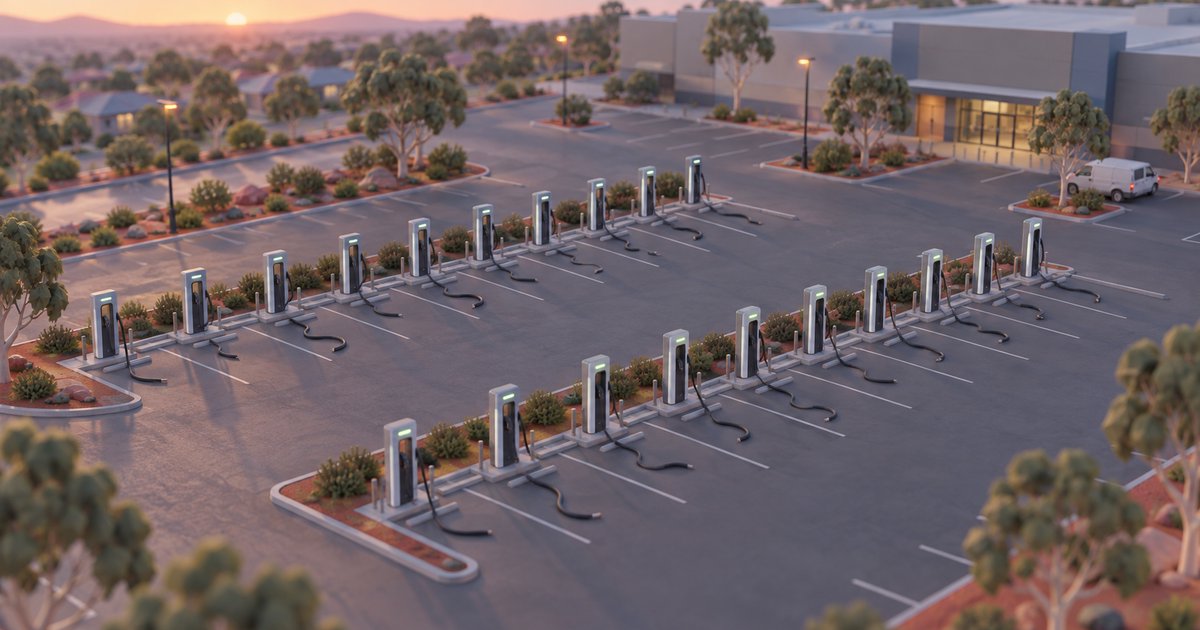
Somebody walked through Ballarat with a power tool on the night of Saturday 26 September and cut the charging cables off 28 bays. Twenty-six of them were Tesla Superchargers. It is the largest single attack on EV charging infrastructure recorded in Australia, and it happened over the AFL Grand Final long weekend, in school holidays, at the start of a route people drive to get out of Melbourne.
What was actually hit
The count is worth getting right, because it has been reported loosely.
| Site | Operator | Cables cut |
|---|---|---|
| Coltman Plaza Shopping Centre, Lucas | Tesla Supercharger | 20 |
| Wendouree Homemaker Centre | Tesla Supercharger | 6 |
| Bedggoods Kia, Wendouree | Exploren | 2 |
Twenty-eight in total, of which 26 are Tesla's and two are not. Headlines describing 28 Tesla bays are two sites' worth of arithmetic run together. The Lucas site had only recently been expanded, which is where the "days after opening" framing comes from.
Damage to the charger housings indicates a power tool was used. Repair work on the Lucas chargers began early on Sunday afternoon, and networks expected the bays back by the end of the week. Replacing a cable runs between 2,000 and 5,000 Australian dollars.
The copper explanation is the obvious one, and it is contested
Every report reaches for copper theft. The price supports the theory: copper is up around 37.8% over twelve months and trades above 14,000 dollars a tonne, and the same weekend V/Line services between Ballarat and Ballan were disrupted by what authorities suspect was copper theft from rail equipment. Geoff Brady of Evie Networks put it plainly: "It's worth saying up front that this isn't really an EV story: it's a copper story," and noted the same thieves take cable from telecommunications pits, construction sites and rail corridors.
The problem is the cable itself. Tesla's DC Supercharger cables are liquid-cooled, which is precisely a design for carrying high current through less copper. Reporting on the incident notes the copper content is small, possibly negligible. If that is right, whoever did this destroyed 26 charging bays for a scrap value that would not cover a tank of fuel.
That leaves two readings, and neither is confirmed. Either the thieves did not know what is inside a water-cooled DC cable — plausible, since AC and rail cable is a genuinely valuable target and they were evidently working a wider pattern — or copper was not the point. Police have not stated a motive and no one has been charged.
Europe has the same problem, differently shaped
This is not a distant story. Four days before Ballarat, France counted 427 formal complaints of charging-cable theft — the same crime, at national scale, on a continent where Tesla's Supercharger network is the one many drivers plan long journeys around.
The practical exposure is identical. A Supercharger site is unstaffed by design. It sits in a retail car park, it is lit but not watched, and it is trivially approachable at night. The feature that makes the network usable — you simply arrive — is the feature that makes it cuttable.
What it means for owners
Little that can be acted on directly, beyond the obvious: on a long drive in a holiday period, know your second option. A site showing available stalls in the app is not the same as a site with cables attached, and the reporting lag between a cable being cut and the network flagging the stall is where people get stranded.
Tesla has not commented. The more useful question is whether liquid-cooled cables are worth stealing at all — because if they are not, hardening the network against theft is the wrong response to the wrong crime.