
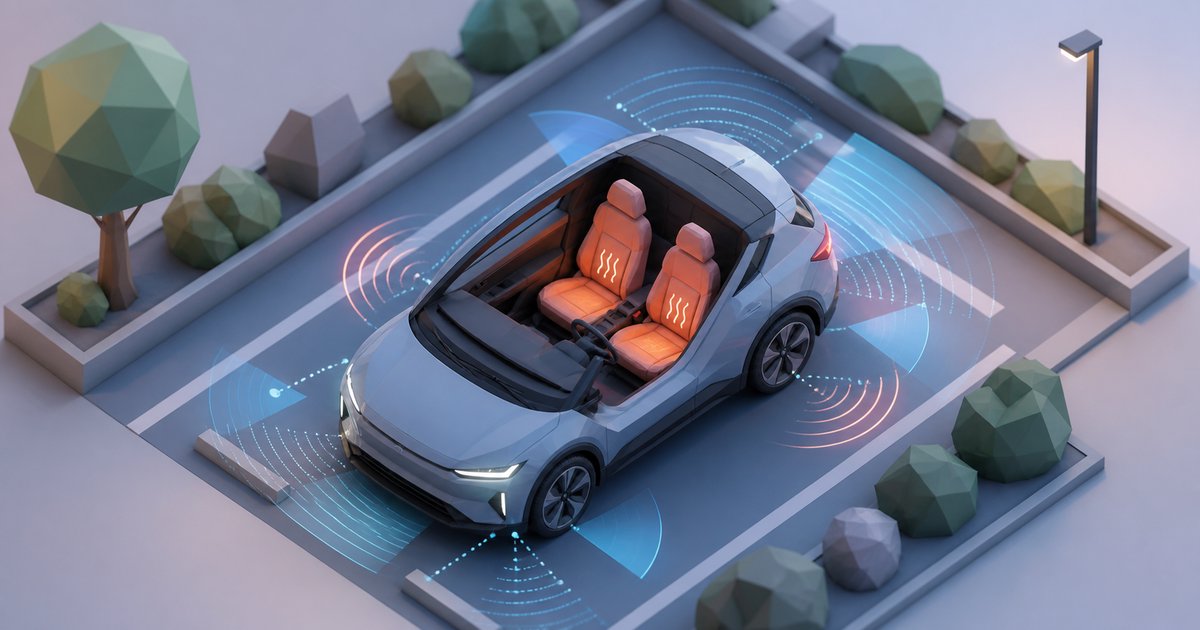
The research firm AutoPacific runs an annual study asking drivers which features they want on their next vehicle. The 2026 edition covered 160 features and surveyed more than 19,000 licensed drivers planning to buy within three years. The winner was heated seats, named a must-have by 47%.
That result has been reported everywhere as proof that buyers are tired of technology. The data does not support that reading, and the gap between the headline and the table underneath it is the interesting part.
The top ten
| # | Feature | Share |
|---|---|---|
| 1 | Heated seats | 47% |
| 2 | Front and rear parking sensors | 45% |
| 3 | Reversing automatic emergency braking | 44% |
| 4 | Power driver's seat | 43% |
| 5 | Lane change assist | 43% |
| 6 | Night vision | 43% |
| 7 | Adaptive cruise with lane centring and stop/go | 43% |
| 8 | 360-degree camera system | 43% |
| 9 | Cross-traffic alert with automatic braking | 42% |
| 10 | Self-parking | 41% |
Seven of those ten entries are driver assistance systems. The distance between the most-wanted comfort feature and the most-wanted safety system is two percentage points, and places four through eight are separated by nothing at all.
What buyers are actually saying
The finding is not "no technology". It is that buyers want technology that removes a specific, recurring annoyance — a cold seat, a tight car park, a lane change with a blind spot — and are indifferent to technology sold as a vision of the future. Autonomous parking makes the top ten. Nothing resembling autonomous driving does.
There is a well-known caveat with stated-preference surveys: nobody is paying at the point of answering. Night vision at 43% is the clearest symptom — it is an expensive, rare option that very few of those respondents would tick on a real configurator. Treat the ordering as a ranking of desire, not of willingness to pay.
The European footnote that changes the exercise
This is a North American survey, and Europe answers most of the list by law rather than by demand.
Under the EU's General Safety Regulation, every new car sold since July 2024 must have advanced emergency braking, intelligent speed assistance, emergency lane-keeping, driver drowsiness and attention warning, a reversing detection system, tyre-pressure monitoring and an event data recorder. Several of the systems North American buyers are asking for, European buyers receive whether they asked or not.
That inverts the question here. A European manufacturer is not deciding whether to fit reversing detection; it is deciding how good to make it, and whether the money left over goes into a heated seat. On that narrower question the survey is genuinely useful, and its answer is unambiguous.
It also explains why a small, cheap European electric car specifies the way it does. Cars like the Geely E2 at €19,990 carry the mandated safety set as a cost of entry, then compete on exactly the comfort items this survey ranks first. The regulation sets the floor; heated seats are what is left to sell.